Showing posts with label house. Show all posts

Saturday, October 13, 2018

Woodland: Would Latrobe Approve?

Kentucky's Bluegrass is an exceptional place. Truly, it is. Whereas the state, as a whole, tends to suffer from both poverty and architectural impoverishment (like much of the South), the triangle of fertile farmland lying between Louisville, Maysville, and Stanford shelters what may be the finest concentration of antebellum buildings west of the Appalachians. Like quasi-Jeffersonian villas? You'll find them here. Multi-pen log structures? Ditto. Greek Revival temples? Likewise. Sprawling Italianate mansions? Yep. The region's incredible agricultural prosperity produced an incredible building stock — and one (seemingly) little-blunted by the Civil War and Reconstruction.

Jessamine County sits at the southern edge of the so-called Inner Bluegrass, the central and most wealthy portion of the broader Bluegrass area. (Here lies Lexington, the "Athens of the West.") Not terribly far from the Lexington city boundary exists the Golf Club of the Bluegrass, which occupies a rural estate once known as Woodland. Woodland, along with many other Jessamine County farms, is listed on the National Register — but it's not well-publicized, in spite of its excellence. The centerpiece of Woodland is an 1889 mansion, commissioned by John Steele (1845–1918) and built in a transitional Italianate–Romanesque style. The round-arched portal, entrance tower, rusticated voussoirs, and semicircular balcony are all features more befitting public buildings than private ones — but then, this is the Bluegrass, where such a thing was possible.

John Steele's residence (1889), now a golf-course clubhouse.

Who built Woodland? I haven't a clue. The National Register nomination is disappointingly terse, giving only the most rudimentary information about the property's history. (One quirk: a child's handprint pressed into a brick sandwiched between two tower windows.) But there are two homes at Woodland — and this fact is what tips the property from the great to the exceptional.

Tucked behind Steele's residence is a low brick structure (quite a contrast to its neighbor's buoyant upward thrust) no less interesting. Like the main house, it seems both to embrace and to smash the architectural norms of its era. It's clearly a Federal-period building, perhaps constructed about the time the British and the Americans fought their last battle, or even shortly before. It diverges from almost all other Jessamine County Federal homes, though, in its studiedness. It doesn't make use of the panoply of traditional floor plans available to early Kentuckians (i.e., central- and side-passage arrangements, or the telescopic configuration pioneered in the Chesapeake). Rather, its five main rooms form an H-shaped footprint, with a service ell jutting to the side. Chimneys are placed between the front and back rooms. The partly enclosed areas formed by the H's hyphen function as porches.


The house's finish is equally unusual. The facade features tripartite windows (very common in the Bluegrass) set within segmental-arched recesses (not common in the Bluegrass). The entry consists of two four-panel doors flanked by sidelights and a fanlight (typical enough), but the porch area is plastered as if an interior room. (This treatment reminds me of the Latrobe-designed Pope Villa's entrance.) The cornice has a usual Federal profile.

Unfortunately, the building has fallen into terrible disrepair. ('Twas long thus — as early as 1977, it served as a storage space.) Both porch's roofs and floors are failing spectacularly, interior plaster is falling from the ceilings and walls, several windows are entirely nonexistent, the foundation appears to be sinking, and much woodwork is missing. (No trim remains in the northeastern room.) A glance through the windows reveals jumbled heaps of furniture, planks, plaster dust, and golf balls.


Who designed it? And for whom? Again, mostly silence. The nomination form attributes its initial ownership to a Mason Singleton. My quick perusal of genealogical sites yielded a bit of information. A Mason Singleton (1804–1894) almost certainly owned the property, but he seems too young to have commissioned the home. His father, Manoah Mason Singleton, Jr. (1773–1833), was more likely the first owner. The Singleton family hailed from Spotsylvania County, Virginia — no doubt a source of many Bluegrass settlers. For a time, Manoah resided with his parents at Bryan Station, a fortified encampment which stood north of Lexington (and predated the city's founding).


So, a quasi-Palladian cottage — the sort of thing a Jefferson or Latrobe might design for a less-prominent client, and a building associated with one of Jessamine County's founding families — lies moldering behind the lovingly maintained mansion which replaced it. Such is the Bluegrass. Alas, I'm not optimistic about the building's long-term survival. Restoring it would require a six-figure (or more) investment — not merely a bit of repainting and refinishing, but a complete reconstruction. Bricks would need to be relaid, woodwork replaned, and walls replastered. Is it worth the money? I hope so. But only the Golf Club of the Bluegrass can make such a judgment.


Friday, February 23, 2018

Clermont County's Collins Farm

Reservoir-building is necessarily destructive. Foliage must be cleared, and topography graded, before water floods the site in question. Fields and fences drown, and entire landscapes disappear under muddy water. Worst of all (if I may flaunt my bias), the construction of dams tends to disproportionately affect historic buildings. Why? Because — in southwestern Ohio, especially — any locale's earliest settlements tended to cluster around its watercourses. Valleys often shelter a particular community's oldest homes and wealthiest farms. Inevitably, dam construction involves the obliteration of these things. One such casualty was a cluster of homes in southeastern Batavia Township, Clermont County, in and around the now-submerged hamlet of Elk Lick. William H. Harsha Lake, created in 1978, now covers the site of Elk Lick, itself commemorated only by an eponymous local road.

The Richard Collins House's front (east) facade, viewed from Elk Lick Road.

I discovered the Collins Farm by accident, one day, while browsing the University of Cincinnati's DAAPSpace media library. (In the 1990s, the university acquired the defunct Miami Purchase Association for Historic Preservation's collection, which it has partly digitized.) Among photos of familiar Clermont County structures, I found an intriguing cluster of images labeled "McGrath Complex." A bit of digging confirmed my suspicion — the buildings were long ago razed. Oddly enough, they receive no mention in the Ohio Historical Society's 1970 "Southwest Ohio Survey" report (which includes one Elk Lick house). More useful, but no less perplexing, is the error-laden East Fork Environmental Impact Statement issued by the Army Corps of Engineers in 1974. According to the report, the homes within the "McGrath Complex" were "[r]emoved from the site according to standard real estate procedures," with some hope for future preservation. This, alas, is nonsense. In reality, they were unceremoniously bulldozed.

The houses in question stood on a terrace overlooking the East Fork of the Miami River, just south of Elk Lick proper. Both were constructed by members of the Collins family, whose progenitor, John, relocated to Ohio from Gloucester County, New Jersey, in 1802. John Collins (1769–1845) was born to Quaker parents, but converted to Methodism well before his arrival in the Buckeye State. (I wonder whether he had something to do with Clermont County's preponderance of New Jerseyans.)

A few years after moving to Ohio — in either 1803 or 1805 — John funded the construction of a two-story stone residence. The structure was strikingly ancient-looking, with its two-bay facade and single-pen plan, and it scarcely differed, in form, from the log homes built by less-wealthy Ohioans of the same generation. Like a few other stone buildings in Clermont County, the John Collins House featured a massive interior-end chimney, a narrow frieze board, and rather skimpy boards which, as far as I can tell, simulated cornice returns.

The John Collins House (circa 1805). Despite what local lore claims, this was not Ohio's oldest stone building.

A stone's throw (no pun intended) from John Collins's statehood-era dwelling stood a much larger, grandiose residence — reportedly commissioned by Richard Collins (1797–1855), John's son, who acquired the family farm in 1853 after a storied career. (The younger Collins practiced law in Hillsboro, Ohio; represented Highland County in Ohio's government; and operated a dry-goods store in Maysville, Kentucky.) Assuming the linked obituary's chronology is correct, Collins built his home in 1853, 1854, or 1855 — all believable construction dates, given the building's appearance.

Richard Collins's grand Grecian edifice.

The house's builder made use of a plan common enough in southwestern Ohio — four rooms arranged around a central hallway, with chimneys placed at the periphery (and, thus, a fireplace in each major room). Here, though, the mundaneness stops. Rather than being two stories in height, the Richard Collins House squeezed an additional half-story, lit by low windows, under its bizarrely shallow gable roof. The home's dominant feature was, of course, its massive Ionic portico, which sheltered first- and second-floor doorways ornamented in typical Greek Revival fashion, with sidelights, transoms, pilasters, and entablatures. The second-floor entrance led onto a small, iron-balustraded balcony structurally independent from the portico itself — not an uncommon arrangement among grander classically inspired homes. Brickwork underneath the eaves simulated an denticulate entablature.


As a work of art, the Richard Collins House was, I think, less successful than a great many Greek Revival homes in northeastern Ohio. (In general, the New Englanders who inhabited the Western Reserve built more faithfully in the Greek idiom than did their southern-Ohio counterparts.) Its size made it ponderous, and its sparsely adorned eaves (i.e., the absence of a proper entablature) rendered it bottom-heavy. Still, it overshadowed almost every building in the vicinity, and its ambitious design placed it among the great Greek Revival homes of the Cincinnati region.

Both John's and Richard's houses were well worth preserving, as even the Army Corps of Engineers noted, but their destruction isn't surprising. Relocating a masonry building is a bloody difficult task; I've heard stories of brick homes crumbling to pieces despite movers' best efforts.

What replaced the dwellings of John and Richard Collins? Have a look.

William H. Harsha Lake (looking north), seen from the East Fork State Park Beach. Photo sourced from Google Maps. The Collins family's farm occupied land near the center of the image.

Sunday, February 4, 2018

The Limits of Grecian Grandeur; or, When Entablatures Metastasize

Sturgis, Michigan, is a peculiar city — it's county-seat-sized, with an appropriately healthy economy and a splendid stock of nineteenth-century buildings, but it lies at the corner of its county, rather far from the usual sources of vitality. (More than likely, the community's survival is a consequence of its proximity to the Indiana Toll Road.) Just south of the business district, on a charming brick-paved street, stands an equally head-scratching home.


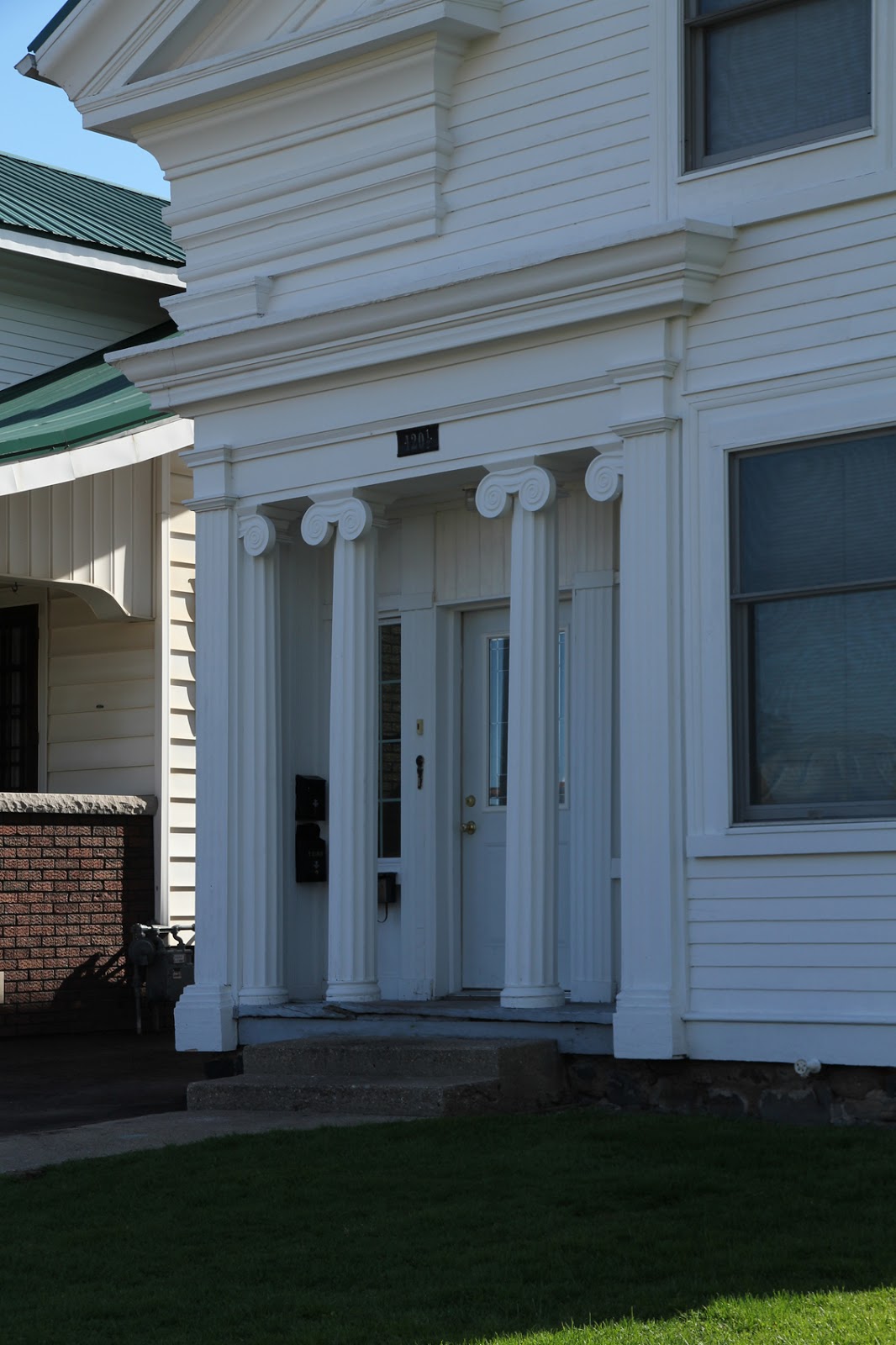
They say that the Greek Revival is a masculine style. (1) If so, this is the Arnold Schwarzenegger of Greco-American homes, with a great rippling, bulging bicep of an entablature. Now, most Greek Revival homes — whether or not their builders adhered rigidly to classical models — possess some grace; but others collapse (metaphorically, of course) under the weight of their ponderous entablatures. This house, it seems, falls into the latter category (though I'm rather partial to the doorway).

The standard Doric entablature consists of three parts: cornice, frieze, and architrave. The adventurous carpenter who constructed this home eschewed the last two, and instead stacked cornice molding atop cornice molding atop cornice molding, creating, in effect, the architectural equivalent of a multi-tiered wedding cake. The result is . . . interesting. It makes me chuckle with delight. Any well-trained classicist or Athenian architect, though, would surely retch in disgust. (I can hear the great I.T. Frary writhing in his grave.)


The doorway is also a purist's nightmare. The columns are too slender, their capitals are too large, and the engaged, semicircular pilasters slam awkwardly into the flat pilasters supporting the entablature.


What do I know about the house's history? Relatively little. In 1893, it belonged to a "Mrs. H. Church." Mrs. Church may have been Emma (1834–1912), wife of Henry Seymour Church (1831–1910), a native of upstate New York (America's Greek Revival capital, if I may say so). At the time of the 1880 census, the Churches lived alone, and Henry worked as a grocer. In all likelihood, Henry was too young to have commissioned this home, (2) so the identity of its builder remains a mystery. Kathryn Eckert's excellent Buildings of Michigan neglects to mention it, and I have no access to the Michigan Historic Preservation Office's archives. So, as with so many blog posts, I'll end with a shrug of bewilderment.

1) I can't entirely agree with this assertion. The Greek Revival mode indeed emphasizes massiveness and stolidity — at least, more than, say, the Gothic and late Victorian styles do. But Davis, Eastlake, and Shaw would surely object to our labeling their work unmanly.

2) I'd estimate a construction date in the 1840s (at the earliest) or the early 1850s (more likely). Given that Henry Church reached adulthood about 1850, it's conceivable — but, again, unlikely — that he bore responsibility for erecting the house.

Monday, August 15, 2016

Charles Dickens and the Siegfried Tavern

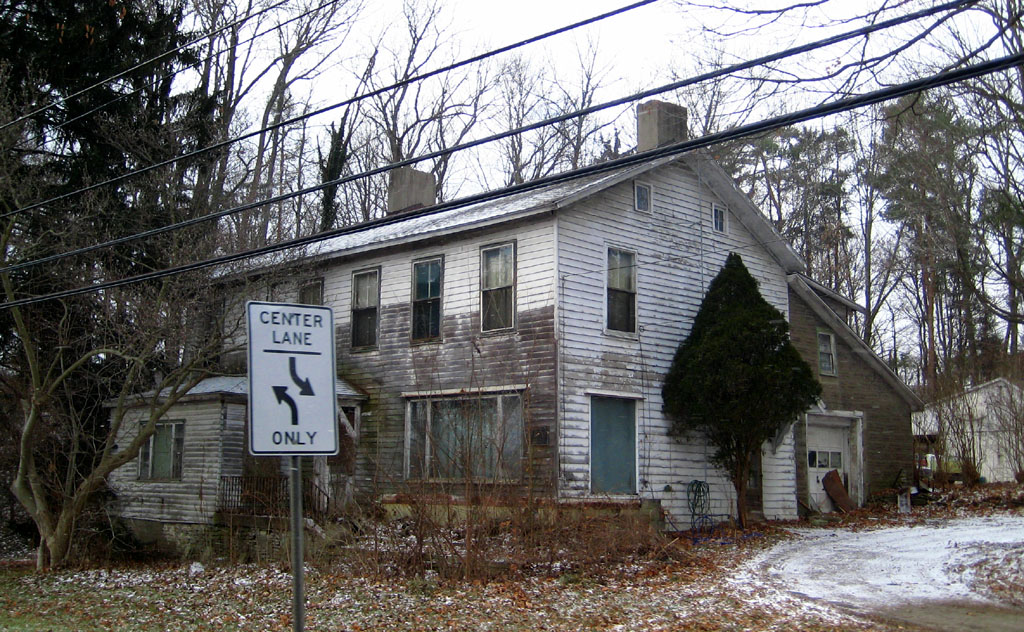
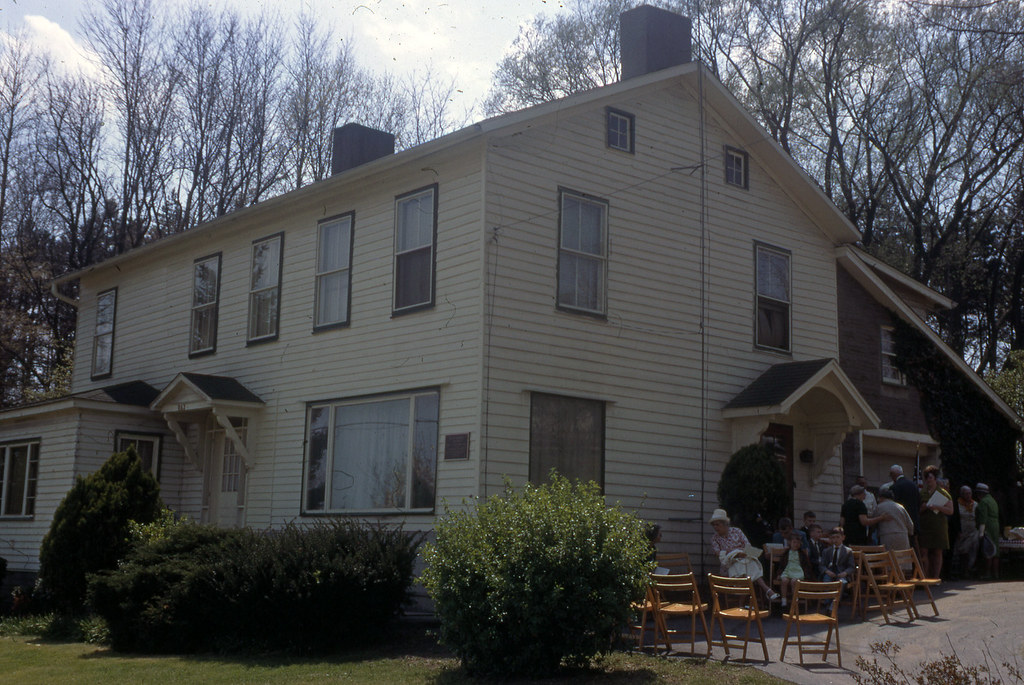
A mile or two north of Delaware, Ohio, stands a weatherbeaten frame building, vacant since 1985, and bearing the usual marks of protracted habitation — additions, alterations, and augmented apertures. It faces busy US Highway 23, which approximates the route of an early road connecting Columbus and Sandusky. The structure's situation betrays its purpose; it served as a tavern (or inn), operated by Jacob Siegfried (1788–1846), a Pennsylvanian, between 1835 and — I presume — 1846.

Siegfried's tavern in 2008. (Yes, this photo is terrible; but then, a person trapped in a moving vehicle cannot expect compositional brilliance!)

And, Siegfried's tavern before its abandonment. Photo by George Cryder (?), 1969, from the Delaware County Historical Society collection.
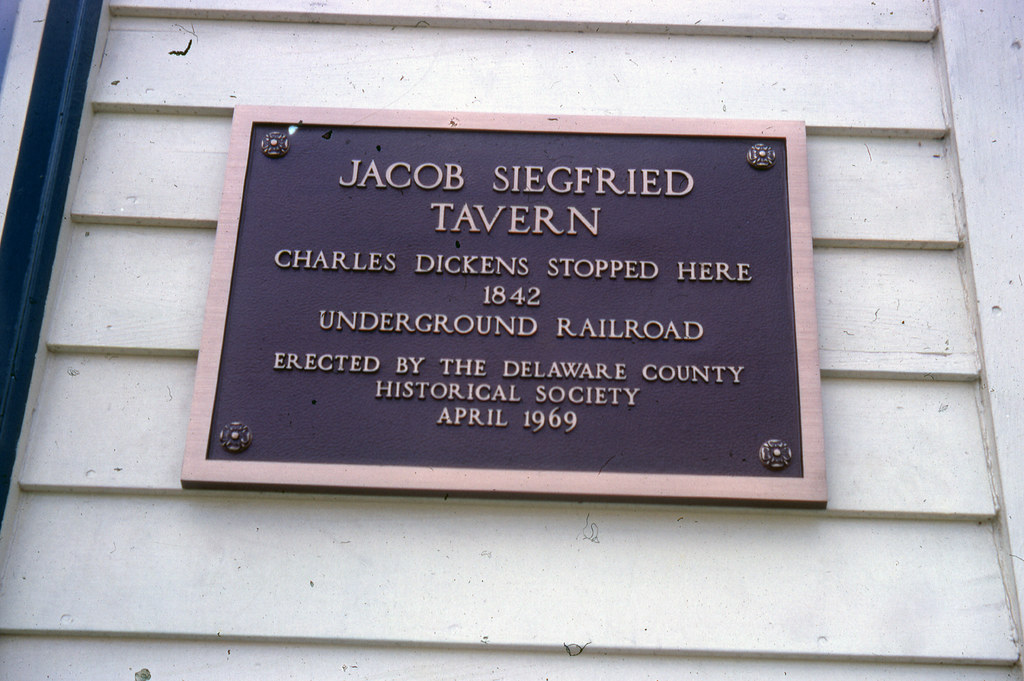
Affixed to the building is a metal plaque, rendered unreadable (during summer months, at least) by unkempt bushes. In my many years of passing the tavern, I could decipher only one word — "tavern" itself. Imagine my surprise, then, when I browsed the Delaware County Historical Society's slide collection and found this:

The plaque. Image by George Cryder (?), 1969, from the Delaware County Historical Society collection.

At first, I accepted the claim with delight. I'd long known about Dickens's 1842 excursion to America, recounted, with invaluable cynicism (1), in American Notes for General Circulation. But, after a moment's thought, I felt a twinge of uncertainty. Though I'd read (and reread) the portion of American Notes covering the Ohio leg of Dickens's journey, I could recall no mention of Delaware.

In the fourteenth chapter, Dickens describes his sole jaunt through Ohio's interior (2):
There being no stage-coach next day, upon the road we wished to take, I hired 'an extra,' at a reasonable charge to carry us [from Columbus] to Tiffin; a small town from whence there is a railroad to Sandusky. This extra was an ordinary four-horse stage-coach, such as I have described, changing horses and drivers, as the stage-coach would, but was exclusively our own for the journey. To ensure our having horses at the proper stations, and being incommoded by no strangers, the proprietors sent an agent on the box, who was to accompany us the whole way through; and thus attended, and bearing with us, besides, a hamper full of savoury cold meats, and fruit, and wine, we started off again in high spirits, at half-past six o’clock next morning, very much delighted to be by ourselves, and disposed to enjoy even the roughest journey. 
We alighted in a pleasant wood towards the middle of the day, dined on a fallen tree, and leaving our best fragments with a cottager, and our worst with the pigs . . . we went forward again, gaily. (3)
As I feared, not so much as a mention of inns, taverns, or Delaware. (I doubt even Dickens, contemptuous of America though he was, would dare to call Siegfried a "cottager.") In the following pages, Dickens describes only one stop between Columbus and Tiffin — Upper Sandusky, which lies well north of Delaware. If Dickens hired an "extra" for the sake of "being incommoded by no strangers," and dined (while sitting on a fallen tree) from his coach's supply of "savoury cold meats, and fruit, and wine," why would he stop at Siegfried's tavern? Why inconvenience himself with the company of strangers? And why avoid writing about the sojourn?

Dickens's diary provides few answers (though, unlike American Notes, it does mention that his coach changed horses several times). A folder labeled "Siegfried Tavern" — held by the Delaware County Historical Society — contains property research and biographical information about the Siegfried family, but barely mentions Dickens's supposed stay. The 1842 copies of Delaware newspapers seem to be lost.

The plaque's claim, then, is neither provable nor falsifiable. The weight of evidence may lie on the side of doubt, but mere weight is scarcely proof. I've no choice but to speculate.

Perhaps the story is merely hearsay — a local legend repeated by innumerable Herodotuses, and having no more credibility than the 6.2 x 10^14 similar tales about George Washington, Andrew Jackson, and Abraham Lincoln. Perhaps "Dickens passed this tavern" mutated, as verbal accounts are wont to do, into "Dickens stopped here." Or, perhaps, Dickens gave a hearty wave from his coach; Siegfried noticed and passed the impression to his descendants, in whom it transformed into today's story. Or Dickens indeed paused at Siegfried's tavern, albeit briefly, and simply for a change of horses or a bit of leg-stretching.

1) The best nineteenth-century descriptions of America tend to be those given by foreigners.
2) Though Dickens twice visited Cincinnati, he ventured into the state proper only once.
3) American Notes for General Circulation, Volume II (1842), 133–134.

Monday, June 27, 2016

The John Moomaw House

I've devoted a few posts to Ross County buildings, and I could pen a thousand more. Among the most charming (though scarcely the grandest) of these structures was a Paint Township farmhouse, reportedly erected by one John Moomaw.

John Moomaw's residence (with requisite leaning chimney). Photo by Mrs. A.W. Geissinger or Mrs. D.N. McBride (?), from Historic Landmarks in Ohio: Volume II, compiled by several chapters of the United States Daughters of 1812 in 1953. Scanned by Columbus Memory.

Moomaw's abode stood on sloping land in the valley of Upper Twin Creek, due west of the Paint Township-Twin Township border. To the south, beyond Farrell Hill (home to a delightful sandstone cottage), lies the verdant Paint Valley, site of Ross County's earliest settlement. Though Moomaw's farm — which, in 1860, occupied 210 acres — contained plenty of arable land, little remains cultivated; the tract has, by and large, reverted to scrubby grassland and second-growth forest.
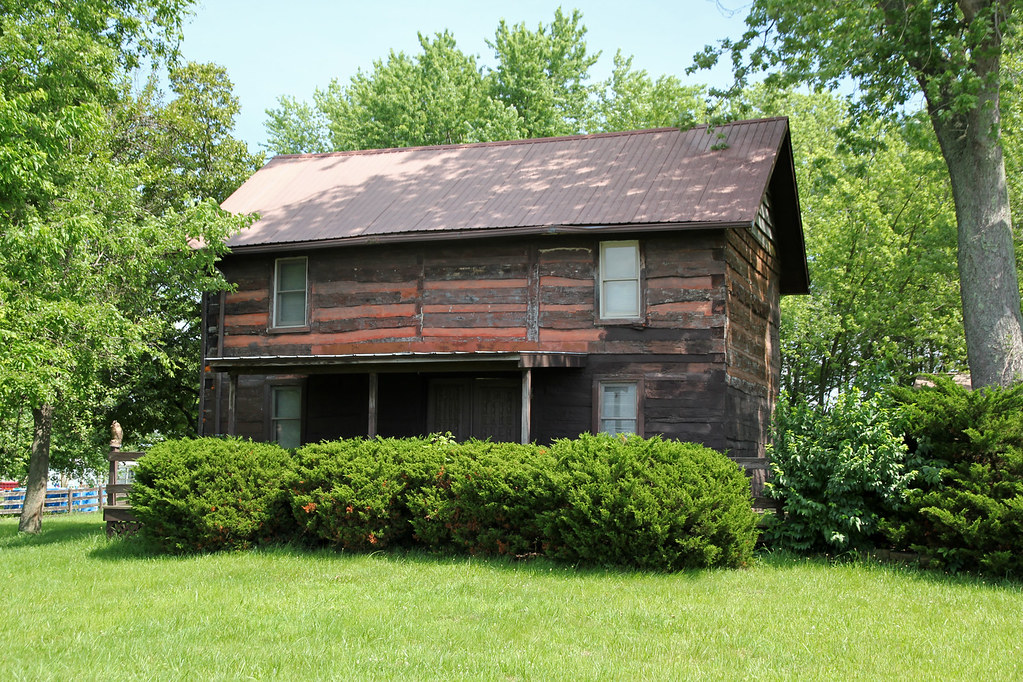
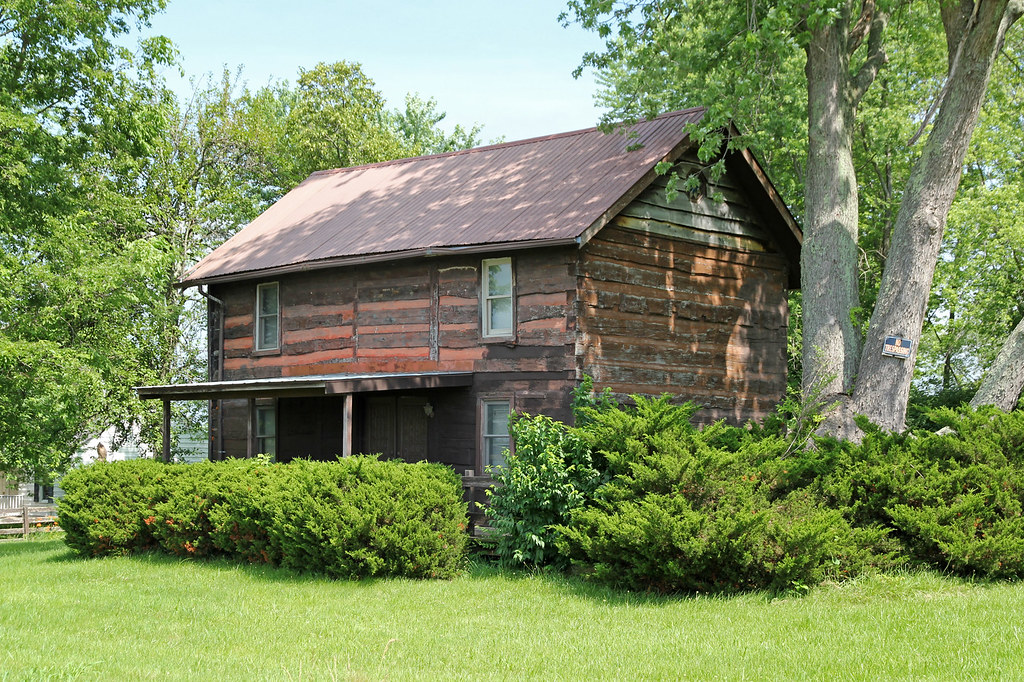
The Moomaw family appeared in America between 1731 and 1732, with the arrival of Jacob and Leonhard Mumma. (Many descendants anglicized their names; this page mentions "at least 18 different ways to spell the surname.") Whether the Ross County branch could trace their descent from Jacob or Leonhard, alas, is difficult to determine. A 1937 Scioto Gazette article describes John Moomaw as an "enterprizing [sic] German settler" and member of a German Baptist congregation.
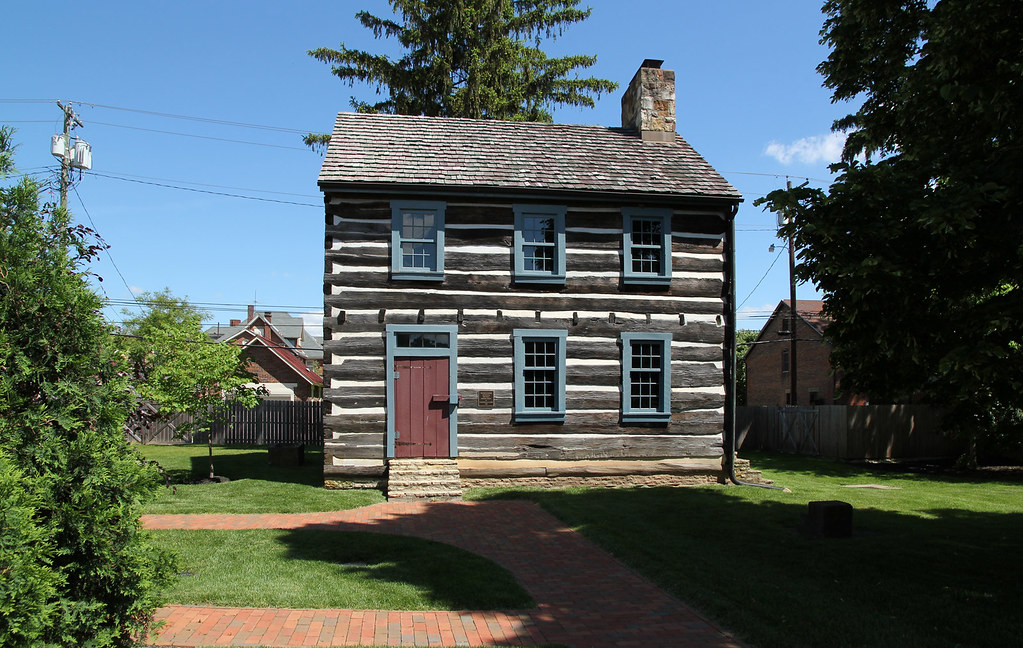
Moomaw, apparently, relocated from Virginia (1) about 1812 and held several offices in Paint Township's fledgling government — in 1813, he worked as an overseer of the poor; and, in 1816, he served as fence-viewer. According to local legend, Moomaw's bank barn — a double-pen log structure — hosted German Baptist ("Dunkard") meetings.

The precise history of the Moomaw residence is difficult to determine. Geissinger and McBride, in Historic Landmarks of Ohio: Volume II, place its construction within the second decade of the nineteenth century:
The date of the house has not been determined, but certain architectural features lead us to believe that it is within the 1812 period.
Rex Hagerling, by contrast, gives the date 1838, presumably gleaned from Ross County tax records. (2) Kevin Coleman writes that "[the Moomaw home] was built about 1820" and classifies the structure as "[having] genetic similarities with the Grenier form." (The "grenier" house, as Coleman defines it, is marked by "[a] symmetrical gabled roof around the loft [which] projects forward, creating an incised or cut-in porch which appears to be carved out of the body of the house instead of being added on." Apparently, the geographer Allen Noble identified this building-type in 1984.)

Indeed, the two-story inset porch — a distinctly Germanic trait — is (or was) the Moomaw home's outstanding feature. This porch; along with the massive sandstone (?) chimney, basement kitchen, exterior staircase, and bizarre window configuration; placed the John Moomaw House among Ross County's finest rural buildings. Its demolition (circa 2000), then, can best be described as "calamitous."

The Moomaw residence after its abandonment. Image by Rex Hagerling, May 1978, from an Ohio Historic Inventory form.

The Ross County Historical Society's collection contains other photos of the Moomaw home.

1) County histories also mention a Henry Moomaw (1791–1871), born in Virginia, who, like John, moved to Paint Township during the War of 1812. Henry's farm existed a few miles west of John's, near the Upper Twin Road-Fordyce Road intersection. No doubt, Henry and John were related.

2) In 1978, Hagerling finished an Ohio Historic Inventory form (ROS-262-11) describing Moomaw's house. In the "Sources of Information" section, he cites "Auditor's Tax Duplicates: 1836, 1837, 1838," and "Ross County Deed Records."

Friday, December 11, 2015

A Most Delightful Description

With the rise of the social sciences, architectural historians (and, for that matter, professionals in other fields) substituted accuracy and objectivity for creative or poetic description. New works of history, though hardly condescending, lack the vigor of their predecessors. I.T. Frary's Early Homes of Ohio is an excellent example of the "old" way of writing about architecture. In Chapter 6, for example, Frary observes:
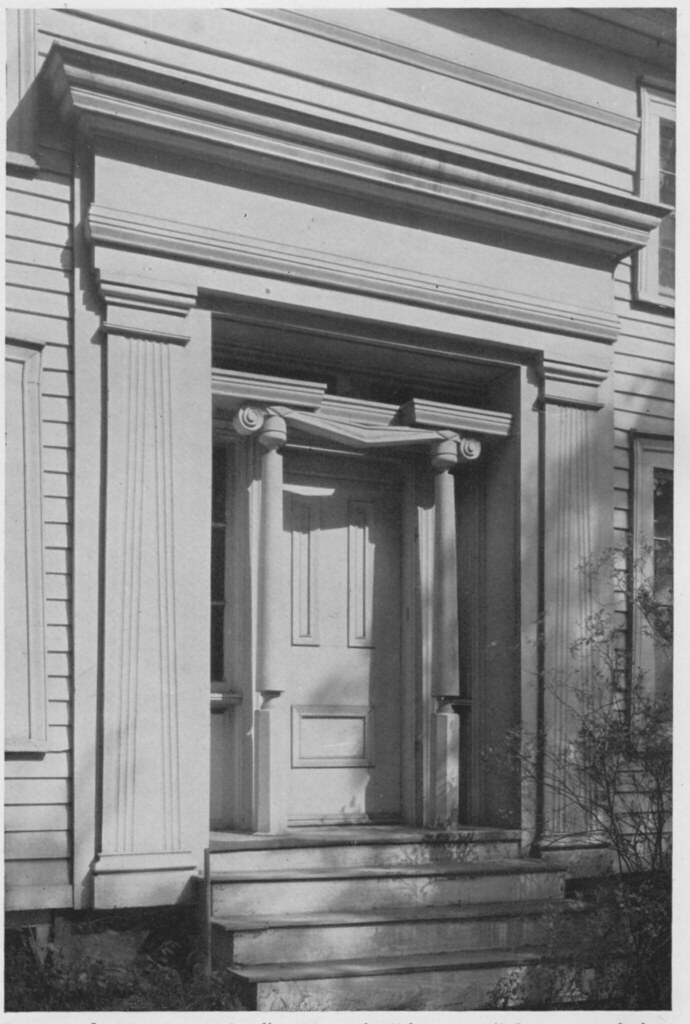
A most curious illustration of the naïve manner in which the builder blithely rang the changes on staid classic details is to be found on a doorway near Medina (Plate 128). The crude pilasters on either side are built with entasis, but, apparently feeling the need for more tapering lines to satisfy the eye, the builder deliberately ran flutings which converge from the base, toward the capital, thus solving, for his mind at least, the problem of giving entasis and lightness of proportion to the shaft. 
But this genius did not stop there. He also introduced turned columns, with acorns at the top, on each side of the door and, surmounting each with one volute of an Ionic capital, he stretched that capital, in a triumphant flourish, completely across the doorway, making one capital to grow where two had always grown before.
The home in question stands near Seville, in Medina County, Ohio.

Plate 128, from Early Homes of Ohio. Scanned by Christopher Busta-Peck.

Friday, October 30, 2015

Overhanging Plates, Again

I've penned a few posts about the mysterious overhanging plate, which, though common in the Upper South and Midwest, remains largely unstudied. Last month, while idling in my college's library, I discovered an early (1952) mention of the overhanging plate in Hugh Morrison's Early American Architecture. On page 168, Morrison writes:
The topmost logs at the ends of the cabin were projected to carry the wall plate forward, thus offering a modicum of protection from rain to the lower wall.
This "cabin" (truly a log house of "saddlebag" plan) stood in Caldwell County, North Carolina, near Blowing Rock. In 1938, Frances Benjamin Johnston photographed the home, then inhabited by one Mrs. Mary Gregg, for her Carnegie Survey of Architecture of the South.

Photo, 1938, by Frances B. Johnston, from the Carnegie Survey of Architecture of the South. Scanned by the Library of Congress.

In Early American Architecture, Morrison suggests the overhanging plate exists to shelter walls from rain, a theory equally plausible as mine (that the overhanging plate evolved from the butting pole). Of course, neither conjecture is provable.

The Gregg residence's logs were unusually well-handled; if I knew no better, I'd describe them as "circular-sawed."

Note the steeple notching, closely-fitted logs, and overhanging plate. The chamfered side log is standard.

Saturday, October 24, 2015

An Unnamed House-Type

Contemporary architectural historians tend to classify buildings by type, much as a biologist groups plant leaves by size and shape. Thus, we see, in books and survey reports, such colorful terms as "I-house," "Foursquare," "gable-front," and "shotgun." Though useful, these terms are often ill-defined, and, in my opinion, little better than the stylistic labels they supplanted. (Most early historians of American architecture, like I.T. Frary and Rexford Newcomb, saw buildings as works of art, and described them accordingly.) For the sake of this post, though, I'll abandon my skepticism and invent a house-type of my own.

Scattered throughout Ohio are homes of strikingly similar design (as similar as, say, the state's many "I-houses" or "upright-and-wings"), but which, so far as I'm aware, remain unmentioned in architectural literature. Buildings of this type are invariably one-and-a-half stories in height (the upper half-story being wholly tucked beneath the roof) and quite "deep," with long side walls. In form, they vaguely resemble the braced frame "Cape Cod" residences of coastal New England. Where they stand, they predominate. These buildings have long intrigued me, but, until recently, I knew little about their origin.

Before continuing, I should give a few examples:

House, Miami Township, Greene County, Ohio. Owned by William R. Corry (1826–1885) in 1874; Corry was born in Chester County, Pennsylvania. Photo, 2012, from the Greene County Auditor's website.
House, Bethel Township, Clermont County, Ohio. Inhabited by Joshua Smart, a native of Pennsylvania, in 1870. Image, undated, from the Clermont County Auditor's website.
House, Brush Creek Township, Highland County, Ohio. Occupied by S.C. Seaman in 1880. Photo, October 2008, from Google Maps.
House, Nottingham Township, Harrison County, Ohio. Owned by one S. Ramsey in 1875. The Ramsey family emigrated from Ireland to York County, Pennsylvania, in the 18th century. Photo, June 2012, from Google Maps.
Homes of the form I've described, it seems, are unique to regions of Scotch-Irish settlement. In The Architecture of Migration, Donald Hutslar briefly describes the group's history:
These people were the Scotch-Irish — Protestant Lowland Scots who had largely resided in stone cottages in northern Ireland a few generations before emigrating to the [American] colonies in several waves[,] beginning early in the eighteenth century.
Between 1800 and 1830, many families of Scotch-Irish descent moved from Pennsylvania to eastern Ohio, settling, primarily, in the Seven Ranges and U.S. Military District. The counties of Guernsey, Harrison, and Jefferson, especially, contained concentrated Scotch-Irish populations. Scotch-Irish, from both Pennsylvania and the Upper South, also settled in the Virginia Military District, and elsewhere in Ohio (though in lesser numbers).

Interestingly, the house-type I've described seems confined to the Midwest. Most extant Scotch-Irish dwellings in southwestern Pennsylvania bear little resemblance to the Ohio house-type; neither do buildings in Virginia and the Carolinas. Precisely where, and when, the "Scotch-Irish box" (inelegant, yes, but so is "upright-and-wing") arose is unclear. Its origin may lie in Pennsylvania, or in Ireland or Scotland.

Monday, September 28, 2015

Dublin's Log Houses

Dublin, platted by John Sells and John Shields about 1810, is one of Franklin County's oldest settlements. According to legend, Shields, an Irishman, named the community for his nation's most prominent city. About 1812, when the Ohio legislature chose to move the state capitol from Chillicothe to a more centrally located city, Dublin was briefly a contender. Despite recent suburban growth, Dublin retains quite a few of its early buildings, two or three of which are log.

Sands House


A standard single pen log building, now vacant. The gable-end entrance is certainly an alteration, as is the shed-roofed dormer. This home retains no original interior features, though, according to a 1976 Ohio Historic Inventory form, its "log construction [is] visible in [the] attic." In 1872, the heirs of one J. Sands owned this lot. Precisely who erected the home, and when, will likely remain a mystery.

The sill is half-dovetailed. Note the faux "foundation," visible to the left; this house, like most log structures, rests atop stone blocks placed at the corners.
Black Horse Tavern


Though several books label this a log building, the Ohio Historic Inventory describes it as, simply, "frame." Eliud Sells, son of Dublin's founder, built (or enlarged) the structure about 1842; the log section, if it indeed exists, may predate the 1840s. The name "Black Horse Tavern" has been applied to multiple Dublin buildings (one being Sells' house, an 1824 stone structure), the earliest of which was no doubt constructed of logs.

The exposed firebox enjoyed its greatest popularity during the Federal era (in Ohio, roughly 18001835).

Board House


This home, though early, receives scant mention in city histories; indeed, Dublin's first Ohio Historic Inventory survey, completed in 1975 and 1976, overlooked it entirely, and one later survey misidentified its construction date as "circa 1910." Whether it is truly a log house — or simply a frame building with unusually deep thresholds — I can't say with certainty.

The small, off-center window, barely visible to the left of the conifer, is a feature standard to early 19th century homes.

Wednesday, September 9, 2015

Binegar (?) Log House

Perry Township, Fayette County, Ohio


In south-central Fayette County, Ohio, near the unincorporated community of Buena Vista, lie the ruins of a small log home; the structure remained standing, albeit precariously, until at least 2012.

Its history is somewhat mysterious; the 1875 Illustrated Historical Atlas of Fayette County, Ohio, omits the home. Perhaps it was moved from another locality.

George W. Binegar (18271886); a native of Virginia, like most of the county's early residents; owned the 30-acre property in 1875. By 1913, ownership had passed to one R. Jones (either Randolph or Robert), who farmed a mere ten acres.


Though diminutive, the building was well-built. Note the steeple notching, intact daubing, firebox opening, and clay pipe (for an interior stove, which replaced the fireplace). The firebox itself, barely visible, is of stone construction; the chimney was brick. A partition wall divided the plastered interior into two rooms of equal size.


Vacant, little-modified log buildings, many abandoned during and shortly after the Great Depression, weren't an uncommon sight in post-World War II Ohio. Most of these homes, alas, have disappeared; the majority of Ohio's extant log structures remain occupied, with substantial alterations.

Friday, August 21, 2015

A Stick Chimney?

In most locales, the earliest and crudest buildings (excepting bark huts, which, if ventilated at all, featured simple roof openings) used exterior chimneys constructed of timber. These "stick-and-clay" or "cat-and-clay" chimneys were, for obvious reasons, quite dangerous, and settlers typically replaced them with masonry chimneys when finances permitted. Andrew Young's History of Wayne County, Indiana (1872) provides a good description of the stick chimney:
A wide chimney place was cut out of one end of the building, and split timbers laid up for jambs, flat sides inward, extending out from the building. This little structure supported the chimney which stood entirely outside of the house, and was built of the rived sticks before mentioned, laid up cob-house* fashion, gradually narrowed in at the top. The spaces between the sticks were filled with clay of the consistency of common mortar. Hence the name of "stick and clay" chimney. The inside of these wooden jambs was covered several feet high with a thick coat of clay or dirt to protect them against fire. The hearth was also dirt.
A standard stick chimney. This building, presumably occupied by freedmen, stood in North Carolina. Image from the Keystone-Mast Collection, held by the University of California. Date and photographer unknown.

In The Architecture of Migration, Donald Hutslar mentions "a carte de visit photograph, of about 1865, showing a catted chimney protected by an enormous gable overhang; the cabin was apparently located in a southern state." The Thornhill Plantation slave quarters (razed), in Greene County, Alabama, were similarly designed:

Photo from the Historic American Buildings Survey collection; date and photographer unknown. By 1935, masonry flues had replaced the stick chimneys.

Just north of the village of Chesapeake, in Union Township, Lawrence County, Ohio, stood a small log house with a similar overhanging gable.

Photo by C. Tim Jones, 1986, from the Ohio Historic Inventory.

The home — quite crudely built, like many dwellings in impoverished Lawrence County — likely postdated 1887 (a property ownership atlas published that year omits the structure). Some Southerners immigrated to the Hanging Rock Iron Region in the 19th century; one may have erected this residence. Given the gable overhang, it's conceivable that the house featured a stick chimney when constructed.


* A "cob-house" is a stack of corn cobs, used as a toy. Nineteenth century authors frequently compare log buildings to "cob pens" or "cob houses"; evidently, the practice was well-known. In early America, isolation produced inventive and frugal children, it seems!

Sunday, July 19, 2015

A Most Curious Log House

Salt Creek Township, Pickaway County, Ohio


This house, despite its small size, features both a "crosswall" and a medial post. If the square notching and narrow logs are any indication, it was likely sided soon after construction, and may date from the mid- or late 19th century. Perhaps, the township had become denuded of large timber by this time, forcing the home's builder to employ the odd medial post-crosswall combination. The medial post appears almost exclusively in areas of German settlement; it is unsurprising, then, that most of Salt Creek Township's early residents were Pennsylvanians of German descent.

The building, owned by J. Markel or J. Butterbach in 1871, sits within the cluster of houses comprising the defunct settlement of Stringtown.

("Stringtown," incidentally, is a name shared by many Ohio communities. All Stringtowns are diminutive; the moniker, I suspect, describes the settlements' appearance — houses "strung out" along a road.)


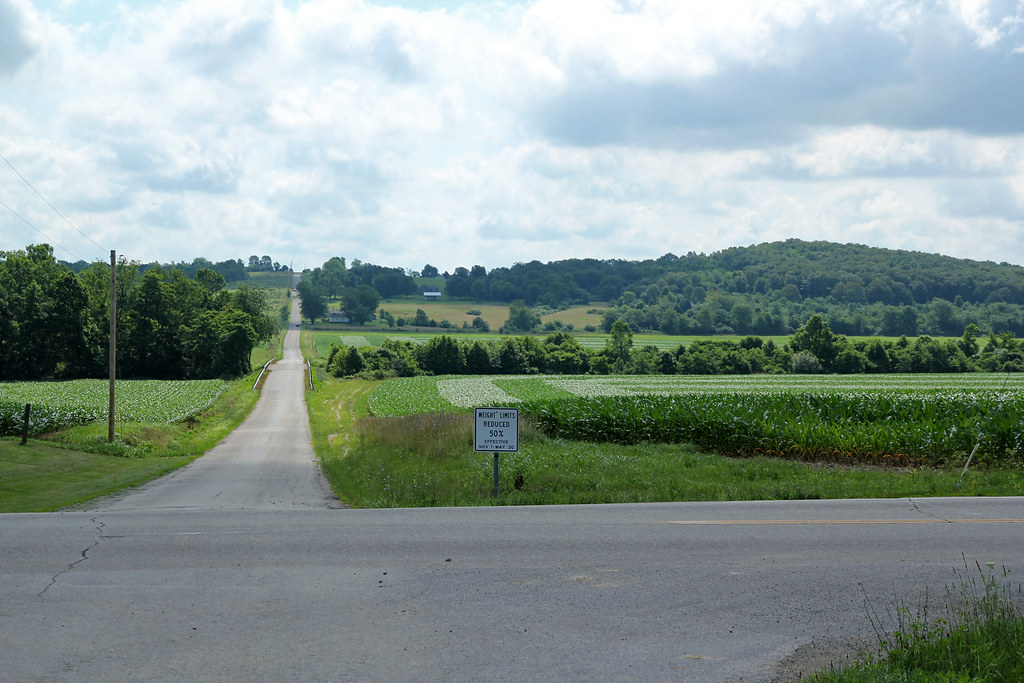
Salt Creek Township lies at the western edge of the Allegheny Plateau. The region, being both hilly and agriculturally wealthy, is quite scenic.

The intersection of South Perry Road and Tarlton-Adelphi Road, looking east. The township's namesake stream, Salt Creek, occupies this valley. Pumpkin Ridge rises in the background.

Sunday, May 31, 2015

Knoles Log House

Chillicothe, Ross County, Ohio


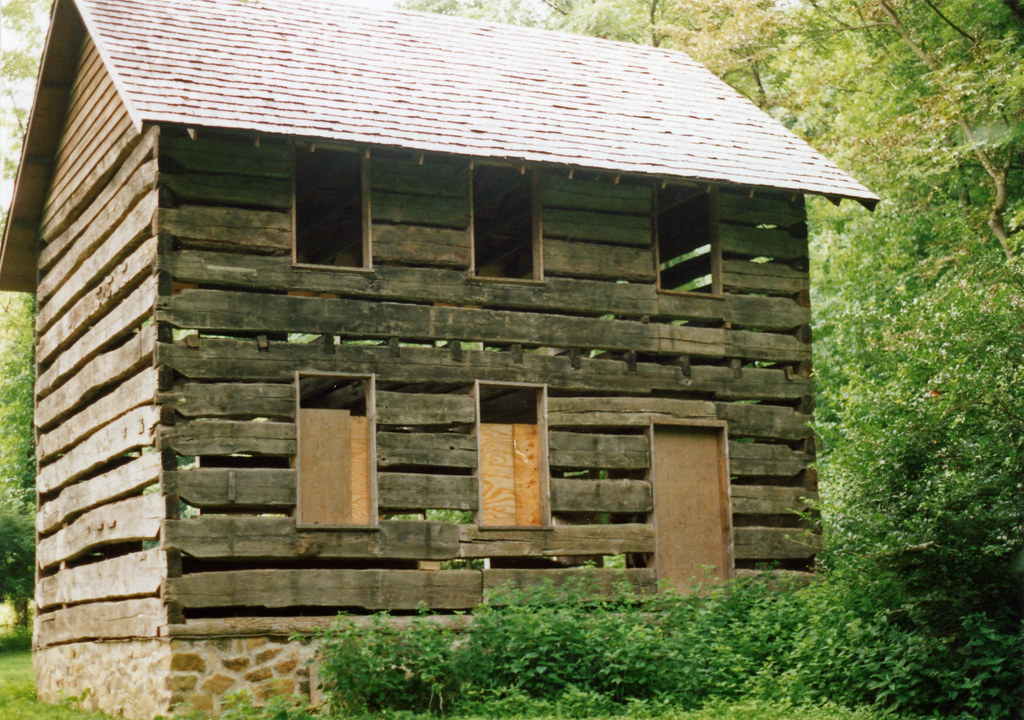
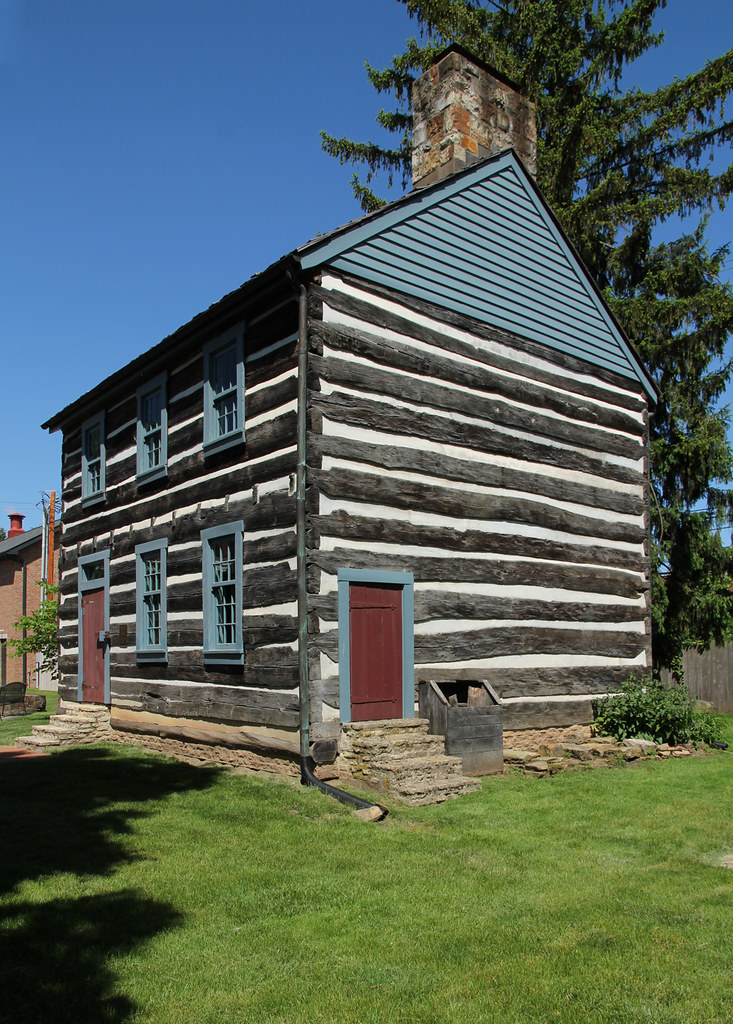
William Knoles, born in Delaware in 1795, likely commissioned this house about 1820. Evidently, Knoles' dwelling was well-known; the 1917 Standard History of Ross County, Ohio mentions "a substantial hewed log house, which has been weatherboarded on the outside, and ceiled on the inside, and now forms a part of the house occupied by [Charles W. Knoles, William's grandson] and his family."

Originally, the house fronted Southern Avenue, just south of its intersection with East 11th Street (an industrial complex now occupies the site). In the 1970s or 1980s, it was moved to the foot of Adena hill. Another relocation occurred in 1992; currently, the home sits behind the Ross County Historical Society museum.

The structure at its second site. Photo by Brian Hackett (?), August 1990, from the Donald Hutslar collection; used courtesy of Jean Hutslar.
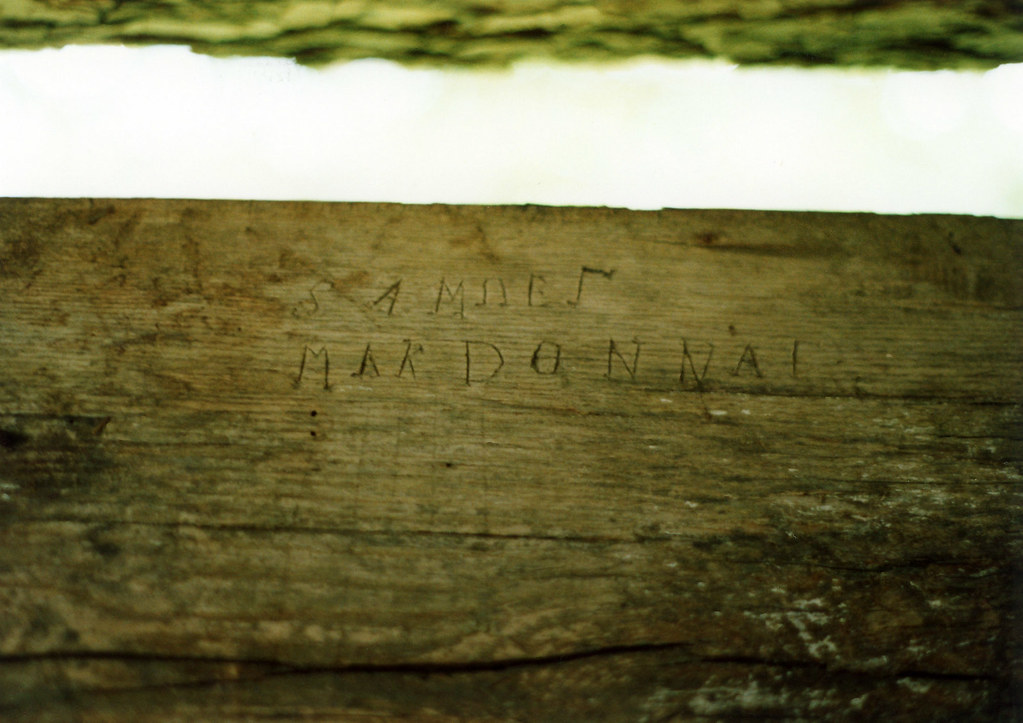
A revealing inscription; presumably, MakDonnal constructed this house for William Knoles. In the 19th century, as now, many better-finished homes were the work of skilled carpenters, rather than owner-builders.

Why Samuel spelled his name "MakDonnal," rather than "McDonnal" or "M'Donnal" (the latter variant was common during the 19th century), is unclear, as is his inversion of the U and L in "Samuel."
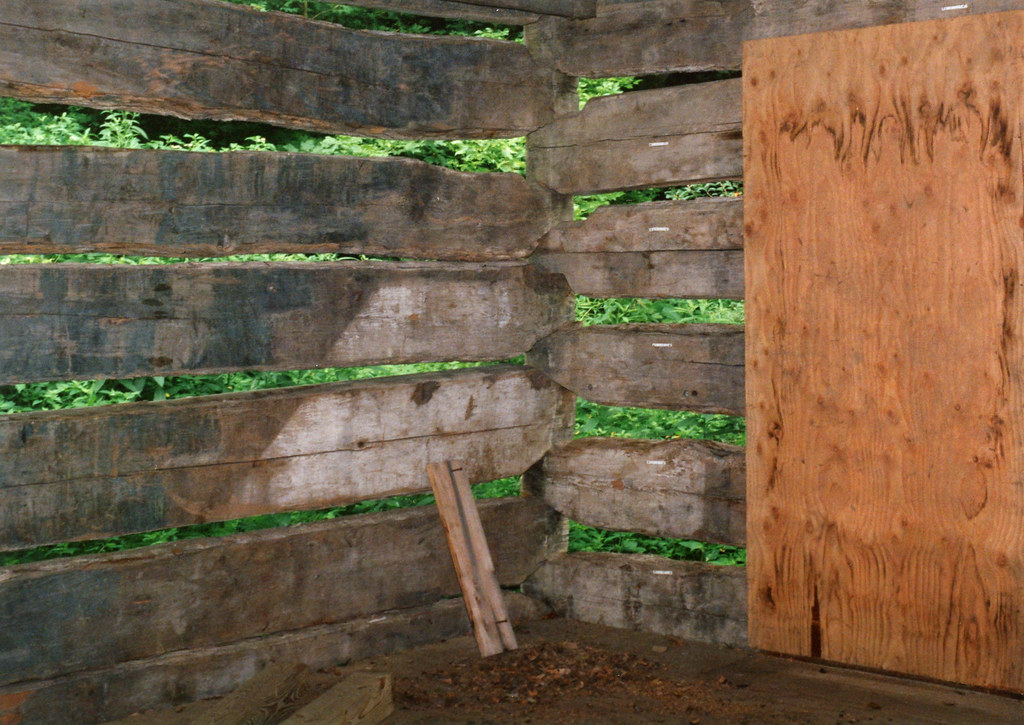
The former stairway's location is obvious. Photo by Brian Hackett (?), August 1990, from the Donald Hutslar collection; used courtesy of Jean Hutslar.
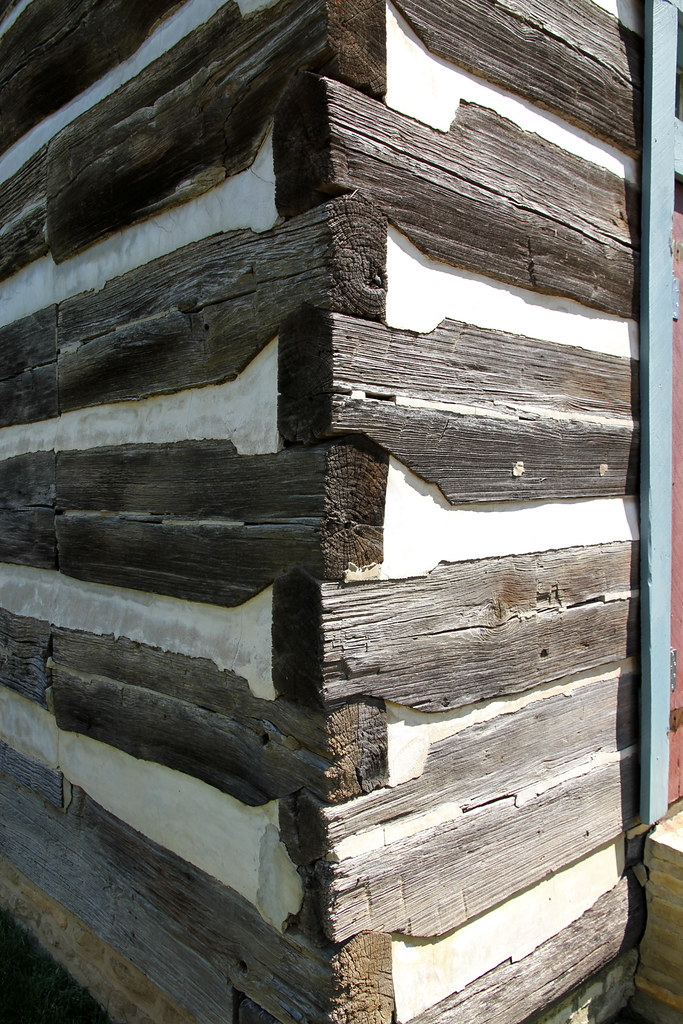
Quite a solidly constructed home, with its large logs and well-handled steeple notching. Evidently, the chimney always existed on the interior.
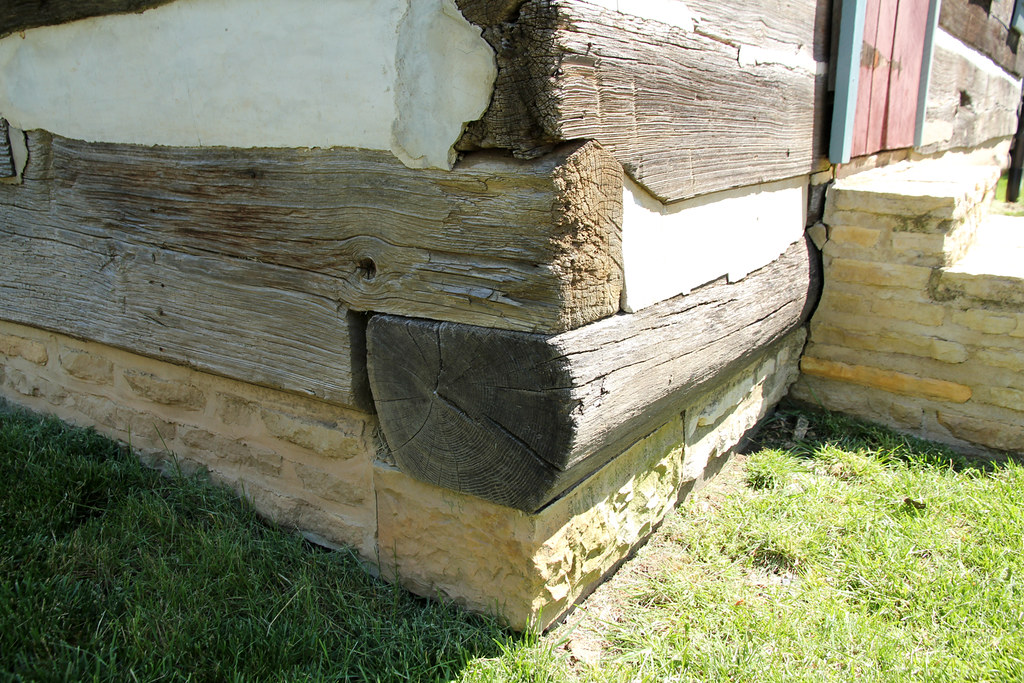
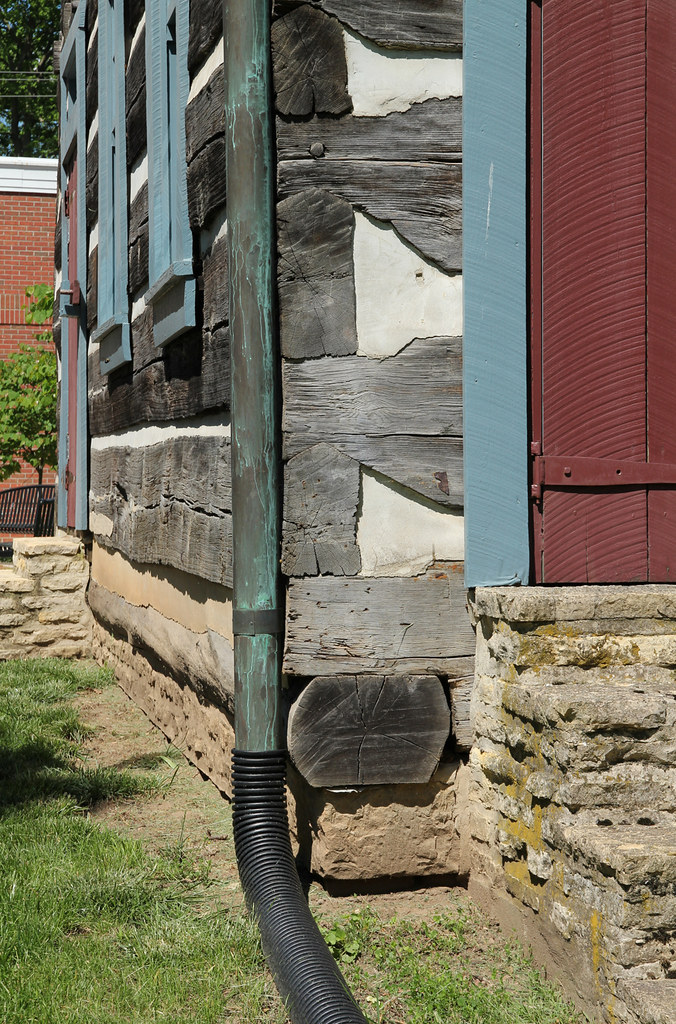
An unusual treatment; sills are typically squared on all sides.