Showing posts with label residence. Show all posts

Sunday, February 4, 2018

The Limits of Grecian Grandeur; or, When Entablatures Metastasize

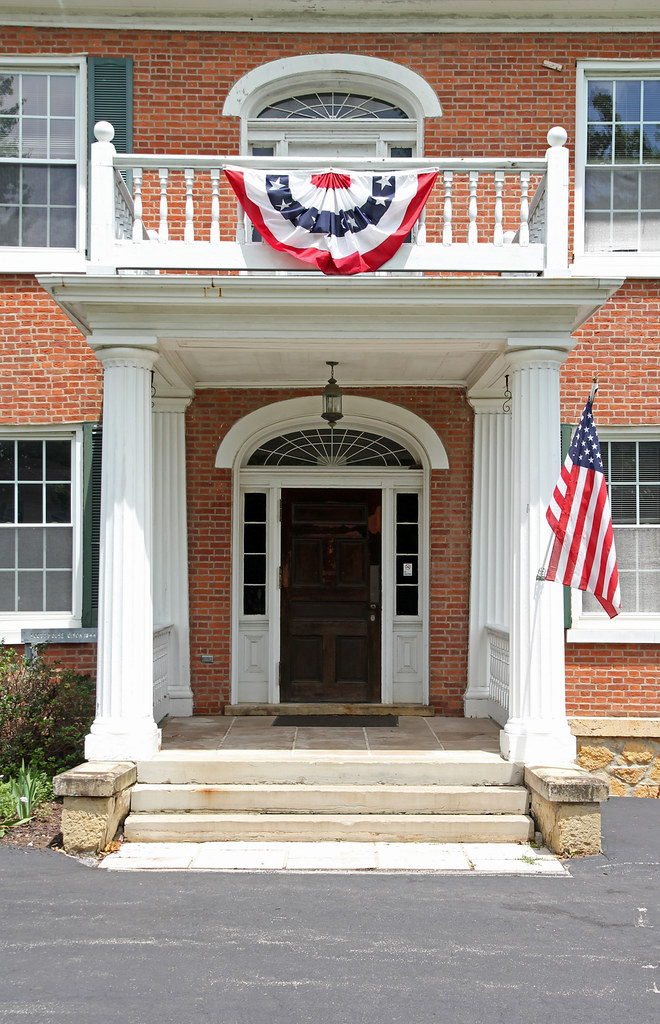
Sturgis, Michigan, is a peculiar city — it's county-seat-sized, with an appropriately healthy economy and a splendid stock of nineteenth-century buildings, but it lies at the corner of its county, rather far from the usual sources of vitality. (More than likely, the community's survival is a consequence of its proximity to the Indiana Toll Road.) Just south of the business district, on a charming brick-paved street, stands an equally head-scratching home.


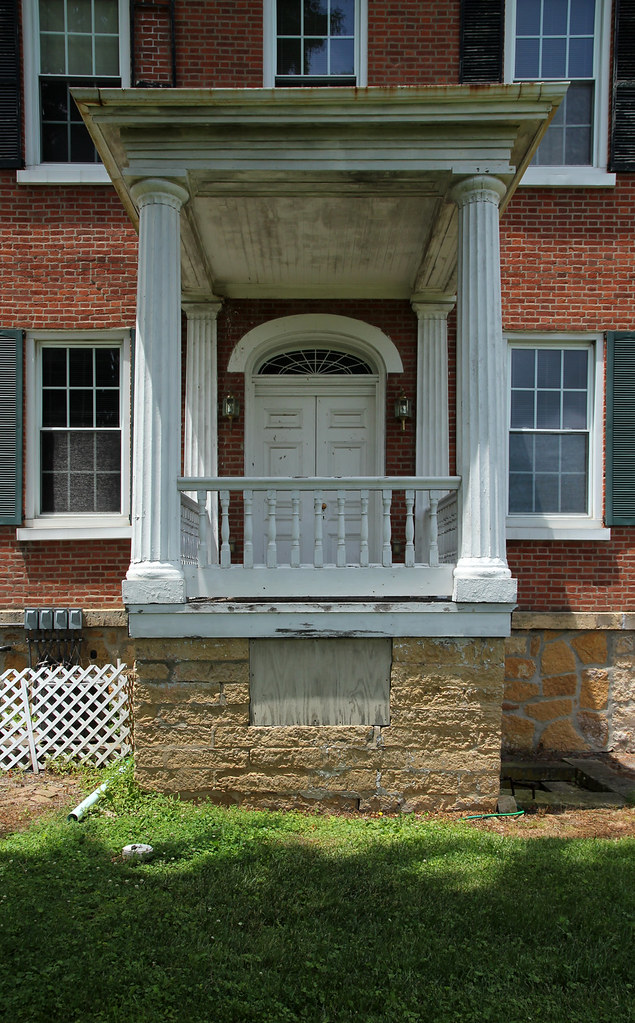
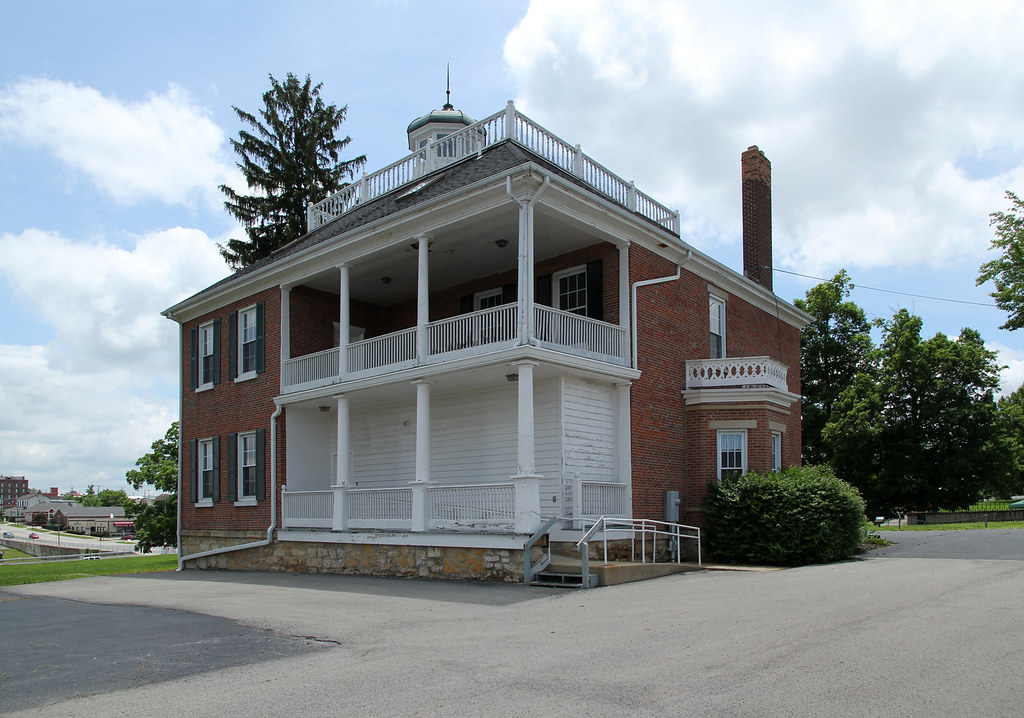
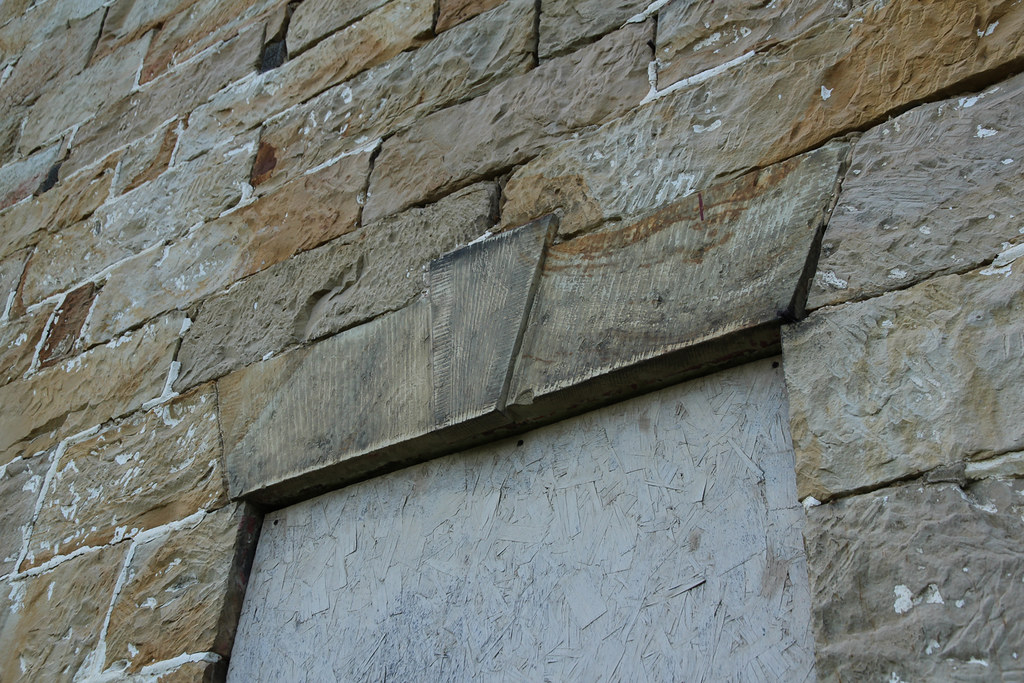
They say that the Greek Revival is a masculine style. (1) If so, this is the Arnold Schwarzenegger of Greco-American homes, with a great rippling, bulging bicep of an entablature. Now, most Greek Revival homes — whether or not their builders adhered rigidly to classical models — possess some grace; but others collapse (metaphorically, of course) under the weight of their ponderous entablatures. This house, it seems, falls into the latter category (though I'm rather partial to the doorway).

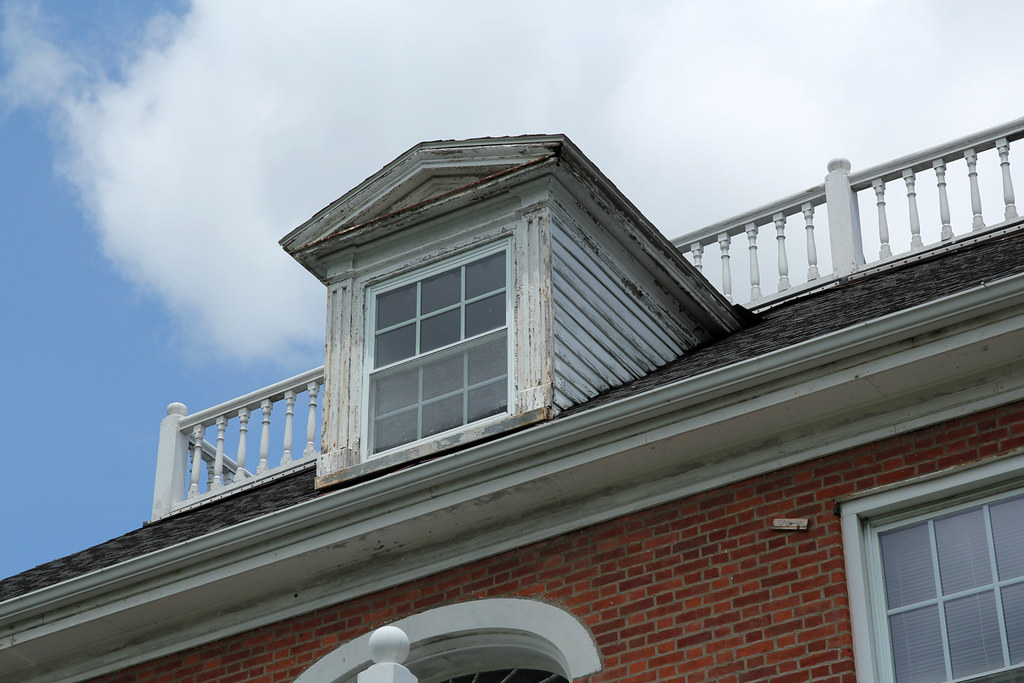
The standard Doric entablature consists of three parts: cornice, frieze, and architrave. The adventurous carpenter who constructed this home eschewed the last two, and instead stacked cornice molding atop cornice molding atop cornice molding, creating, in effect, the architectural equivalent of a multi-tiered wedding cake. The result is . . . interesting. It makes me chuckle with delight. Any well-trained classicist or Athenian architect, though, would surely retch in disgust. (I can hear the great I.T. Frary writhing in his grave.)
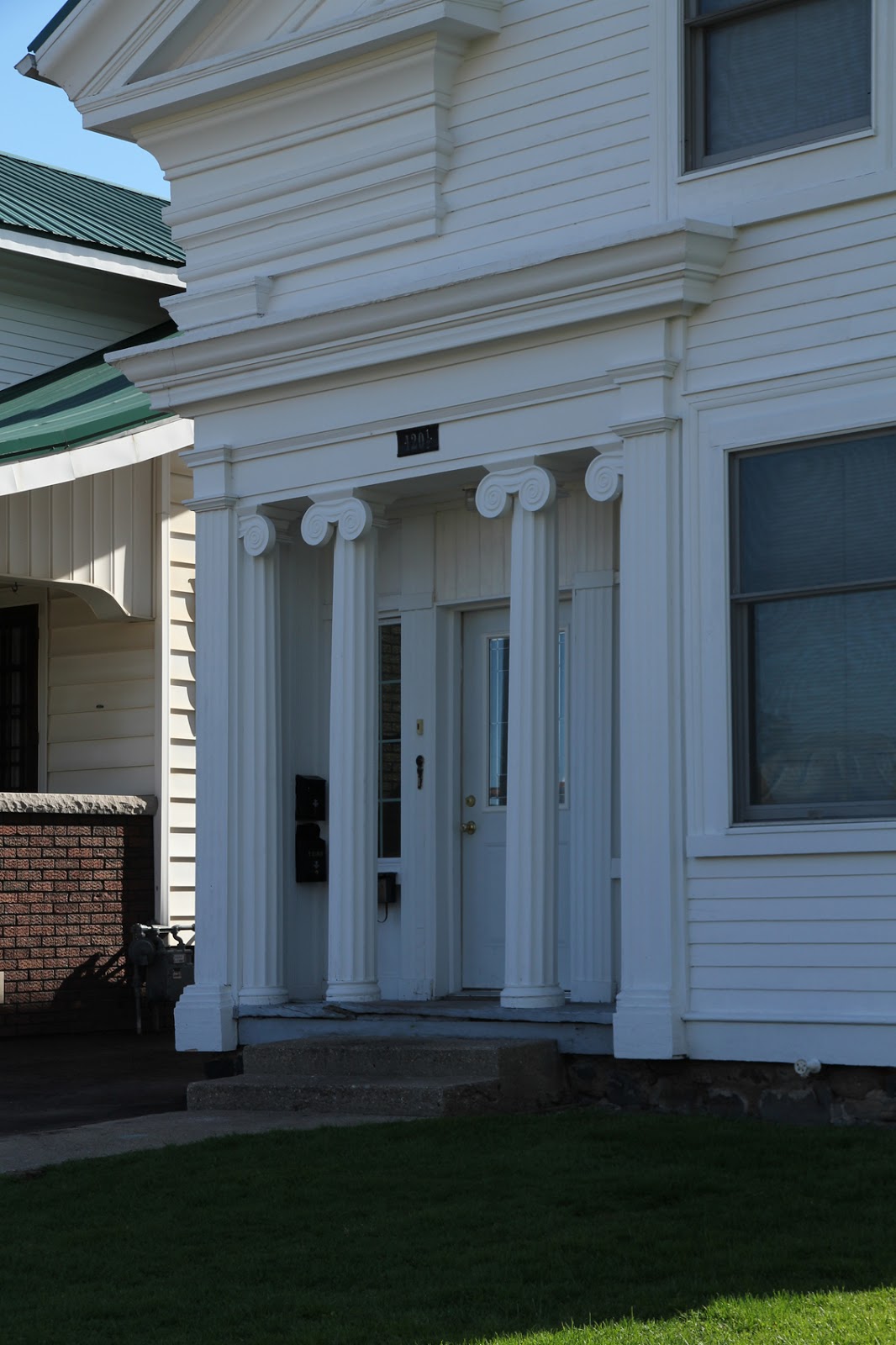

The doorway is also a purist's nightmare. The columns are too slender, their capitals are too large, and the engaged, semicircular pilasters slam awkwardly into the flat pilasters supporting the entablature.


What do I know about the house's history? Relatively little. In 1893, it belonged to a "Mrs. H. Church." Mrs. Church may have been Emma (1834–1912), wife of Henry Seymour Church (1831–1910), a native of upstate New York (America's Greek Revival capital, if I may say so). At the time of the 1880 census, the Churches lived alone, and Henry worked as a grocer. In all likelihood, Henry was too young to have commissioned this home, (2) so the identity of its builder remains a mystery. Kathryn Eckert's excellent Buildings of Michigan neglects to mention it, and I have no access to the Michigan Historic Preservation Office's archives. So, as with so many blog posts, I'll end with a shrug of bewilderment.

1) I can't entirely agree with this assertion. The Greek Revival mode indeed emphasizes massiveness and stolidity — at least, more than, say, the Gothic and late Victorian styles do. But Davis, Eastlake, and Shaw would surely object to our labeling their work unmanly.

2) I'd estimate a construction date in the 1840s (at the earliest) or the early 1850s (more likely). Given that Henry Church reached adulthood about 1850, it's conceivable — but, again, unlikely — that he bore responsibility for erecting the house.

Thursday, December 21, 2017

A Warren County Puzzle

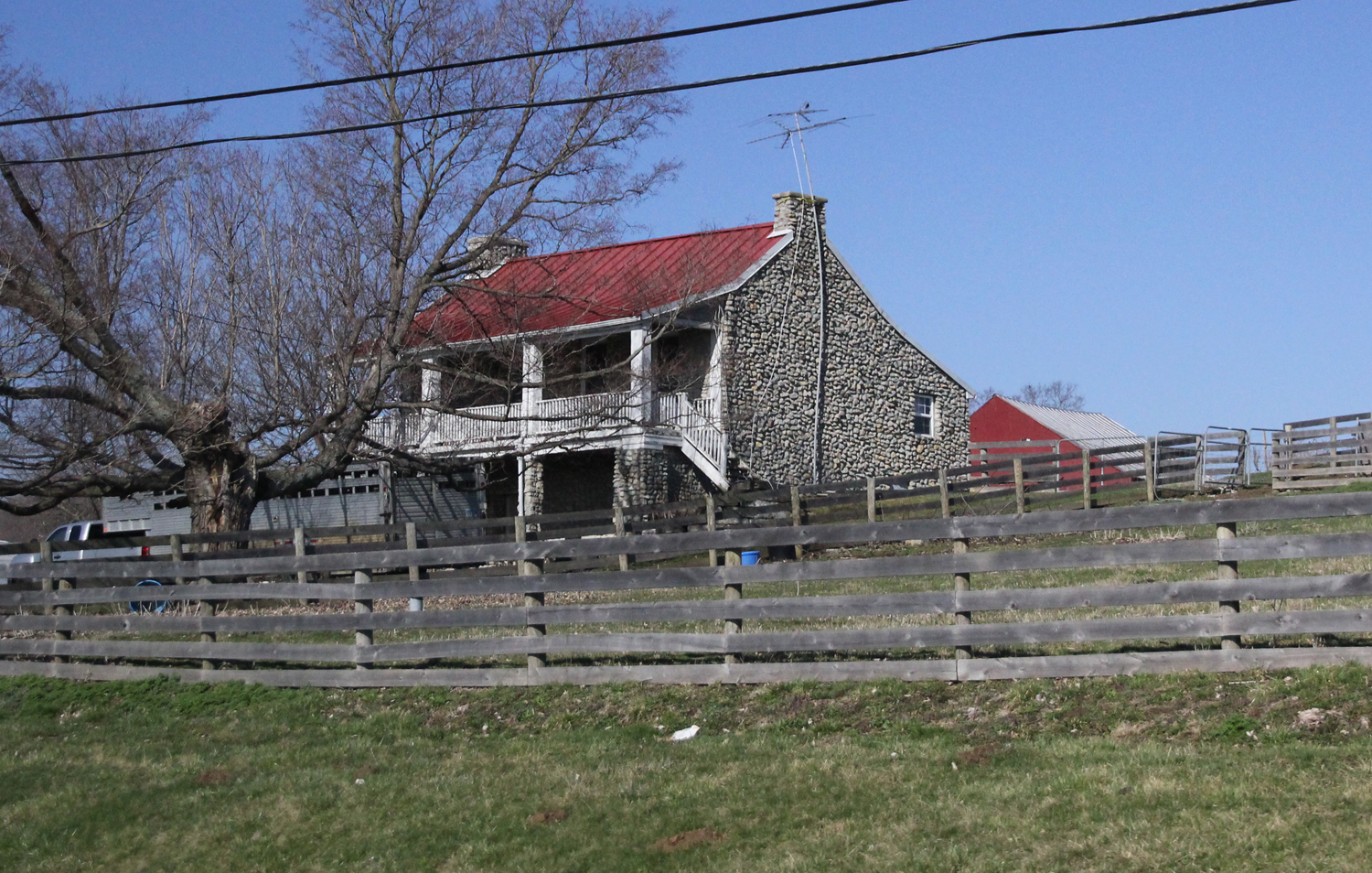
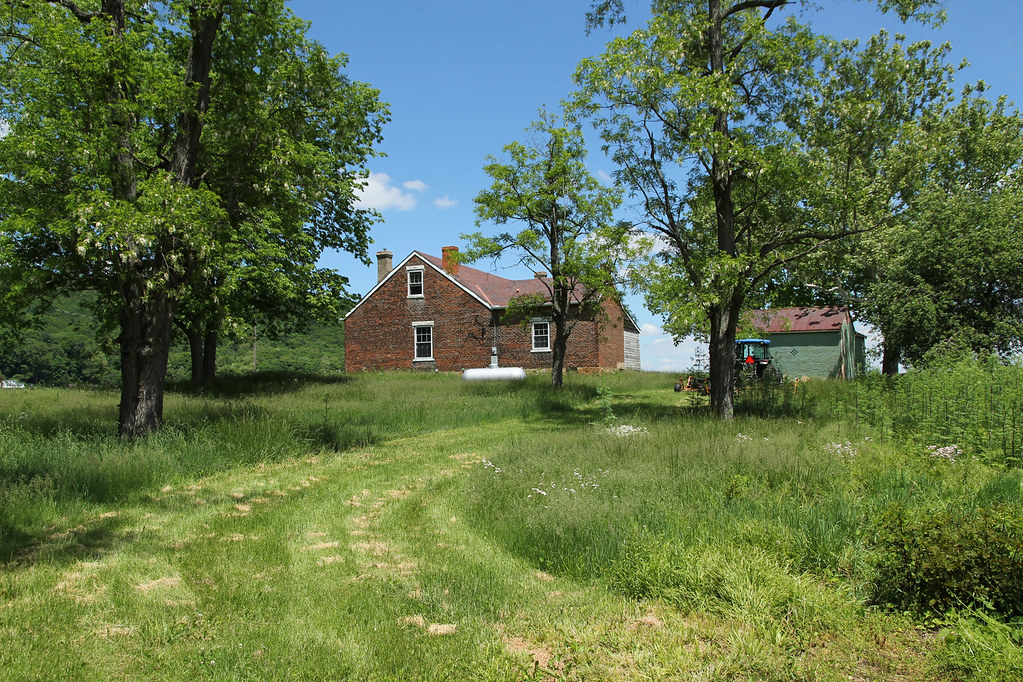
Perched on a hillside northeast of Waynesville, in Warren County, is a curious brick farmhouse. It's obviously an ancient structure (by Ohio's standards), with its flush chimneys and rake boards, and it fronts an early thoroughfare connecting Waynesville and cities farther north. Like a few other homes in the vicinity, it makes stupendous use of its sloping site; the basement is at once a first floor, a quirk which allowed the builder to attach a two-story gallery to what seems, from one angle, a single-story structure.

My lone, woefully inadequate photo of the building.

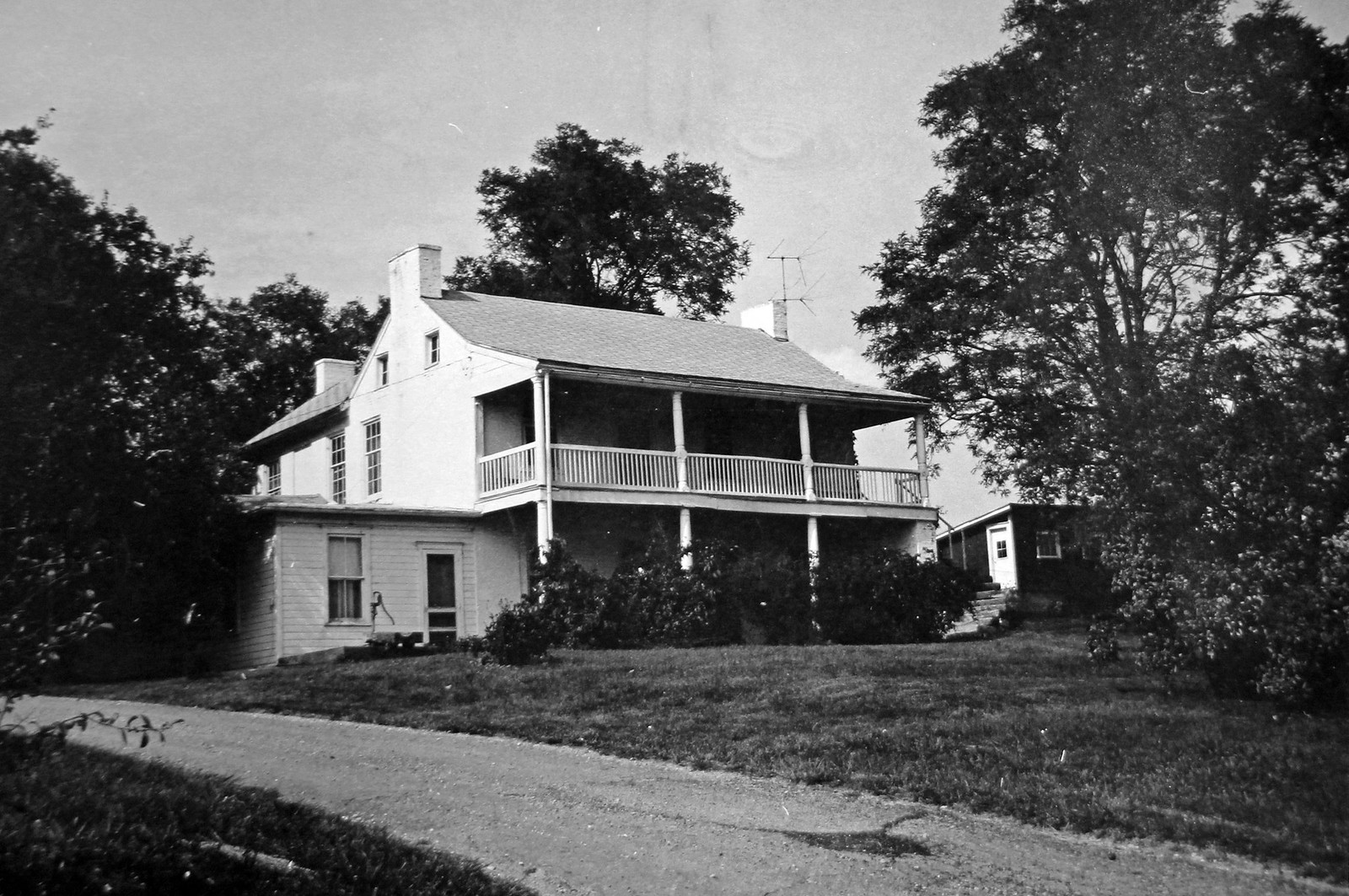
Alas, someone, at some time (perhaps in the finest decade for tasteful design — the 1970s), thought it wise to seal half the window and door openings, then reface the entire building, including its porch's columns (!), with stones of varied size and shape. The result looks, to my jaundiced eye, like the architectural equivalent of type-I neurofibromatosis (or some other tumor-inducing disease). Thankfully, staff from the Ohio Historical Society photographed the house in 1969 or 1970, well before the remodeling. At the time, the building retained its original six-over-nine windows.

Image, 1969 or 1970, from the "Southwest Ohio Survey" collection; held by the Ohio Historical Society.

Obviously, the house is early and noteworthy, but researching its history proved more difficult than I anticipated. The earliest digitized map of Warren County land ownership, published in 1856, lists "J. Parkhill" as owner of the 204-acre tract where this home stands. As is so often the case, Parkhill seemingly left no literary footprint — he receives no mention in county histories, and grave records are equally scanty. (The closest match in Find A Grave's database is James Parkhill (d. 1896), interred in Deerfield Township's Rose Hill Cemetery.) The 1850 census, though, records a Joseph Parkhill, born about 1815 in Ohio, as a resident of Wayne Township. Parkhill had a large family, and he provided room and board for at least three non-family-members — evidence, perhaps, that local tradition has correctly identified the building as an inn or tavern.

Some time between 1856 and 1874, Parkhill's property passed to Israel Hopkins Harris (1823–1897), a Waynesville banker and member of a locally prominent family. If the postcard pictured below is any indication, Harris's name — and not Parkhill's — became attached to the house, no doubt because of the Harris family's considerable cachet.

Postcard, undated, from the collection of Donald and Jean Hutslar.

Assuming the building did function as a "wayside inn," it did so during Parkhill's occupancy (or earlier), and not Harris's. But Parkhill was reasonably young in 1850, and it's unlikely that he commissioned or built the structure. (Given that Waynesville itself was platted in 1796, and that Warren County comprises one of Ohio's wealthiest, earliest-settled regions, a construction date in the 1810s or 1820s seems perfectly believable.) But, alack, tracing Warren County property ownership beyond Franklin Pierce's presidency requires (a) good literary sources or (b) a trip to the county courthouse, so, for now, the Parkhill–Harris residence's ultimate identity will remain a mystery.

A slightly later (?) photo gives an even finer glimpse of the house's two-story porch, its twin entrances, and its most distinctive feature — a semicircular stone staircase, which partly provides ground-level access to the gallery's upper story.

Image, undated, from the collection of Donald and Jean Hutslar.

Monday, August 15, 2016

Charles Dickens and the Siegfried Tavern

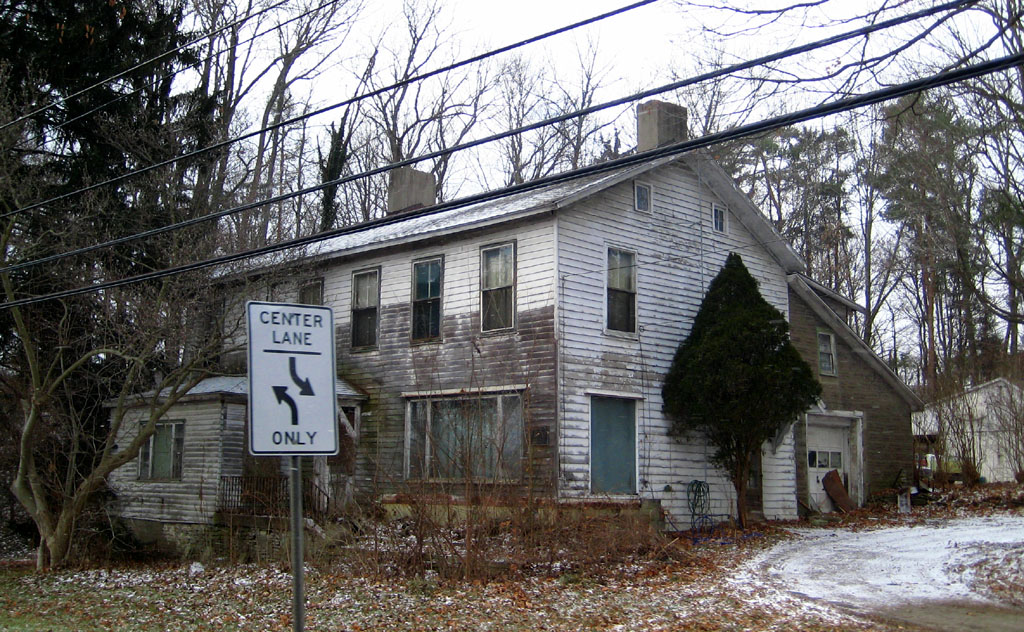
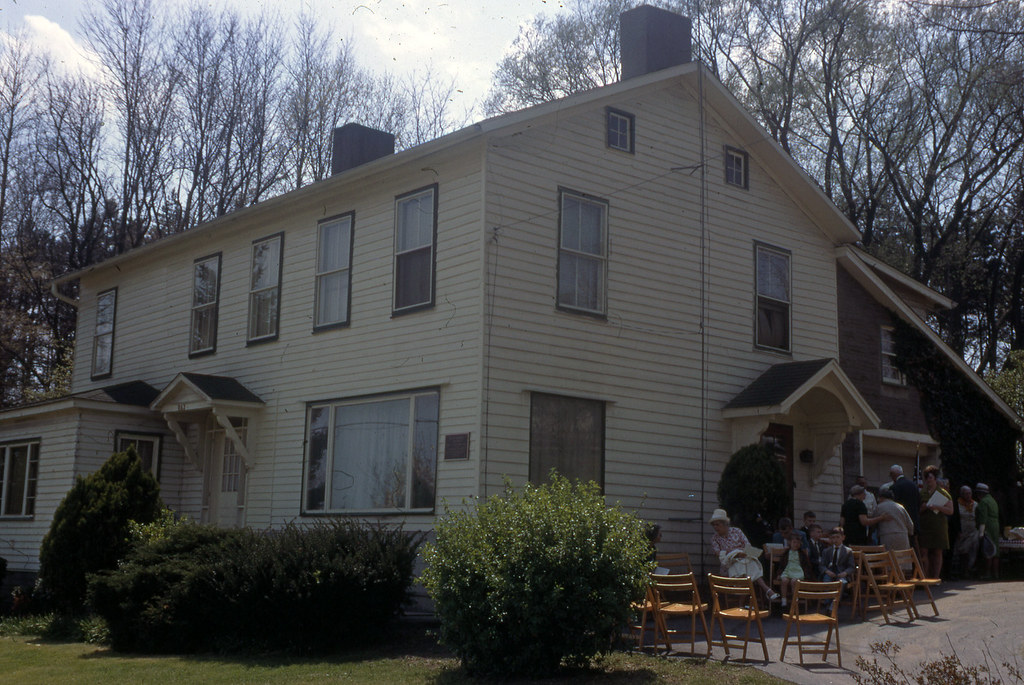
A mile or two north of Delaware, Ohio, stands a weatherbeaten frame building, vacant since 1985, and bearing the usual marks of protracted habitation — additions, alterations, and augmented apertures. It faces busy US Highway 23, which approximates the route of an early road connecting Columbus and Sandusky. The structure's situation betrays its purpose; it served as a tavern (or inn), operated by Jacob Siegfried (1788–1846), a Pennsylvanian, between 1835 and — I presume — 1846.

Siegfried's tavern in 2008. (Yes, this photo is terrible; but then, a person trapped in a moving vehicle cannot expect compositional brilliance!)

And, Siegfried's tavern before its abandonment. Photo by George Cryder (?), 1969, from the Delaware County Historical Society collection.

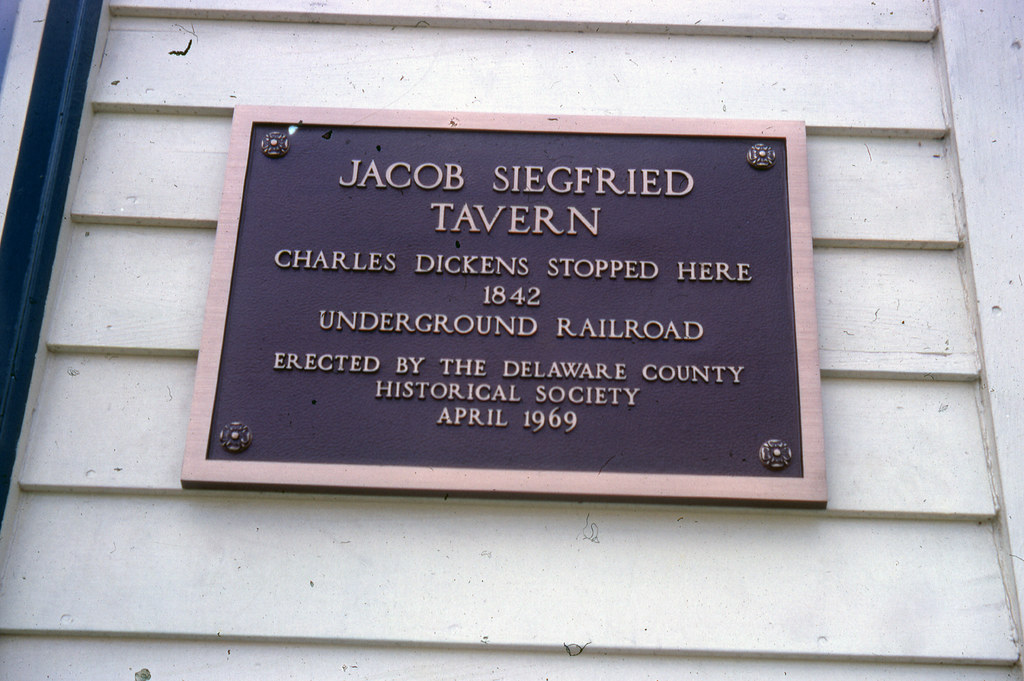
Affixed to the building is a metal plaque, rendered unreadable (during summer months, at least) by unkempt bushes. In my many years of passing the tavern, I could decipher only one word — "tavern" itself. Imagine my surprise, then, when I browsed the Delaware County Historical Society's slide collection and found this:

The plaque. Image by George Cryder (?), 1969, from the Delaware County Historical Society collection.

At first, I accepted the claim with delight. I'd long known about Dickens's 1842 excursion to America, recounted, with invaluable cynicism (1), in American Notes for General Circulation. But, after a moment's thought, I felt a twinge of uncertainty. Though I'd read (and reread) the portion of American Notes covering the Ohio leg of Dickens's journey, I could recall no mention of Delaware.

In the fourteenth chapter, Dickens describes his sole jaunt through Ohio's interior (2):
There being no stage-coach next day, upon the road we wished to take, I hired 'an extra,' at a reasonable charge to carry us [from Columbus] to Tiffin; a small town from whence there is a railroad to Sandusky. This extra was an ordinary four-horse stage-coach, such as I have described, changing horses and drivers, as the stage-coach would, but was exclusively our own for the journey. To ensure our having horses at the proper stations, and being incommoded by no strangers, the proprietors sent an agent on the box, who was to accompany us the whole way through; and thus attended, and bearing with us, besides, a hamper full of savoury cold meats, and fruit, and wine, we started off again in high spirits, at half-past six o’clock next morning, very much delighted to be by ourselves, and disposed to enjoy even the roughest journey. 
We alighted in a pleasant wood towards the middle of the day, dined on a fallen tree, and leaving our best fragments with a cottager, and our worst with the pigs . . . we went forward again, gaily. (3)
As I feared, not so much as a mention of inns, taverns, or Delaware. (I doubt even Dickens, contemptuous of America though he was, would dare to call Siegfried a "cottager.") In the following pages, Dickens describes only one stop between Columbus and Tiffin — Upper Sandusky, which lies well north of Delaware. If Dickens hired an "extra" for the sake of "being incommoded by no strangers," and dined (while sitting on a fallen tree) from his coach's supply of "savoury cold meats, and fruit, and wine," why would he stop at Siegfried's tavern? Why inconvenience himself with the company of strangers? And why avoid writing about the sojourn?

Dickens's diary provides few answers (though, unlike American Notes, it does mention that his coach changed horses several times). A folder labeled "Siegfried Tavern" — held by the Delaware County Historical Society — contains property research and biographical information about the Siegfried family, but barely mentions Dickens's supposed stay. The 1842 copies of Delaware newspapers seem to be lost.

The plaque's claim, then, is neither provable nor falsifiable. The weight of evidence may lie on the side of doubt, but mere weight is scarcely proof. I've no choice but to speculate.

Perhaps the story is merely hearsay — a local legend repeated by innumerable Herodotuses, and having no more credibility than the 6.2 x 10^14 similar tales about George Washington, Andrew Jackson, and Abraham Lincoln. Perhaps "Dickens passed this tavern" mutated, as verbal accounts are wont to do, into "Dickens stopped here." Or, perhaps, Dickens gave a hearty wave from his coach; Siegfried noticed and passed the impression to his descendants, in whom it transformed into today's story. Or Dickens indeed paused at Siegfried's tavern, albeit briefly, and simply for a change of horses or a bit of leg-stretching.

1) The best nineteenth-century descriptions of America tend to be those given by foreigners.
2) Though Dickens twice visited Cincinnati, he ventured into the state proper only once.
3) American Notes for General Circulation, Volume II (1842), 133–134.

Monday, June 27, 2016

The John Moomaw House

I've devoted a few posts to Ross County buildings, and I could pen a thousand more. Among the most charming (though scarcely the grandest) of these structures was a Paint Township farmhouse, reportedly erected by one John Moomaw.

John Moomaw's residence (with requisite leaning chimney). Photo by Mrs. A.W. Geissinger or Mrs. D.N. McBride (?), from Historic Landmarks in Ohio: Volume II, compiled by several chapters of the United States Daughters of 1812 in 1953. Scanned by Columbus Memory.

Moomaw's abode stood on sloping land in the valley of Upper Twin Creek, due west of the Paint Township-Twin Township border. To the south, beyond Farrell Hill (home to a delightful sandstone cottage), lies the verdant Paint Valley, site of Ross County's earliest settlement. Though Moomaw's farm — which, in 1860, occupied 210 acres — contained plenty of arable land, little remains cultivated; the tract has, by and large, reverted to scrubby grassland and second-growth forest.

The Moomaw family appeared in America between 1731 and 1732, with the arrival of Jacob and Leonhard Mumma. (Many descendants anglicized their names; this page mentions "at least 18 different ways to spell the surname.") Whether the Ross County branch could trace their descent from Jacob or Leonhard, alas, is difficult to determine. A 1937 Scioto Gazette article describes John Moomaw as an "enterprizing [sic] German settler" and member of a German Baptist congregation.

Moomaw, apparently, relocated from Virginia (1) about 1812 and held several offices in Paint Township's fledgling government — in 1813, he worked as an overseer of the poor; and, in 1816, he served as fence-viewer. According to local legend, Moomaw's bank barn — a double-pen log structure — hosted German Baptist ("Dunkard") meetings.

The precise history of the Moomaw residence is difficult to determine. Geissinger and McBride, in Historic Landmarks of Ohio: Volume II, place its construction within the second decade of the nineteenth century:
The date of the house has not been determined, but certain architectural features lead us to believe that it is within the 1812 period.
Rex Hagerling, by contrast, gives the date 1838, presumably gleaned from Ross County tax records. (2) Kevin Coleman writes that "[the Moomaw home] was built about 1820" and classifies the structure as "[having] genetic similarities with the Grenier form." (The "grenier" house, as Coleman defines it, is marked by "[a] symmetrical gabled roof around the loft [which] projects forward, creating an incised or cut-in porch which appears to be carved out of the body of the house instead of being added on." Apparently, the geographer Allen Noble identified this building-type in 1984.)

Indeed, the two-story inset porch — a distinctly Germanic trait — is (or was) the Moomaw home's outstanding feature. This porch; along with the massive sandstone (?) chimney, basement kitchen, exterior staircase, and bizarre window configuration; placed the John Moomaw House among Ross County's finest rural buildings. Its demolition (circa 2000), then, can best be described as "calamitous."

The Moomaw residence after its abandonment. Image by Rex Hagerling, May 1978, from an Ohio Historic Inventory form.

The Ross County Historical Society's collection contains other photos of the Moomaw home.

1) County histories also mention a Henry Moomaw (1791–1871), born in Virginia, who, like John, moved to Paint Township during the War of 1812. Henry's farm existed a few miles west of John's, near the Upper Twin Road-Fordyce Road intersection. No doubt, Henry and John were related.

2) In 1978, Hagerling finished an Ohio Historic Inventory form (ROS-262-11) describing Moomaw's house. In the "Sources of Information" section, he cites "Auditor's Tax Duplicates: 1836, 1837, 1838," and "Ross County Deed Records."
Friday, October 30, 2015

Overhanging Plates, Again

I've penned a few posts about the mysterious overhanging plate, which, though common in the Upper South and Midwest, remains largely unstudied. Last month, while idling in my college's library, I discovered an early (1952) mention of the overhanging plate in Hugh Morrison's Early American Architecture. On page 168, Morrison writes:
The topmost logs at the ends of the cabin were projected to carry the wall plate forward, thus offering a modicum of protection from rain to the lower wall.
This "cabin" (truly a log house of "saddlebag" plan) stood in Caldwell County, North Carolina, near Blowing Rock. In 1938, Frances Benjamin Johnston photographed the home, then inhabited by one Mrs. Mary Gregg, for her Carnegie Survey of Architecture of the South.

Photo, 1938, by Frances B. Johnston, from the Carnegie Survey of Architecture of the South. Scanned by the Library of Congress.

In Early American Architecture, Morrison suggests the overhanging plate exists to shelter walls from rain, a theory equally plausible as mine (that the overhanging plate evolved from the butting pole). Of course, neither conjecture is provable.

The Gregg residence's logs were unusually well-handled; if I knew no better, I'd describe them as "circular-sawed."

Note the steeple notching, closely-fitted logs, and overhanging plate. The chamfered side log is standard.

Wednesday, September 9, 2015

Binegar (?) Log House

Perry Township, Fayette County, Ohio


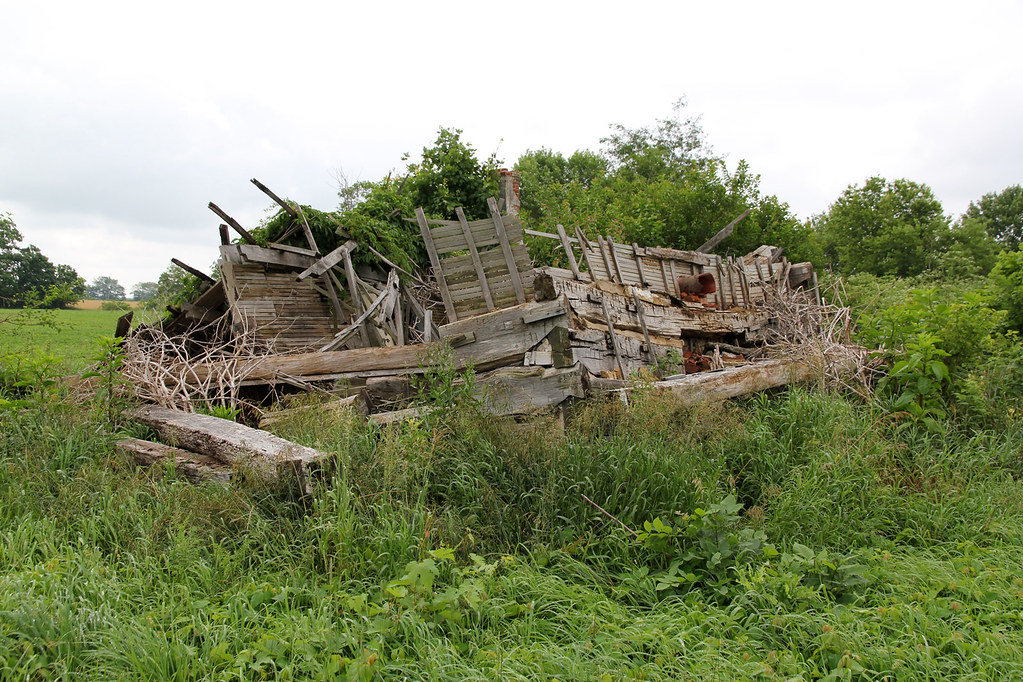
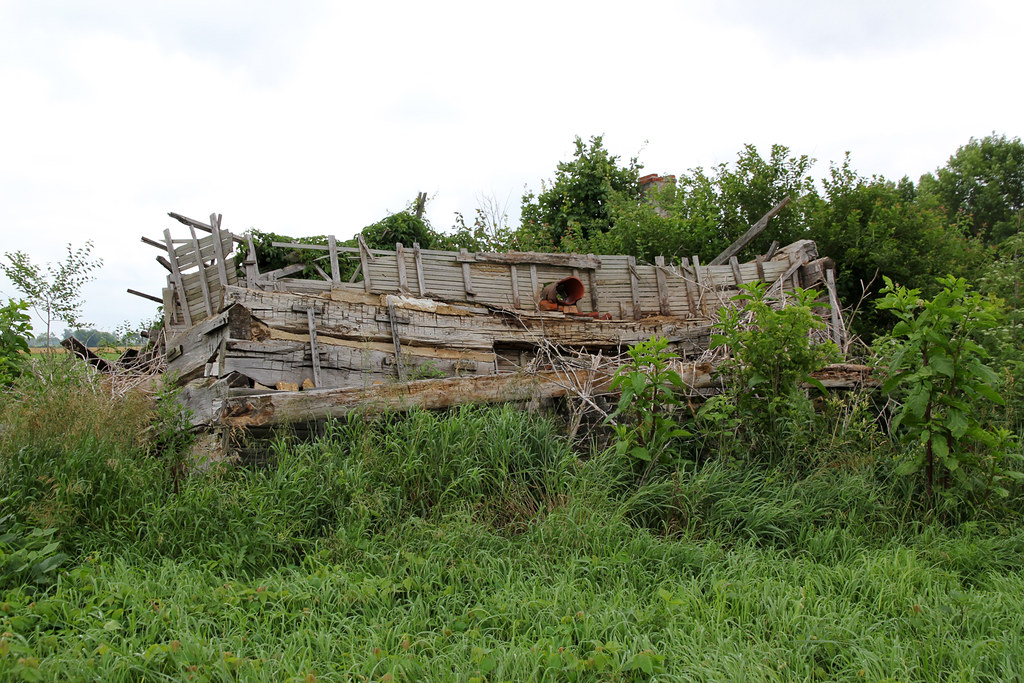
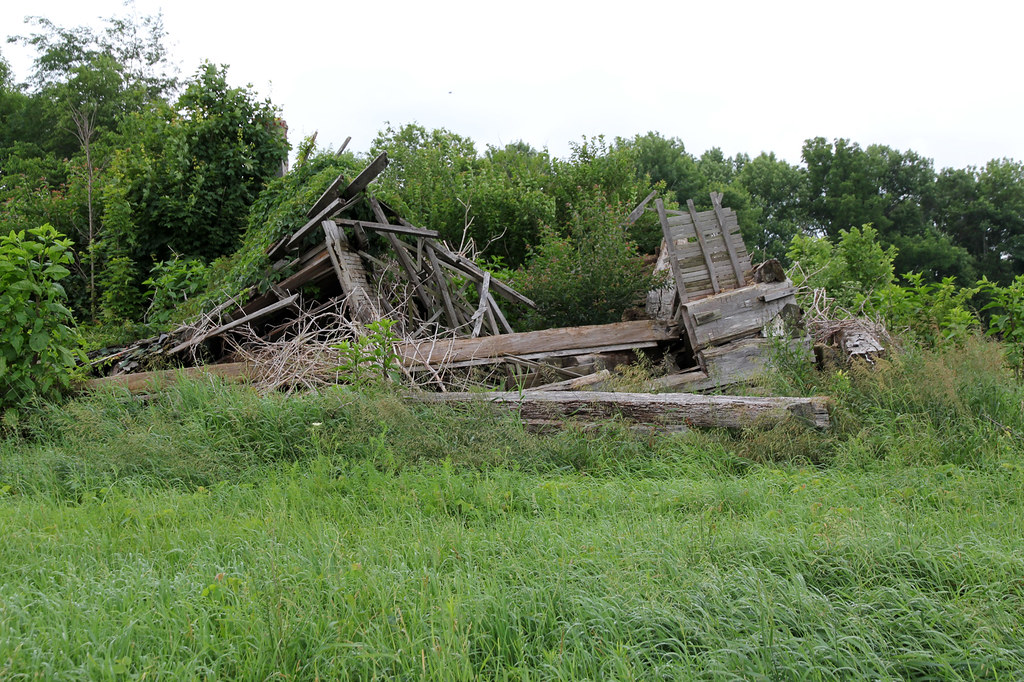
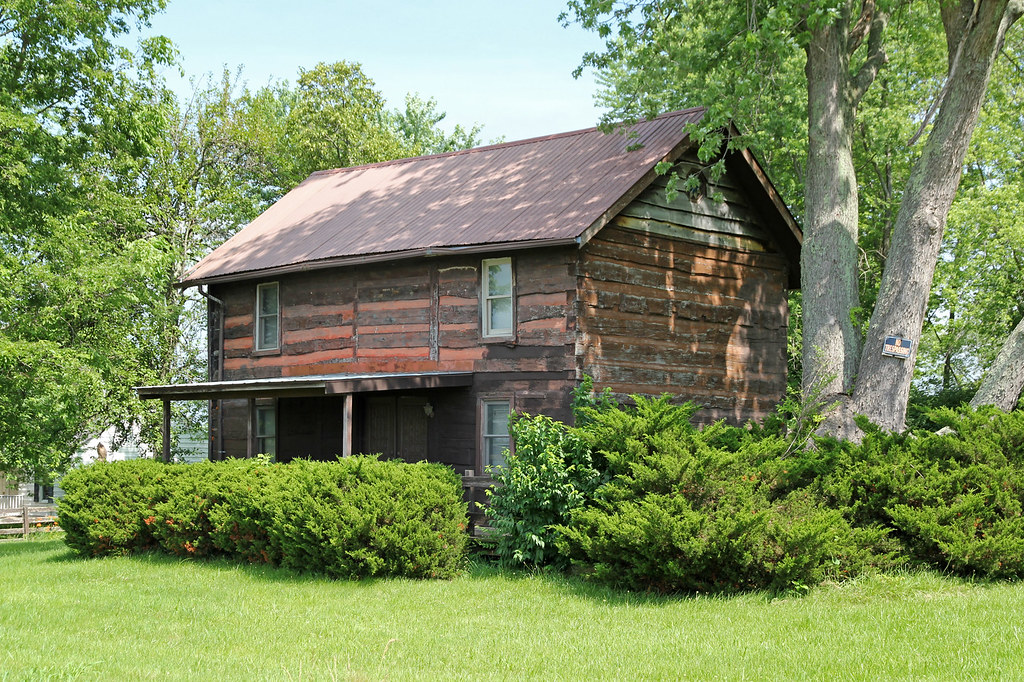
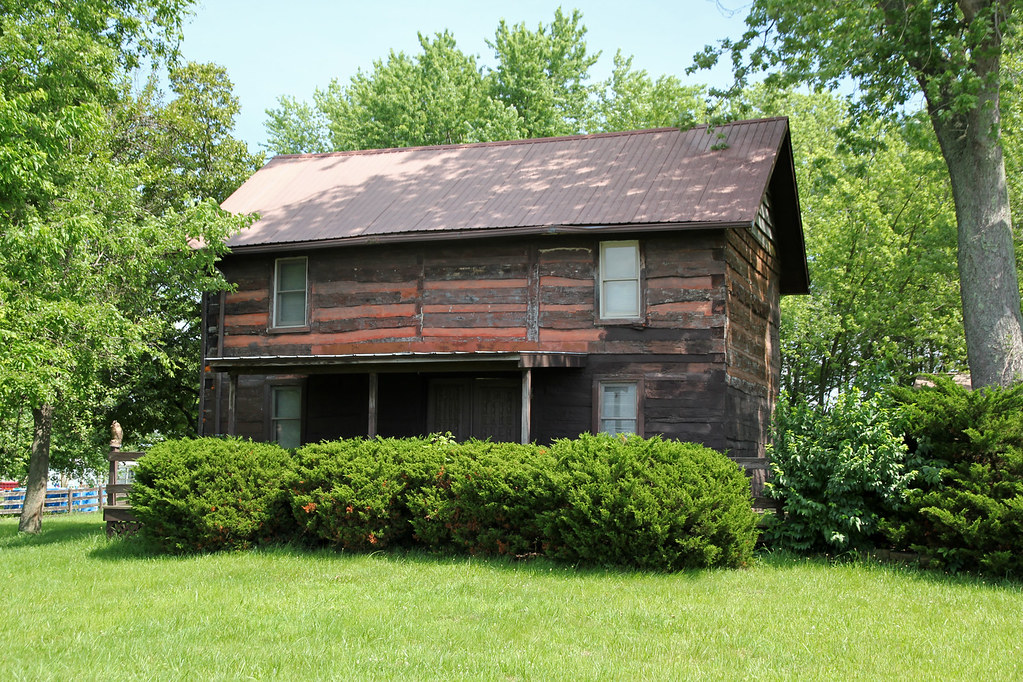
In south-central Fayette County, Ohio, near the unincorporated community of Buena Vista, lie the ruins of a small log home; the structure remained standing, albeit precariously, until at least 2012.

Its history is somewhat mysterious; the 1875 Illustrated Historical Atlas of Fayette County, Ohio, omits the home. Perhaps it was moved from another locality.

George W. Binegar (18271886); a native of Virginia, like most of the county's early residents; owned the 30-acre property in 1875. By 1913, ownership had passed to one R. Jones (either Randolph or Robert), who farmed a mere ten acres.


Though diminutive, the building was well-built. Note the steeple notching, intact daubing, firebox opening, and clay pipe (for an interior stove, which replaced the fireplace). The firebox itself, barely visible, is of stone construction; the chimney was brick. A partition wall divided the plastered interior into two rooms of equal size.


Vacant, little-modified log buildings, many abandoned during and shortly after the Great Depression, weren't an uncommon sight in post-World War II Ohio. Most of these homes, alas, have disappeared; the majority of Ohio's extant log structures remain occupied, with substantial alterations.

Sunday, July 19, 2015

A Most Curious Log House

Salt Creek Township, Pickaway County, Ohio


This house, despite its small size, features both a "crosswall" and a medial post. If the square notching and narrow logs are any indication, it was likely sided soon after construction, and may date from the mid- or late 19th century. Perhaps, the township had become denuded of large timber by this time, forcing the home's builder to employ the odd medial post-crosswall combination. The medial post appears almost exclusively in areas of German settlement; it is unsurprising, then, that most of Salt Creek Township's early residents were Pennsylvanians of German descent.

The building, owned by J. Markel or J. Butterbach in 1871, sits within the cluster of houses comprising the defunct settlement of Stringtown.

("Stringtown," incidentally, is a name shared by many Ohio communities. All Stringtowns are diminutive; the moniker, I suspect, describes the settlements' appearance — houses "strung out" along a road.)


Salt Creek Township lies at the western edge of the Allegheny Plateau. The region, being both hilly and agriculturally wealthy, is quite scenic.

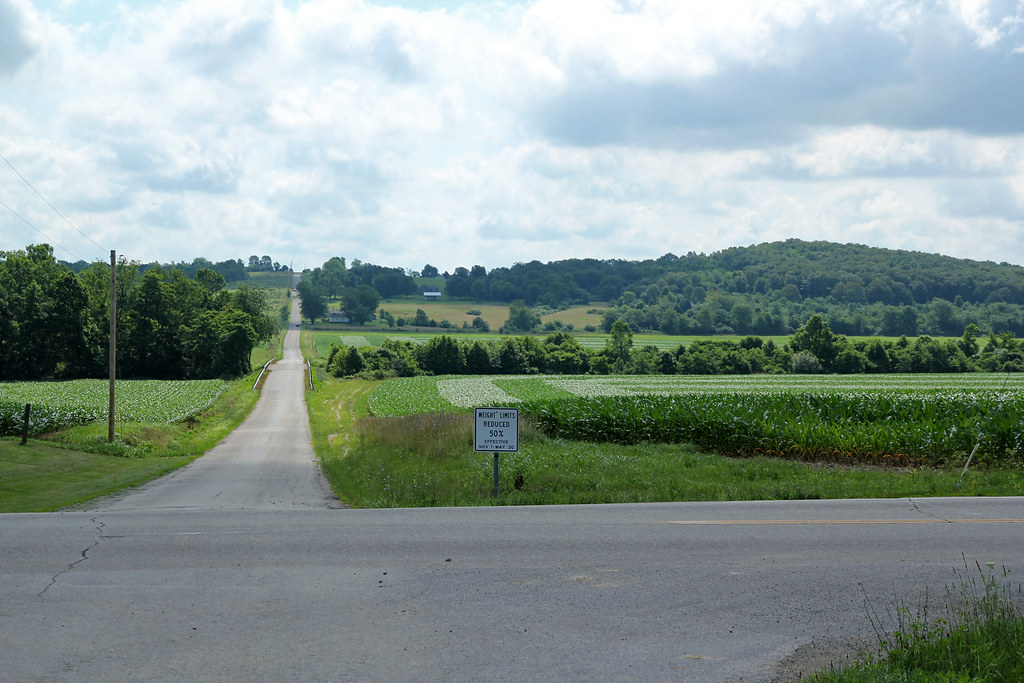
The intersection of South Perry Road and Tarlton-Adelphi Road, looking east. The township's namesake stream, Salt Creek, occupies this valley. Pumpkin Ridge rises in the background.

Sunday, May 31, 2015

Knoles Log House

Chillicothe, Ross County, Ohio


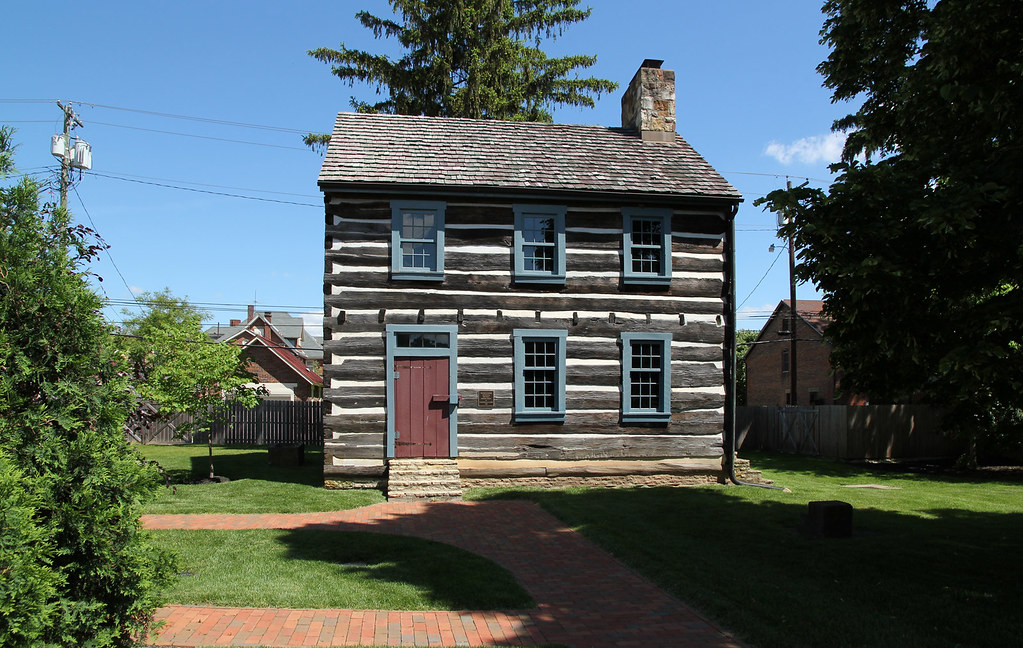
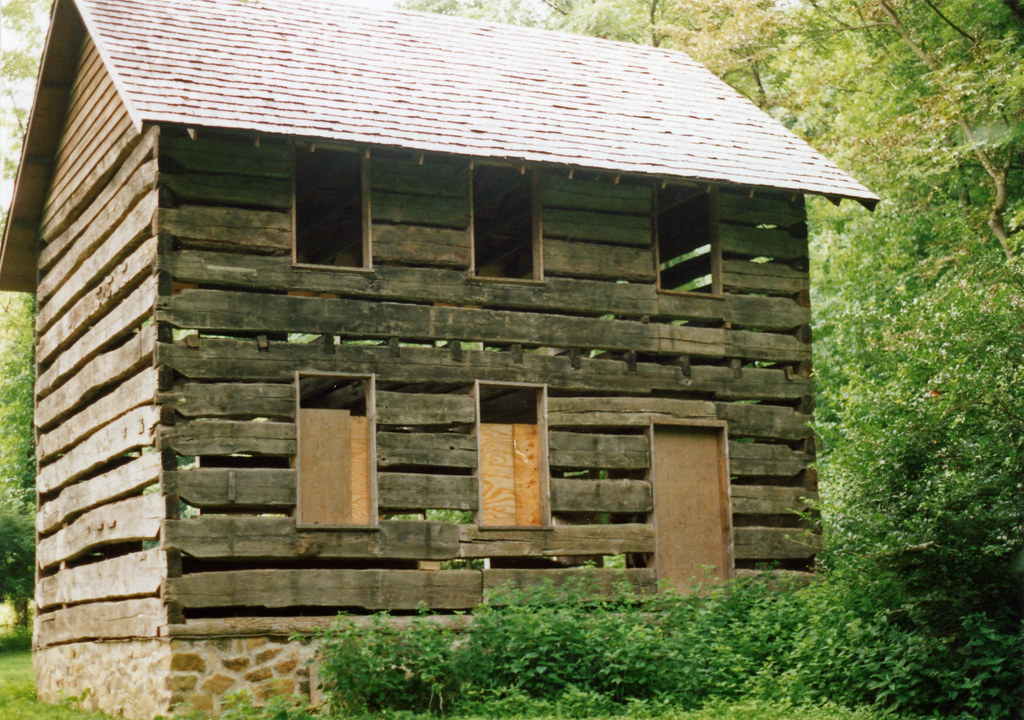
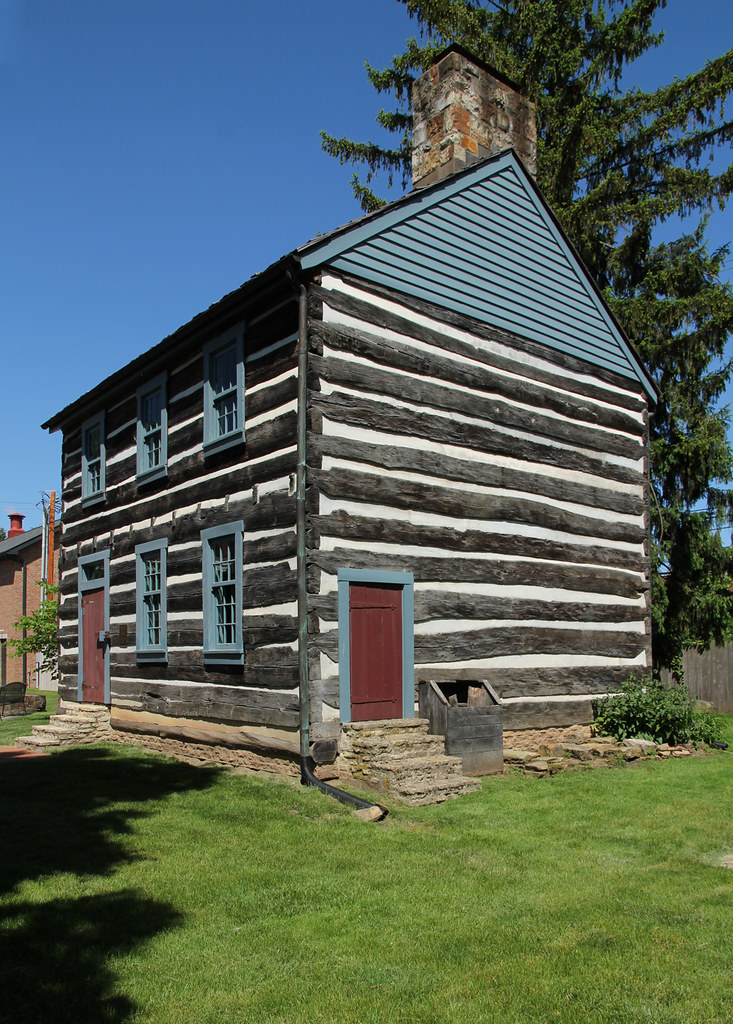
William Knoles, born in Delaware in 1795, likely commissioned this house about 1820. Evidently, Knoles' dwelling was well-known; the 1917 Standard History of Ross County, Ohio mentions "a substantial hewed log house, which has been weatherboarded on the outside, and ceiled on the inside, and now forms a part of the house occupied by [Charles W. Knoles, William's grandson] and his family."

Originally, the house fronted Southern Avenue, just south of its intersection with East 11th Street (an industrial complex now occupies the site). In the 1970s or 1980s, it was moved to the foot of Adena hill. Another relocation occurred in 1992; currently, the home sits behind the Ross County Historical Society museum.

The structure at its second site. Photo by Brian Hackett (?), August 1990, from the Donald Hutslar collection; used courtesy of Jean Hutslar.
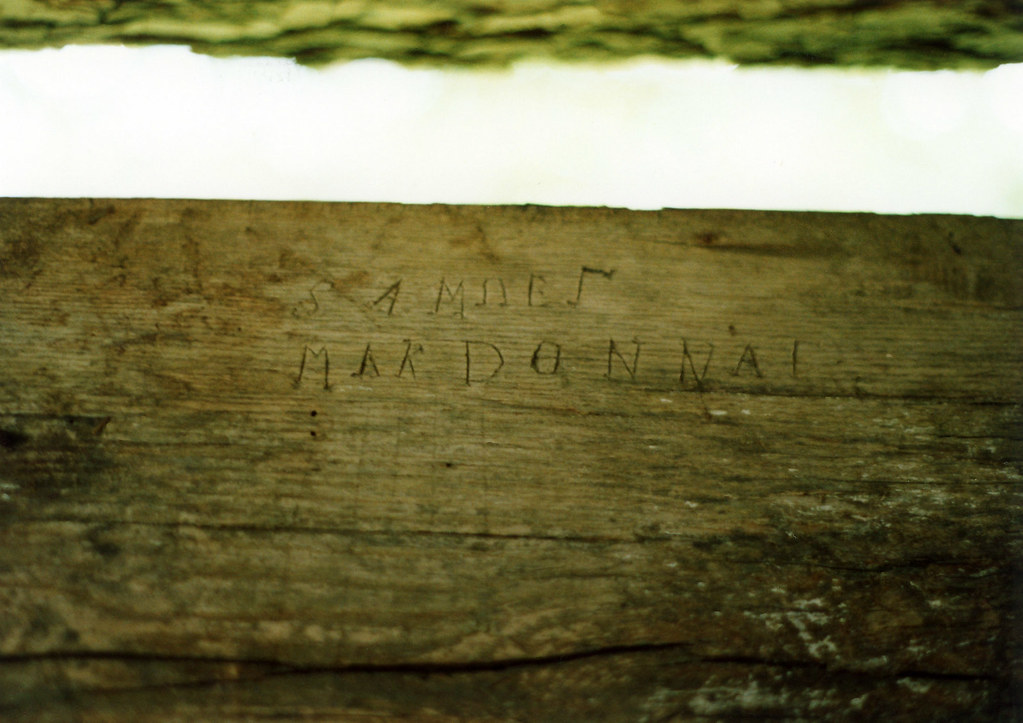
A revealing inscription; presumably, MakDonnal constructed this house for William Knoles. In the 19th century, as now, many better-finished homes were the work of skilled carpenters, rather than owner-builders.

Why Samuel spelled his name "MakDonnal," rather than "McDonnal" or "M'Donnal" (the latter variant was common during the 19th century), is unclear, as is his inversion of the U and L in "Samuel."
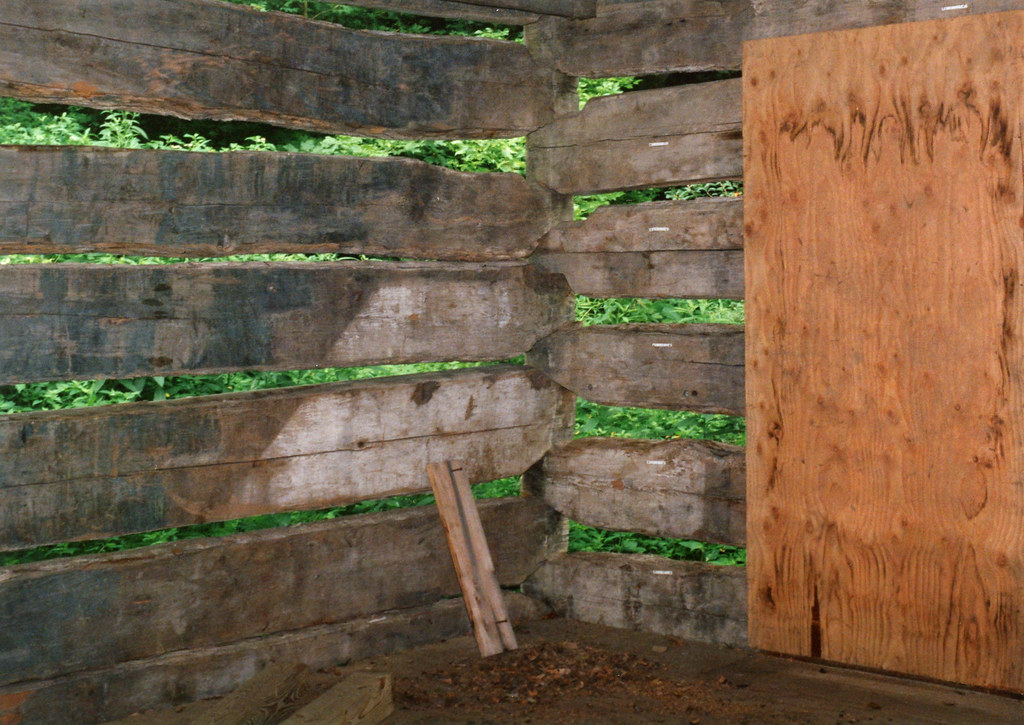
The former stairway's location is obvious. Photo by Brian Hackett (?), August 1990, from the Donald Hutslar collection; used courtesy of Jean Hutslar.
Quite a solidly constructed home, with its large logs and well-handled steeple notching. Evidently, the chimney always existed on the interior.
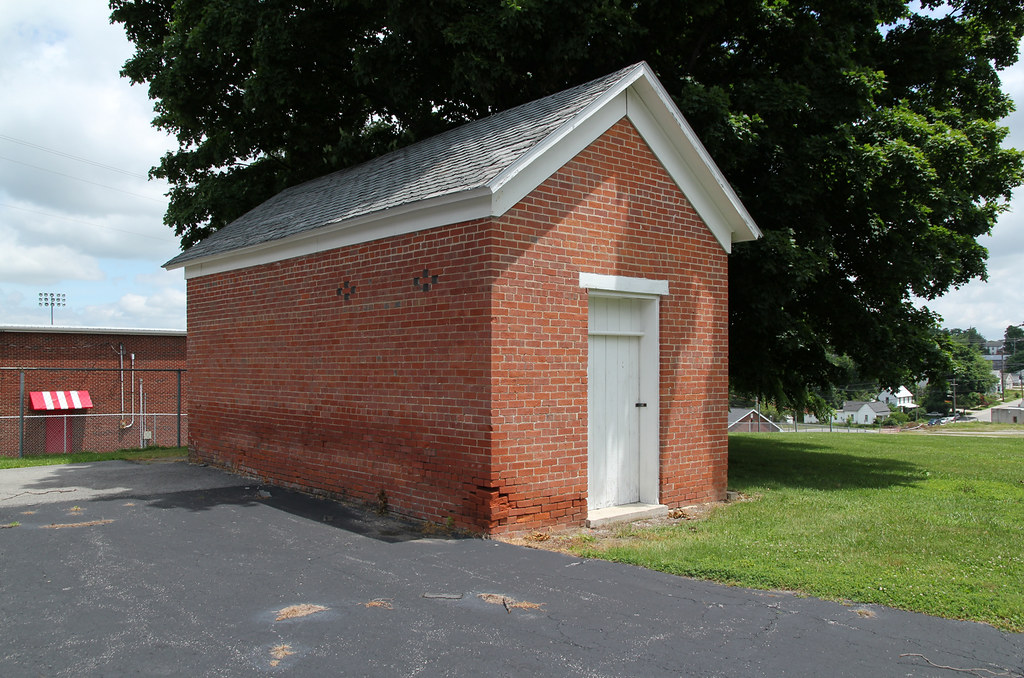
An unusual treatment; sills are typically squared on all sides.

Sunday, April 26, 2015

William Scott House

Hillsboro, Highland County, Ohio


Certainly Hillsboro's finest classically inspired residence, completed about 1835. The Ohio Historic Places Dictionary, Volume II describes its architecture:
The building displays, through its overall massing and details, Georgian style architectural features. It exhibits classically influenced detailing which includes doorways with elliptical fanlights, six-over-six multi-paned windows, molded fascia board along the roofline, entrance porticoes with fluted Doric columns and pilasters. The unique cupola and projecting bay on the west elevation may have been later additions, since their detailing suggests the romantic influence of the Italianate style of the mid-19th century.
The author's labeling of the home as "Georgian" is perhaps labored; though it shares certain features — its cubic form and classical ornamentation, most prominently  with the style, the Scott House postdates the Georgian era.


The east porch. Note the differences between the home's doorways; this entrance features double doors, while the main entrance is trabeated, with sidelights.
The rear elevation.
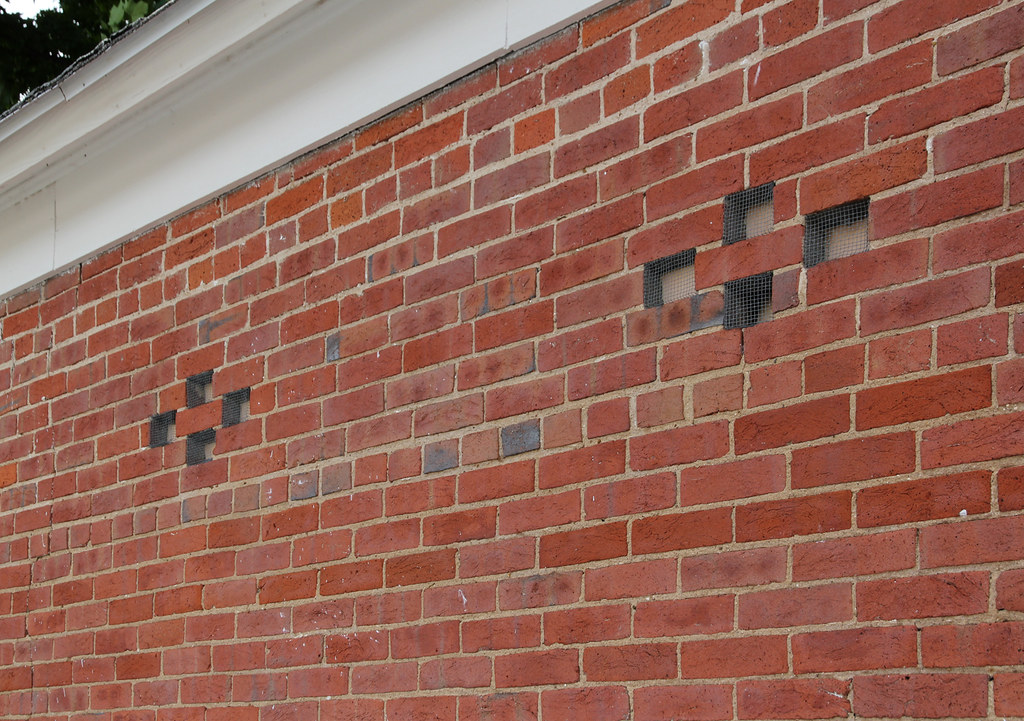
This structure, like the Blackstone and Renick smokehouses, features ventilation slits clustered in the shape of a diamond. Presumably, Scott was a Virginian.

Wednesday, April 22, 2015

Mary Worthington-Macomb House

Chillicothe, Ross County, Ohio


Thomas Worthington, Ohio's sixth governor and owner of the outstanding Latrobe-designed Adena mansion, purchased this building shortly after its 1815 construction. Worthington's daughter, Mary, occupied the home for several years before relocating to Florida. Until recently, a complex of industrial buildings surrounded the structure.

The rear elevation. Note the stairwell window, sitting between the first and second floors; this configuration is typical of well-finished Federal-era homes.
The tool marks are quite visible.
Note the interior stone wall and altered, presumably six-panel front door.
Typical Federal-era woodwork. The mantel's removal is unfortunate.

Monday, April 6, 2015

Blackstone House

Paxton Township, Ross County, Ohio


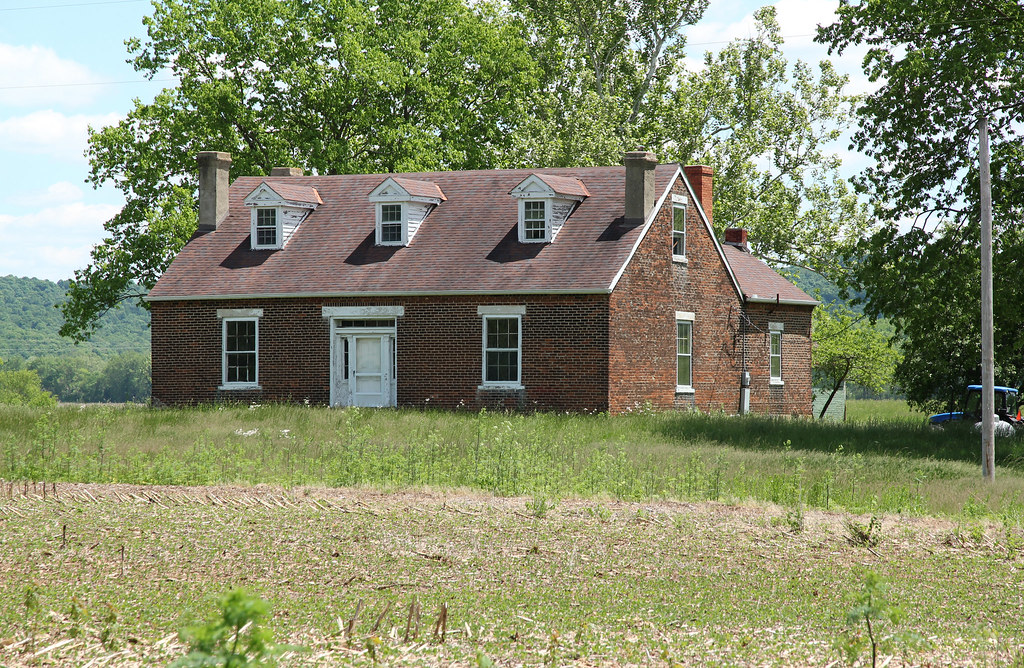
One of few mid-19th century Ohio homes with original dormers. Though common in the Tidewater South (and other regions settled during the colonial period), dormers never gained popularity in the Midwestern states.

The OHPO's GIS lists the structure as the "Dr. William Blackstone House," built about 1840. The Blackstone family moved to Paxton Township from Botetourt County, Virginia, in 1802.

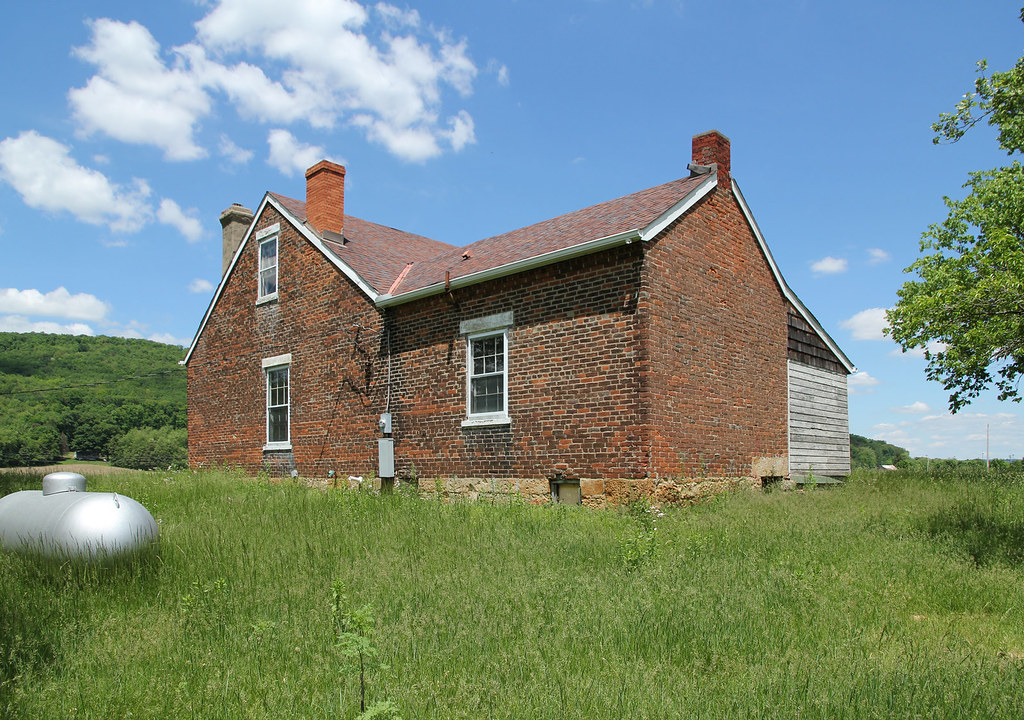
The house's rear. Note the rake boards and flush chimney.

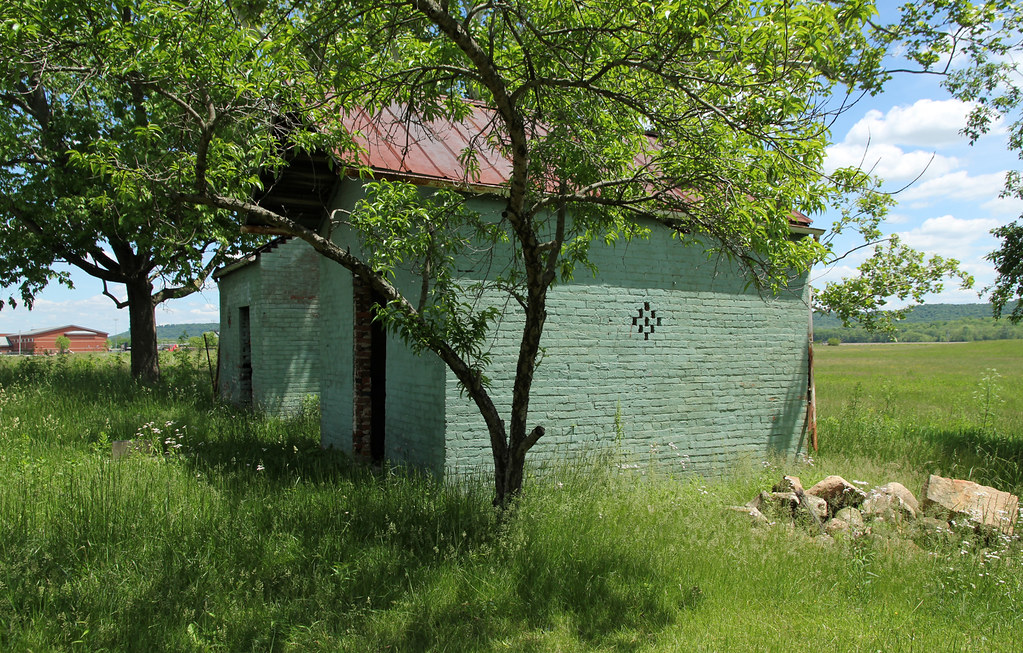
The accompanying smokehouse is particularly interesting.


The clustered holes provided ventilation. A smokehouse adjoining Mount Oval, in Pickaway County, features similar ventilation slits; Frary included a photograph of this structure in Early Homes of Ohio (page 134), with the following description:
The smokehouse . . . may be traced directly to Virginia, as it should be, for the Renicks came from the Old Dominion. Just what were the antecedents of this attractive little building may not be known, but certain it is that the open diamond pattern in the brickwork is to be found on various buildings in Virginia, including Bremo on the James and Barboursville in Orange County, both of which, by the way, were designed by Thomas Jefferson.


Friday, April 3, 2015

Joseph Maltby House

Springfield Township, Williams County, Ohio

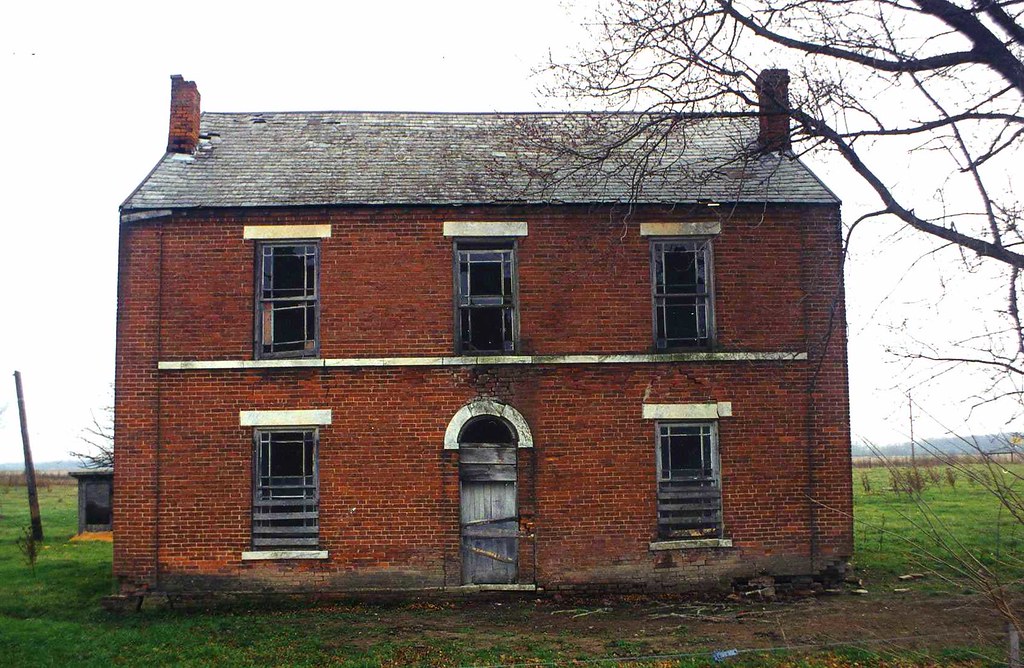
This residence is, so far as I'm aware, Ohio's only extant building with explicitly English antecedents (Muskingum County's Smith House, erected in 1833, is one possible exception); the stone trim, round-arched doorway, window configuration, and slate roof are elements infrequently seen in northern Ohio.

The home before its collapse. Photo by Jon Cutrell, 1996.
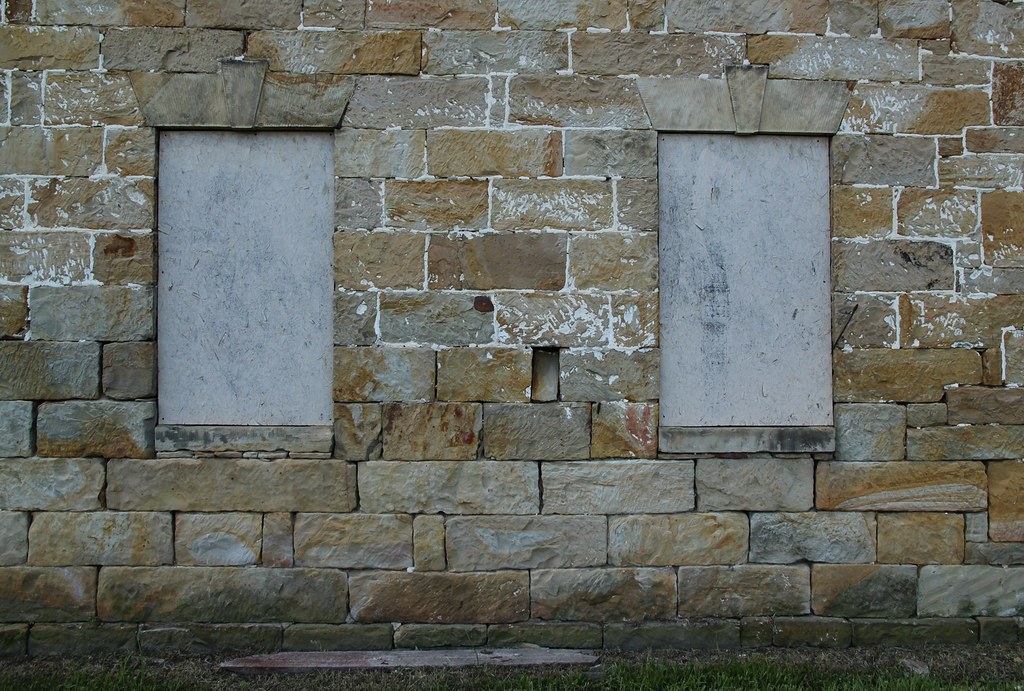
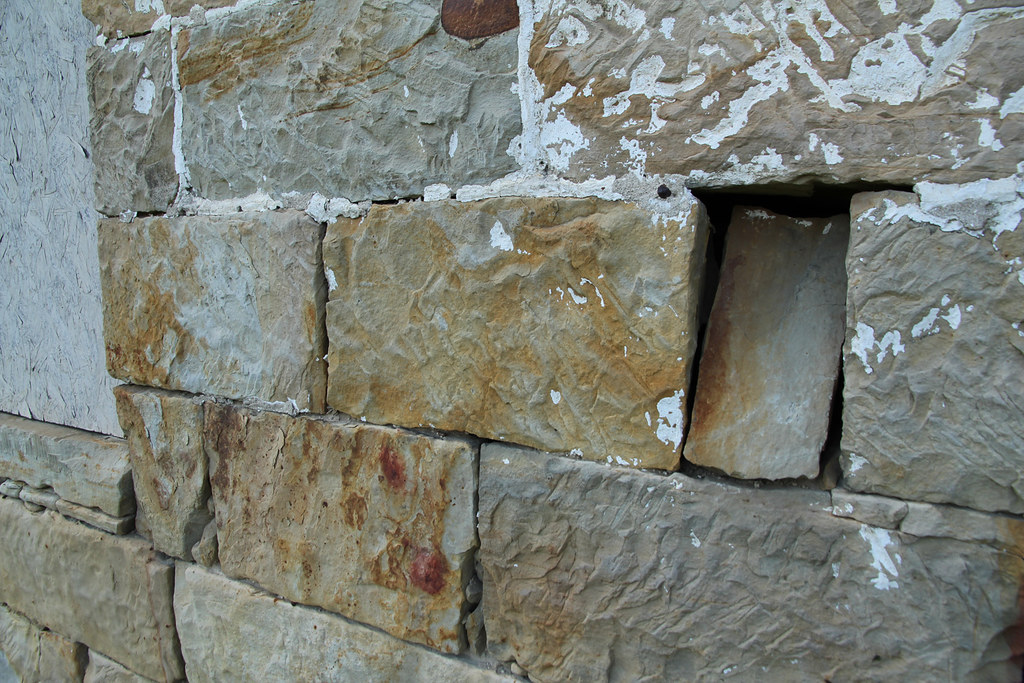
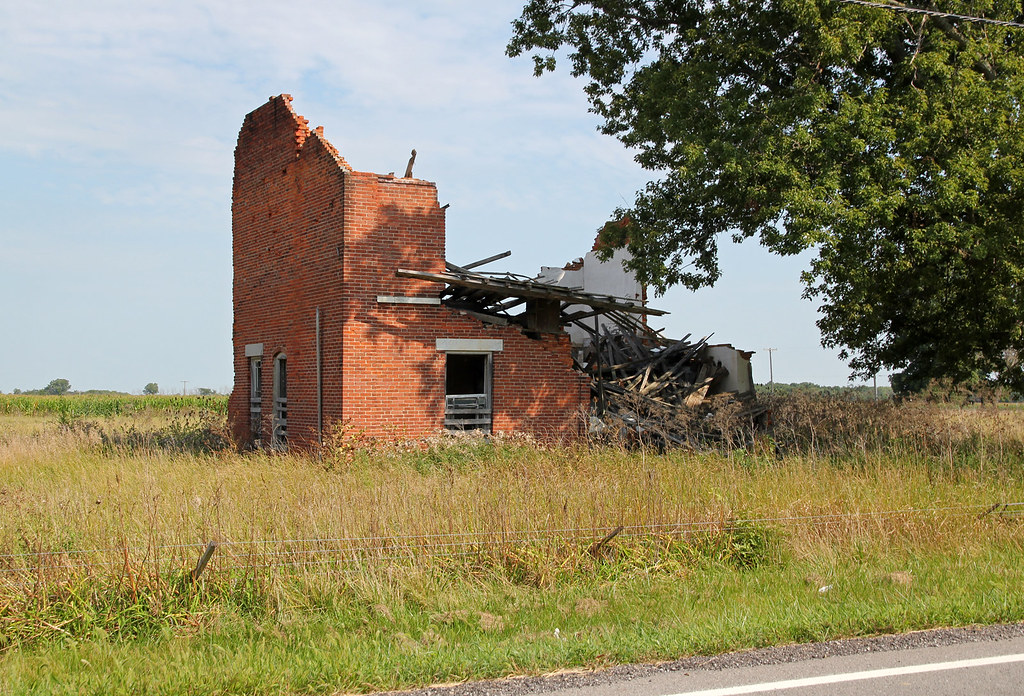
Joseph Maltby (18171879), a native of Derbyshire, England, immigrated to Williams County after his 1846 marriage, purchasing 120 acres in Springfield Township. Maltby's residence, now ruined, likely dates from the 1860s.

The house in 2014; its current condition is a travesty.