Showing posts with label inn. Show all posts

Thursday, December 21, 2017

A Warren County Puzzle

Perched on a hillside northeast of Waynesville, in Warren County, is a curious brick farmhouse. It's obviously an ancient structure (by Ohio's standards), with its flush chimneys and rake boards, and it fronts an early thoroughfare connecting Waynesville and cities farther north. Like a few other homes in the vicinity, it makes stupendous use of its sloping site; the basement is at once a first floor, a quirk which allowed the builder to attach a two-story gallery to what seems, from one angle, a single-story structure.
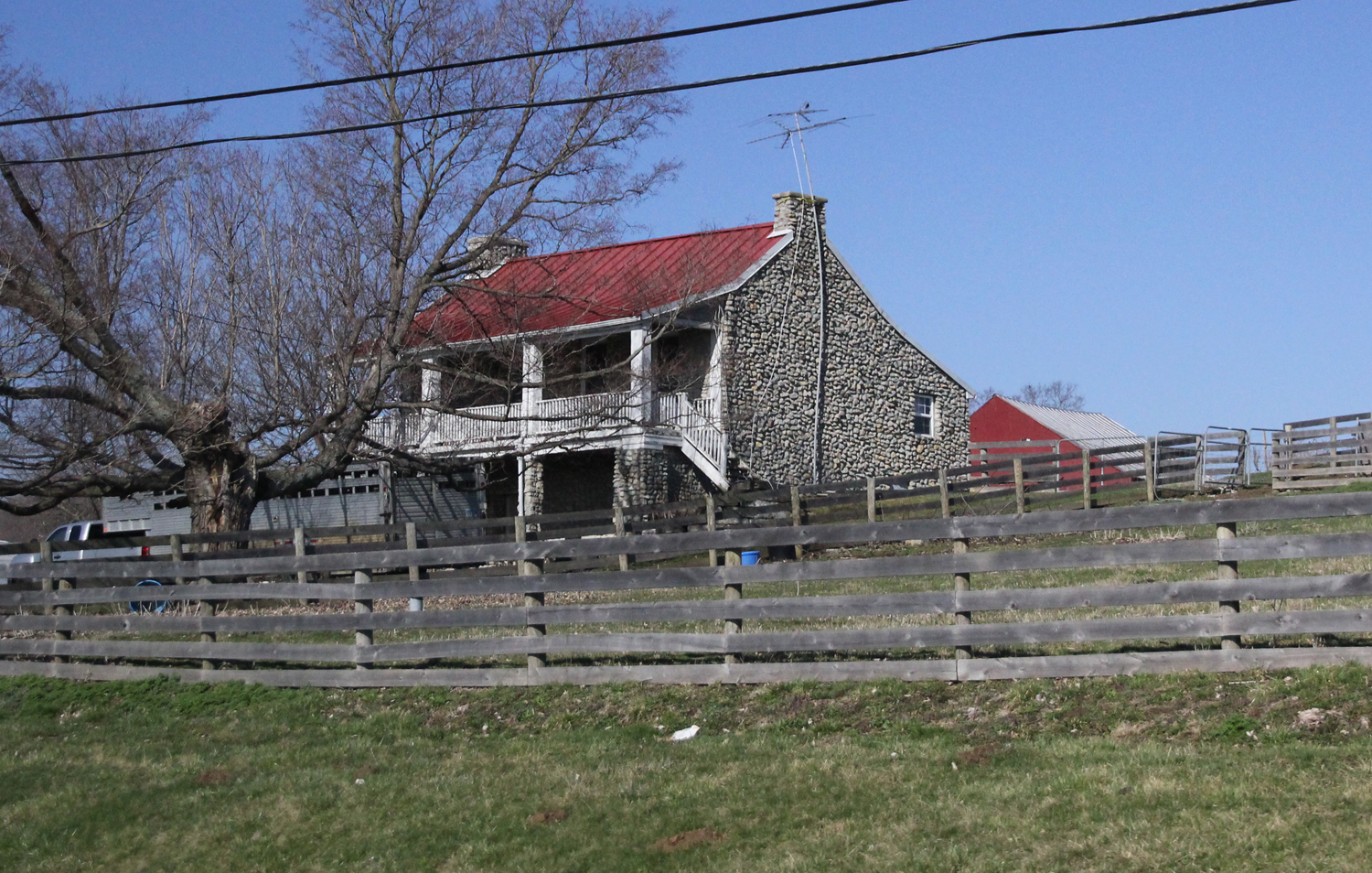
My lone, woefully inadequate photo of the building.

Alas, someone, at some time (perhaps in the finest decade for tasteful design — the 1970s), thought it wise to seal half the window and door openings, then reface the entire building, including its porch's columns (!), with stones of varied size and shape. The result looks, to my jaundiced eye, like the architectural equivalent of type-I neurofibromatosis (or some other tumor-inducing disease). Thankfully, staff from the Ohio Historical Society photographed the house in 1969 or 1970, well before the remodeling. At the time, the building retained its original six-over-nine windows.
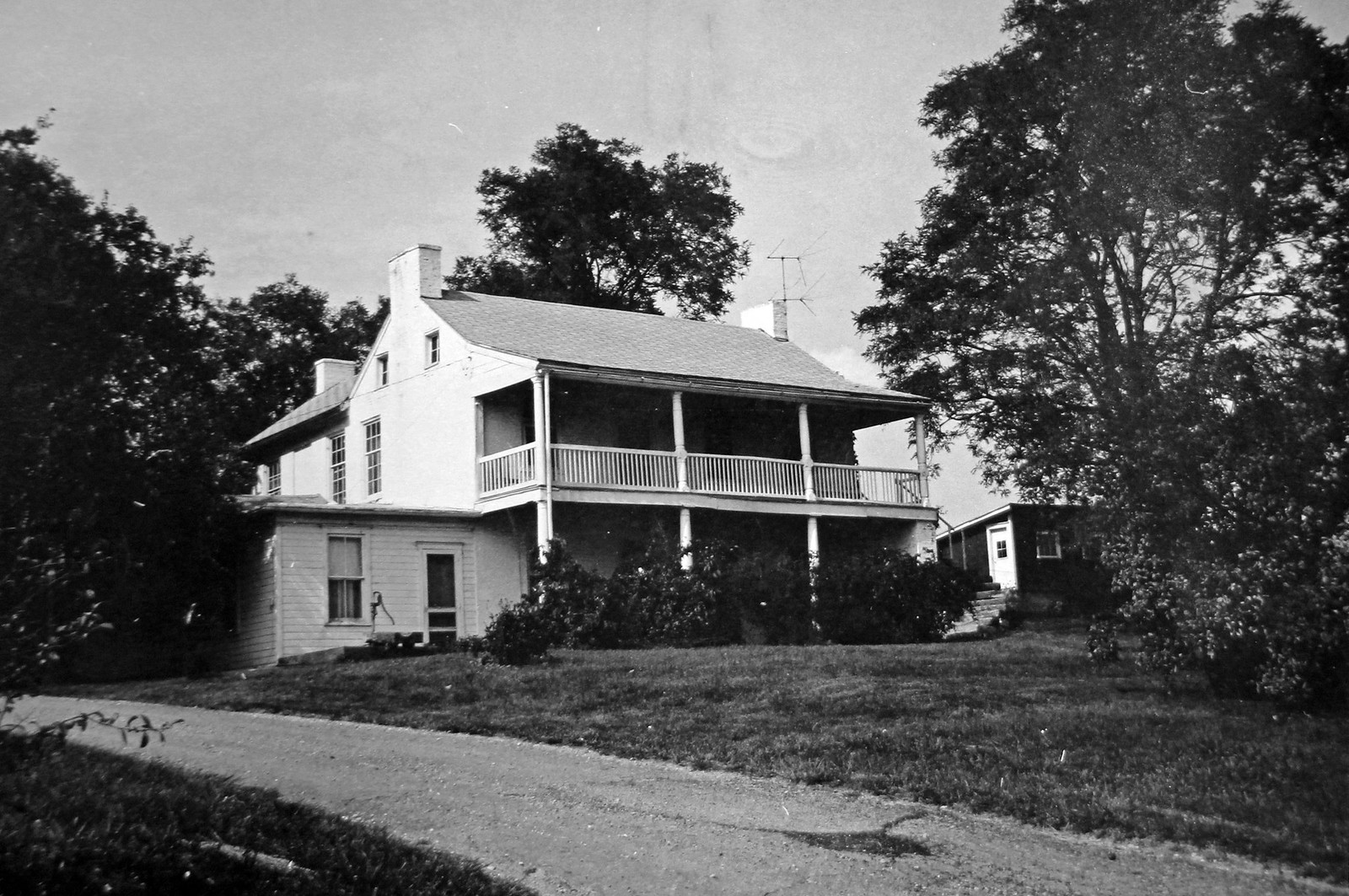
Image, 1969 or 1970, from the "Southwest Ohio Survey" collection; held by the Ohio Historical Society.

Obviously, the house is early and noteworthy, but researching its history proved more difficult than I anticipated. The earliest digitized map of Warren County land ownership, published in 1856, lists "J. Parkhill" as owner of the 204-acre tract where this home stands. As is so often the case, Parkhill seemingly left no literary footprint — he receives no mention in county histories, and grave records are equally scanty. (The closest match in Find A Grave's database is James Parkhill (d. 1896), interred in Deerfield Township's Rose Hill Cemetery.) The 1850 census, though, records a Joseph Parkhill, born about 1815 in Ohio, as a resident of Wayne Township. Parkhill had a large family, and he provided room and board for at least three non-family-members — evidence, perhaps, that local tradition has correctly identified the building as an inn or tavern.

Some time between 1856 and 1874, Parkhill's property passed to Israel Hopkins Harris (1823–1897), a Waynesville banker and member of a locally prominent family. If the postcard pictured below is any indication, Harris's name — and not Parkhill's — became attached to the house, no doubt because of the Harris family's considerable cachet.

Postcard, undated, from the collection of Donald and Jean Hutslar.

Assuming the building did function as a "wayside inn," it did so during Parkhill's occupancy (or earlier), and not Harris's. But Parkhill was reasonably young in 1850, and it's unlikely that he commissioned or built the structure. (Given that Waynesville itself was platted in 1796, and that Warren County comprises one of Ohio's wealthiest, earliest-settled regions, a construction date in the 1810s or 1820s seems perfectly believable.) But, alack, tracing Warren County property ownership beyond Franklin Pierce's presidency requires (a) good literary sources or (b) a trip to the county courthouse, so, for now, the Parkhill–Harris residence's ultimate identity will remain a mystery.

A slightly later (?) photo gives an even finer glimpse of the house's two-story porch, its twin entrances, and its most distinctive feature — a semicircular stone staircase, which partly provides ground-level access to the gallery's upper story.

Image, undated, from the collection of Donald and Jean Hutslar.

Monday, August 15, 2016

Charles Dickens and the Siegfried Tavern

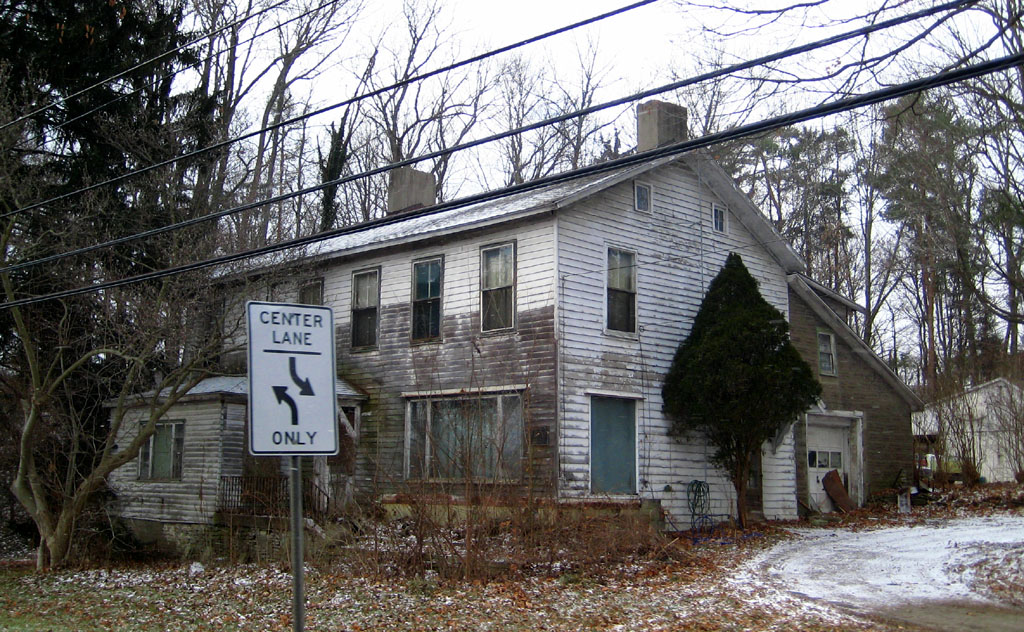
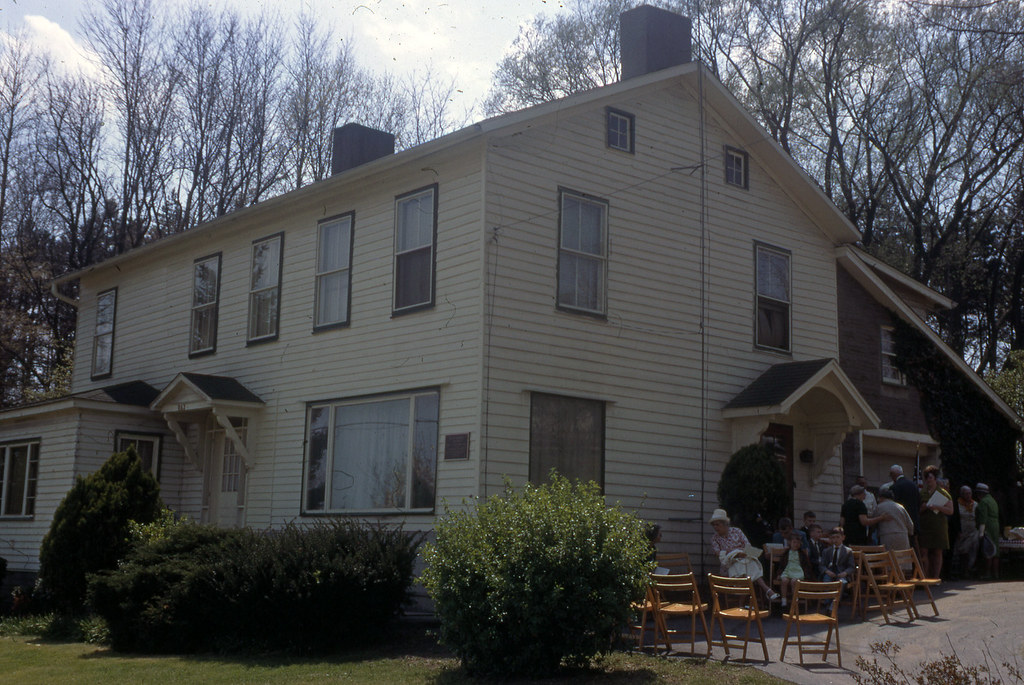
A mile or two north of Delaware, Ohio, stands a weatherbeaten frame building, vacant since 1985, and bearing the usual marks of protracted habitation — additions, alterations, and augmented apertures. It faces busy US Highway 23, which approximates the route of an early road connecting Columbus and Sandusky. The structure's situation betrays its purpose; it served as a tavern (or inn), operated by Jacob Siegfried (1788–1846), a Pennsylvanian, between 1835 and — I presume — 1846.

Siegfried's tavern in 2008. (Yes, this photo is terrible; but then, a person trapped in a moving vehicle cannot expect compositional brilliance!)

And, Siegfried's tavern before its abandonment. Photo by George Cryder (?), 1969, from the Delaware County Historical Society collection.

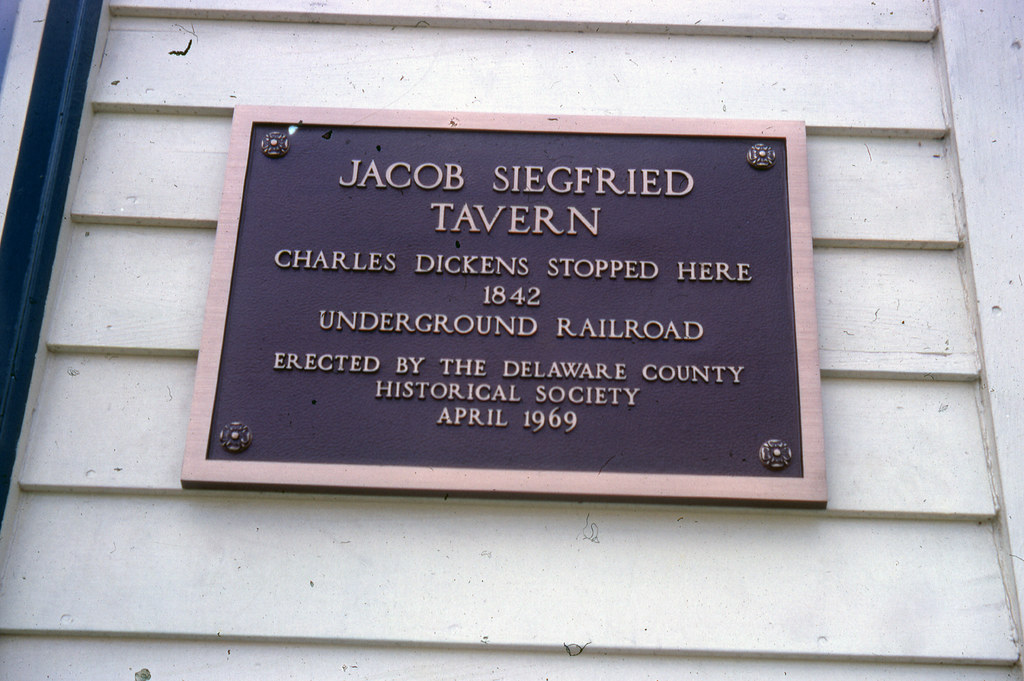
Affixed to the building is a metal plaque, rendered unreadable (during summer months, at least) by unkempt bushes. In my many years of passing the tavern, I could decipher only one word — "tavern" itself. Imagine my surprise, then, when I browsed the Delaware County Historical Society's slide collection and found this:

The plaque. Image by George Cryder (?), 1969, from the Delaware County Historical Society collection.

At first, I accepted the claim with delight. I'd long known about Dickens's 1842 excursion to America, recounted, with invaluable cynicism (1), in American Notes for General Circulation. But, after a moment's thought, I felt a twinge of uncertainty. Though I'd read (and reread) the portion of American Notes covering the Ohio leg of Dickens's journey, I could recall no mention of Delaware.

In the fourteenth chapter, Dickens describes his sole jaunt through Ohio's interior (2):
There being no stage-coach next day, upon the road we wished to take, I hired 'an extra,' at a reasonable charge to carry us [from Columbus] to Tiffin; a small town from whence there is a railroad to Sandusky. This extra was an ordinary four-horse stage-coach, such as I have described, changing horses and drivers, as the stage-coach would, but was exclusively our own for the journey. To ensure our having horses at the proper stations, and being incommoded by no strangers, the proprietors sent an agent on the box, who was to accompany us the whole way through; and thus attended, and bearing with us, besides, a hamper full of savoury cold meats, and fruit, and wine, we started off again in high spirits, at half-past six o’clock next morning, very much delighted to be by ourselves, and disposed to enjoy even the roughest journey. 
We alighted in a pleasant wood towards the middle of the day, dined on a fallen tree, and leaving our best fragments with a cottager, and our worst with the pigs . . . we went forward again, gaily. (3)
As I feared, not so much as a mention of inns, taverns, or Delaware. (I doubt even Dickens, contemptuous of America though he was, would dare to call Siegfried a "cottager.") In the following pages, Dickens describes only one stop between Columbus and Tiffin — Upper Sandusky, which lies well north of Delaware. If Dickens hired an "extra" for the sake of "being incommoded by no strangers," and dined (while sitting on a fallen tree) from his coach's supply of "savoury cold meats, and fruit, and wine," why would he stop at Siegfried's tavern? Why inconvenience himself with the company of strangers? And why avoid writing about the sojourn?

Dickens's diary provides few answers (though, unlike American Notes, it does mention that his coach changed horses several times). A folder labeled "Siegfried Tavern" — held by the Delaware County Historical Society — contains property research and biographical information about the Siegfried family, but barely mentions Dickens's supposed stay. The 1842 copies of Delaware newspapers seem to be lost.

The plaque's claim, then, is neither provable nor falsifiable. The weight of evidence may lie on the side of doubt, but mere weight is scarcely proof. I've no choice but to speculate.

Perhaps the story is merely hearsay — a local legend repeated by innumerable Herodotuses, and having no more credibility than the 6.2 x 10^14 similar tales about George Washington, Andrew Jackson, and Abraham Lincoln. Perhaps "Dickens passed this tavern" mutated, as verbal accounts are wont to do, into "Dickens stopped here." Or, perhaps, Dickens gave a hearty wave from his coach; Siegfried noticed and passed the impression to his descendants, in whom it transformed into today's story. Or Dickens indeed paused at Siegfried's tavern, albeit briefly, and simply for a change of horses or a bit of leg-stretching.

1) The best nineteenth-century descriptions of America tend to be those given by foreigners.
2) Though Dickens twice visited Cincinnati, he ventured into the state proper only once.
3) American Notes for General Circulation, Volume II (1842), 133–134.