Showing posts with label steeple notching. Show all posts

Friday, January 12, 2018

The Cluxton Log House

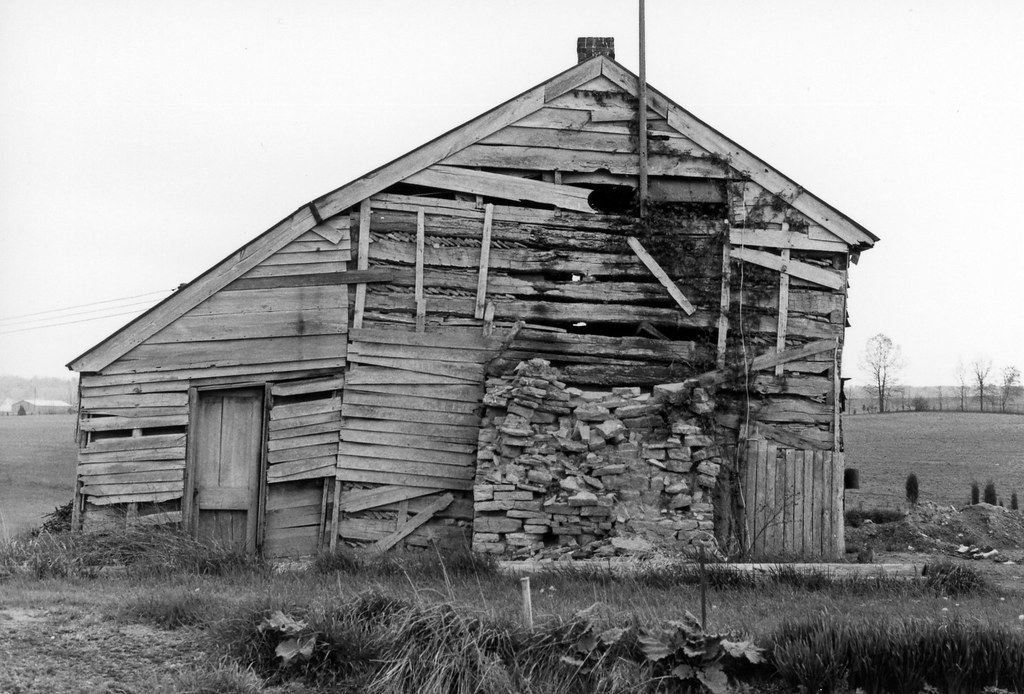
Unlike Kentucky, Tennessee, and other states south of the Ohio River and west of the Appalachians, Ohio boasts relatively few double-pen log buildings. (For those unversed in the arcane art of log-divining, a double-pen building is one which contains two structurally independent units, or pens.*) One of the Buckeye State's finest double-pen dwellings stood, appropriately enough, in one of its most "Southern" counties (geographically and culturally) — Adams — just north of West Union, the county seat. Nestled among billowing pastureland within an agriculturally deficient region known, historically, as the "white oak barrens," the house languished in obscurity and decrepitude until Stephen Kelley, president of the Adams County Historical Society, photographed it in 1977. Kelley's images found their way into Donald Hutslar's hands, and thence into two books (this and this). It's scarcely surprising, then, that state and national surveys of historic buildings neglected to include it — and shall always neglect to include it, since the house disappeared in the 1990s.

The house's front (northwest) elevation. Image by Stephen Kelley, 1977, from the collection of Donald and Jean Hutslar.

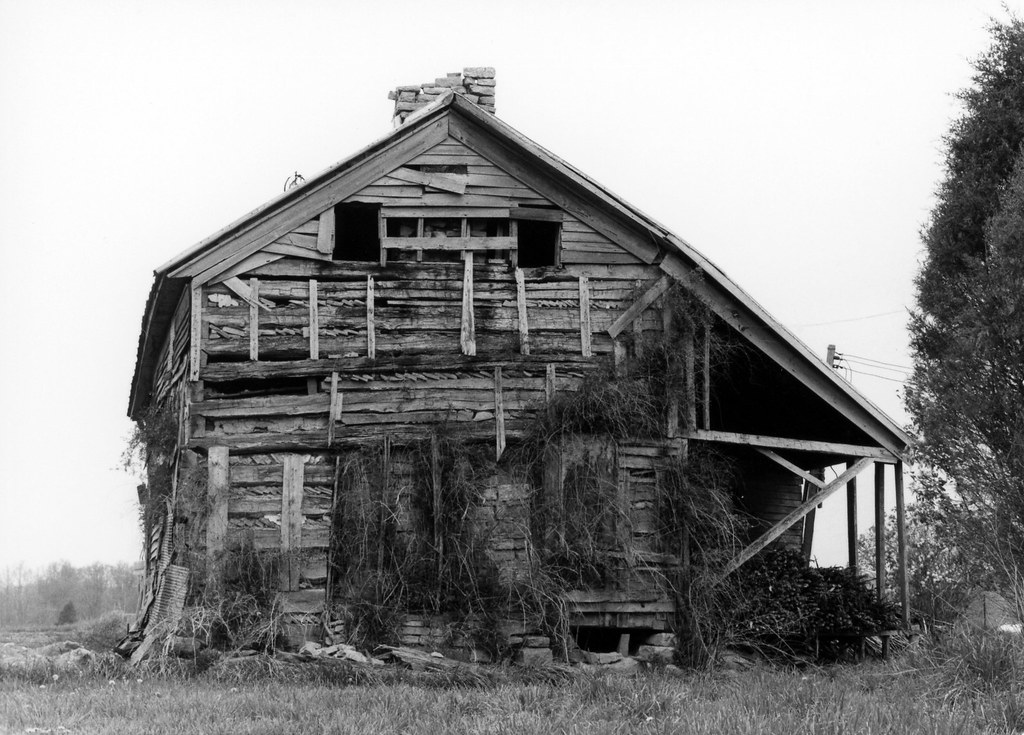
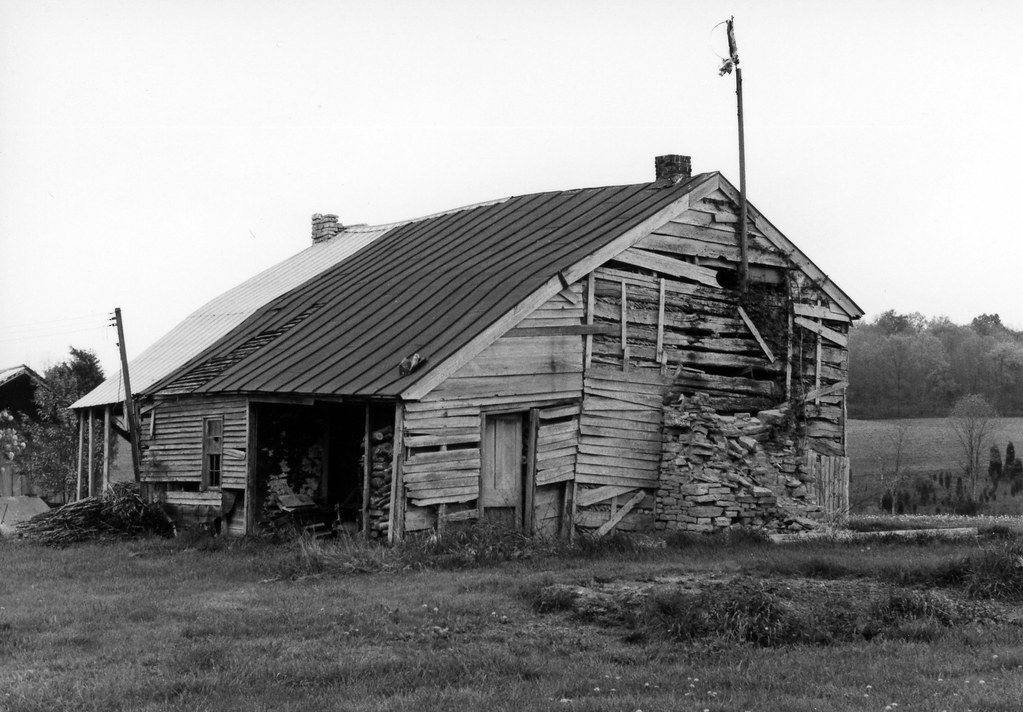
The home was an utterly classic double-pen structure — precisely the sort of building I'd expect to find within the earlier-settled portions of the Upland South. It made use of two one-and-a-half-story pens, each constructed of steeple-notched logs and adorned with a single window opening. It featured two massive rubble-stone chimneys — one exterior, and one interior (with an exposed firebox). In all likelihood, the passage between the pens was always enclosed (unlike in the case of the archetypal "dogtrot" house), and the braced-frame rear rooms, which lent the structure a "saltbox" roofline, might have been planned at the time of construction.
The rear (southeast) and side elevations. Note the square attic windows, rake boards, and cantilevered porch framing. I must say, I'm a bit baffled by the pole-mounted hoop. Was it a DIY television antenna? A massive dream-catcher? A homing device for extraterrestrial spacecraft?

Kelley, it seems, failed to photograph the interior, but he did have the foresight to sketch a floor plan, which I've adapted into a proper CAD rendering.
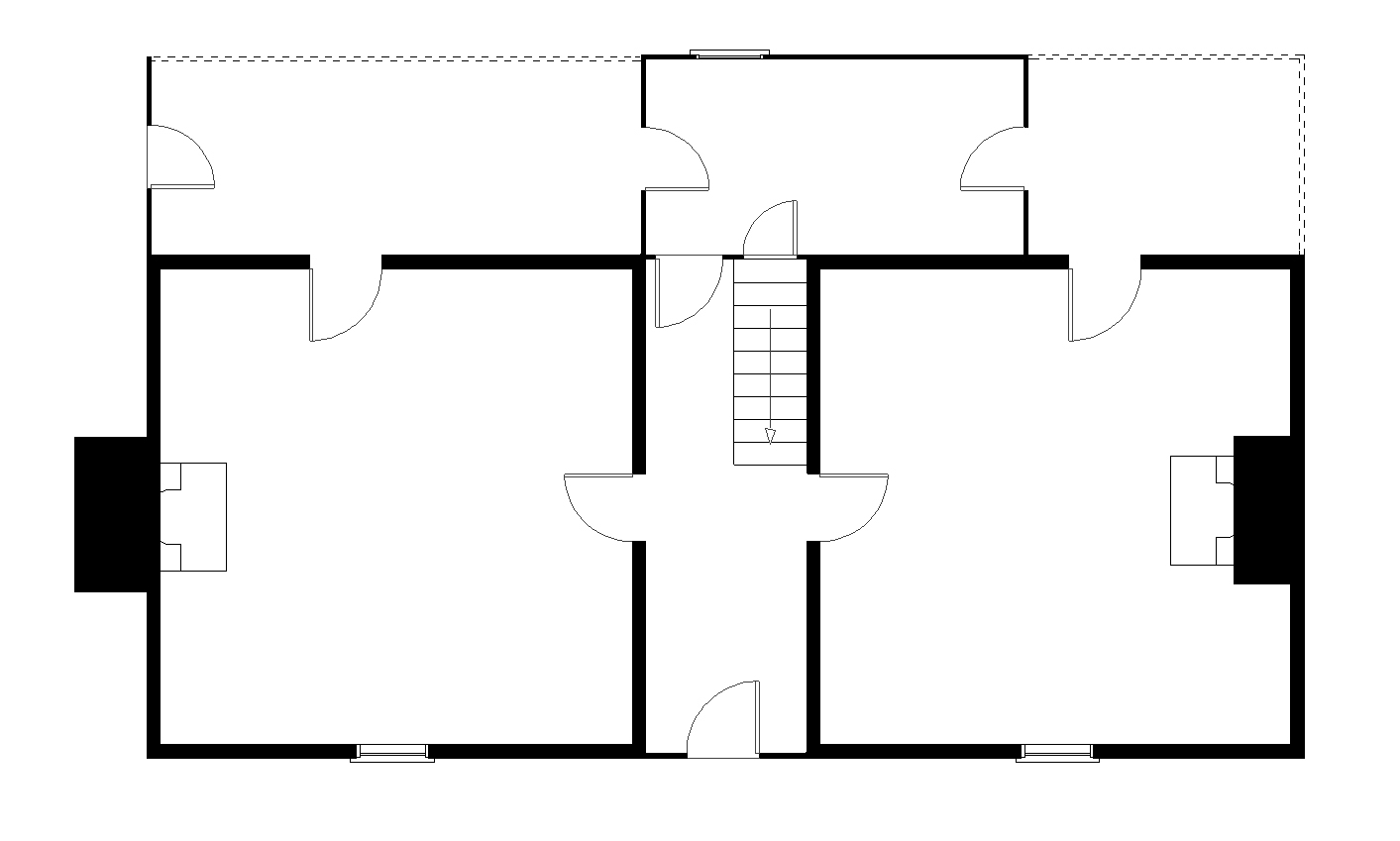

In some ways, the house's oddest feature was its staircase. More often than not, early inhabitants of Ohio's southern half jammed their stairways into the space between the fireplace and exterior wall. This house's builder, by contrast, placed the staircase within the "breezeway," but left it accessible only from the home's rear room. This suggests two possibilities — that (a) the building underwent a massive interior remodeling sometime in the nineteenth century, or that (b) the frame rear portion and the log pens were contemporaneous. Either possibility seems perfectly likely.

Dating the house is a tricky affair. Given its existence in Adams County, site of some of Ohio's earliest permanent settlements, it could have been a statehood-era structure. Then again, its placement on less-than-desirable land may mark it as a late survival of archaic building techniques. Tracing its ownership, alas, provides few answers. In 1880, it belonged to one S.P. Cluxton — perhaps Samuel Page Cluxton (b. 1838), a middle-aged farmer of Scots-Irish descent. It's unlikely that Samuel built or inherited the house; if mid-century census data is any indication, members of the Cluxton family lived exclusively in nearby Liberty Township, and their first place of settlement was the Brush Creek valley, several miles distant. (ApparentlyCluxton is a variant of Clugston, a "habitational name from the barony of Clugston in Wigtownshire," Scotland.)

So, the house's origin will remain a mystery — at least, until someone pays a visit to Adams County's courthouse and slogs through nineteenth-century tax records. I'll end my post with a rendering of how the house may have appeared in better days.
The house reconstructed in SketchUp, from the floor plan pictured above.

* Like all definitions, this one is subject to exception. Some of Ohio's seeming double-pen buildings — Brown County's Erastus Atkins House, for instance — are, in reality, unified structures whose rooms are divided by interlocked log walls.

Friday, January 1, 2016

Minutiae of Log Architecture: Notching

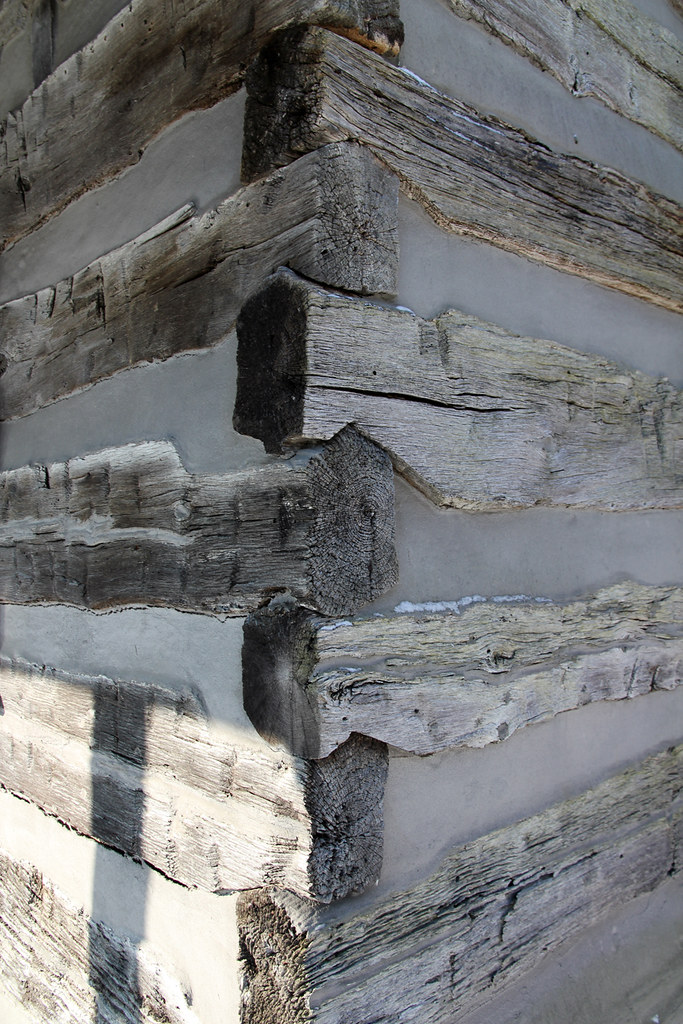
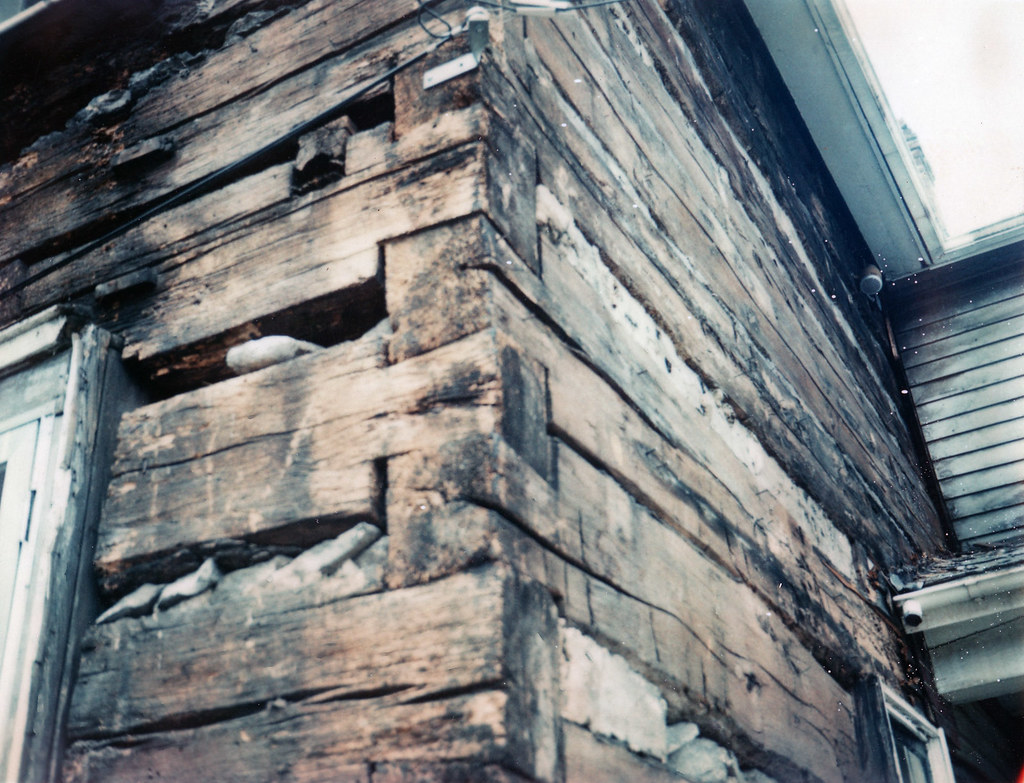
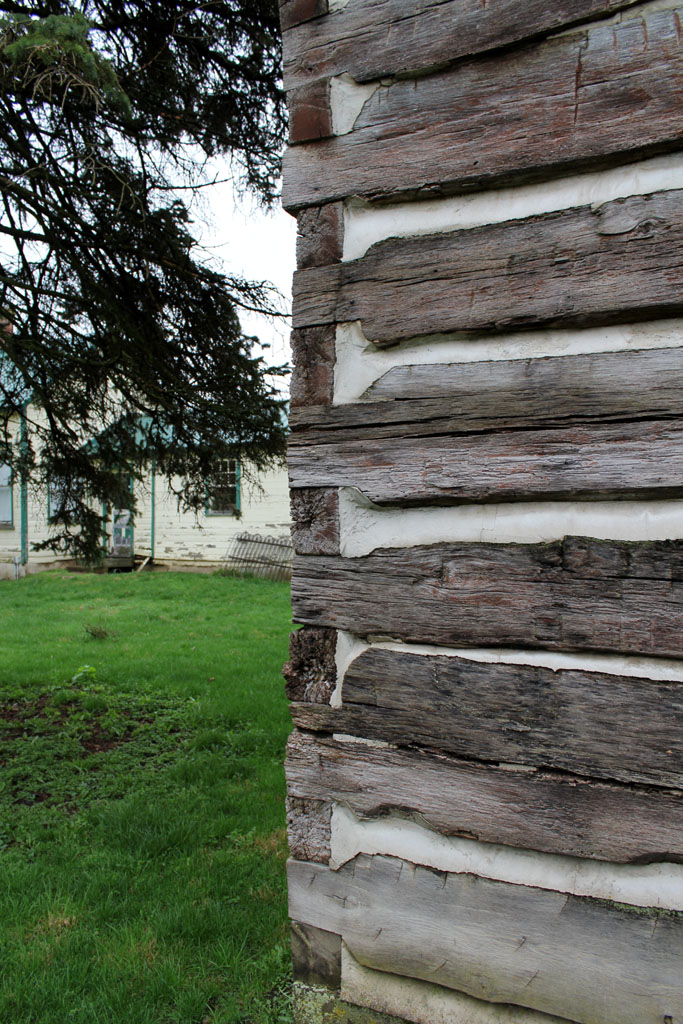
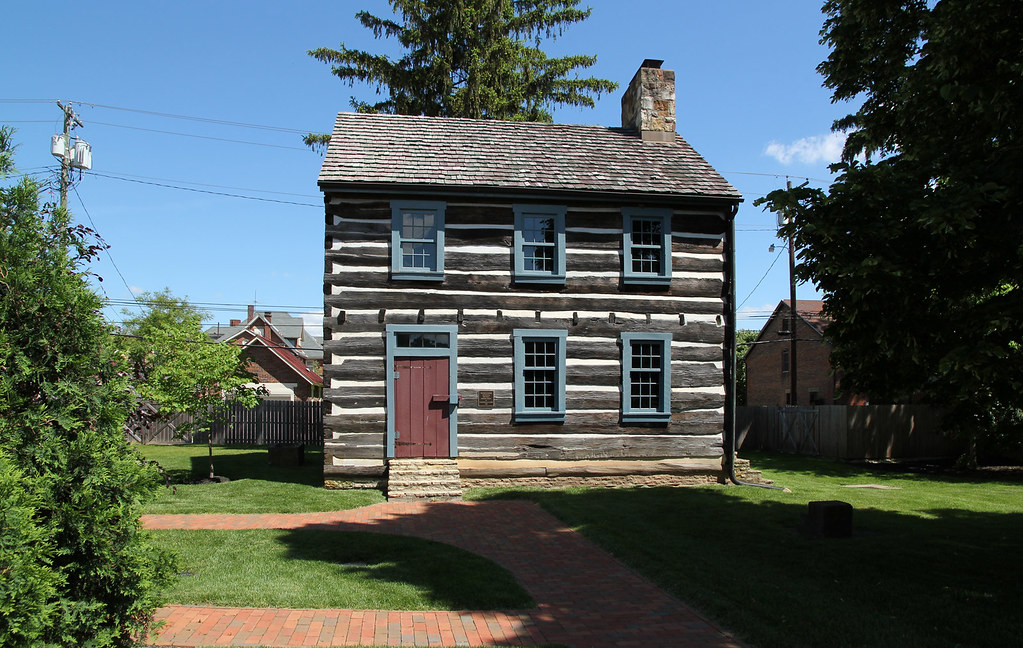
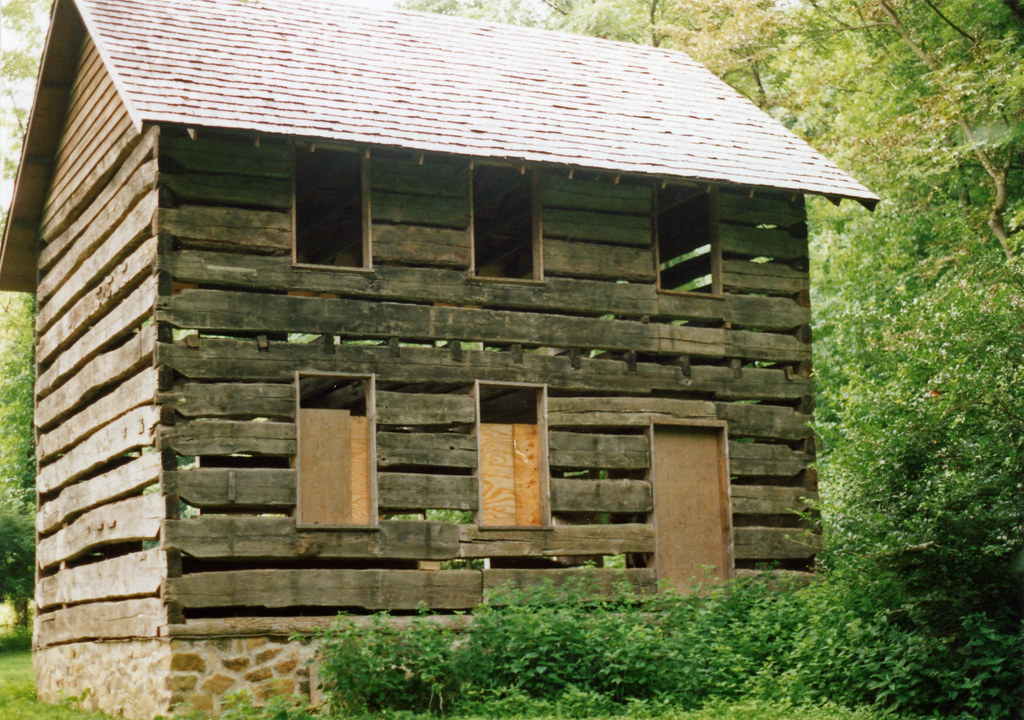
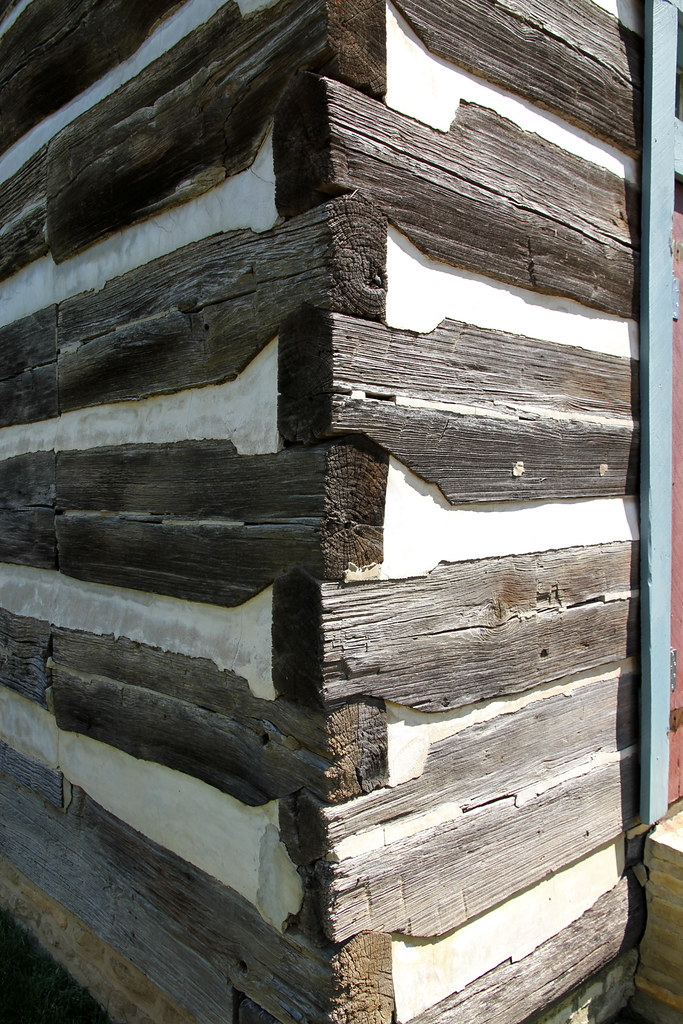
Most scholarly works about architectural history mention four types of corner notching: the steeple (or, more accurately, (1) "saddle") notch, the half-dovetail notch, the dovetail (or "full dovetail") notch, and the round notch. We shouldn't suppose this list is exhaustive. Other varieties of notching exist: the Finns of Minnesota and Wisconsin, for example, used the intricate hammasnurkka joint; while some builders avoided notching their logs altogether, and instead merely squared the ends, permitting the structure's weight to protect it from lateral force. (2) Still others, working with round logs, hewed the ends into a teardrop-like shape.

Standard steeple notching in South Charleston, Ohio.

If Weslager's thesis is correct; and Swedes and Germans introduced log construction to the English and Scotch-Irish, who carried it westward; one would expect to find a great variety of notching types in regions settled by the latter populations. But this isn't so. Those who adopted log construction, it seems, adopted only its simplest techniques. No Scotsman erected a replica of a Swedish parstue, with meddrag and full-dovetail notching. In America, myriad architectural traditions blended into what Donald Hutslar labels "an eclectic nonstyle."
In Ohio, two types of notching — steeple and half-dovetail — predominate. Though steeple notching remained popular throughout the 19th century, the half-dovetail notch was seldom used during the century's first two decades. Ohio's earliest extant half-dovetailed structure is, I believe, the Benjamin Iddings House, built about 1804 in Newton Township, Miami County. The 1811 Gebhart Tavern, in Miamisburg, may be the state's only full-dovetailed building. (Though I've heard reports of other full-dovetailed structures in Ohio, I haven't confirmed them.)

Miamisburg's Gebhart Tavern is constructed of full-dovetailed logs. Photo by Jackie Zelinka (?), late 1970s, from the Donald Hutslar collection; used courtesy of Jean Hutslar.
Half-dovetail notching in Arnold, Ohio.

The varieties of notching associated with round-log construction are, as expected, nearly nonexistent in Ohio; cabins, and the features unique to them, have disappeared from the landscape. Square-notched buildings lie scattered across the state, primarily in late-settled regions.

Square notching. This residence, built about 1824, stands in London, Ohio.

1) In the 18th and 19th centuries, builders likely applied the word "saddle" — instead of "steeple" — to this method of notching. Donald Hutslar discusses the philological confusion surrounding "steeple notch" (and other terms) in The Architecture of Migration.

2) Typically, notching prevents logs from slipping sideways if pushed. Friction between stacked logs is often sufficient to avert collapse.

Wednesday, September 9, 2015

Binegar (?) Log House

Perry Township, Fayette County, Ohio


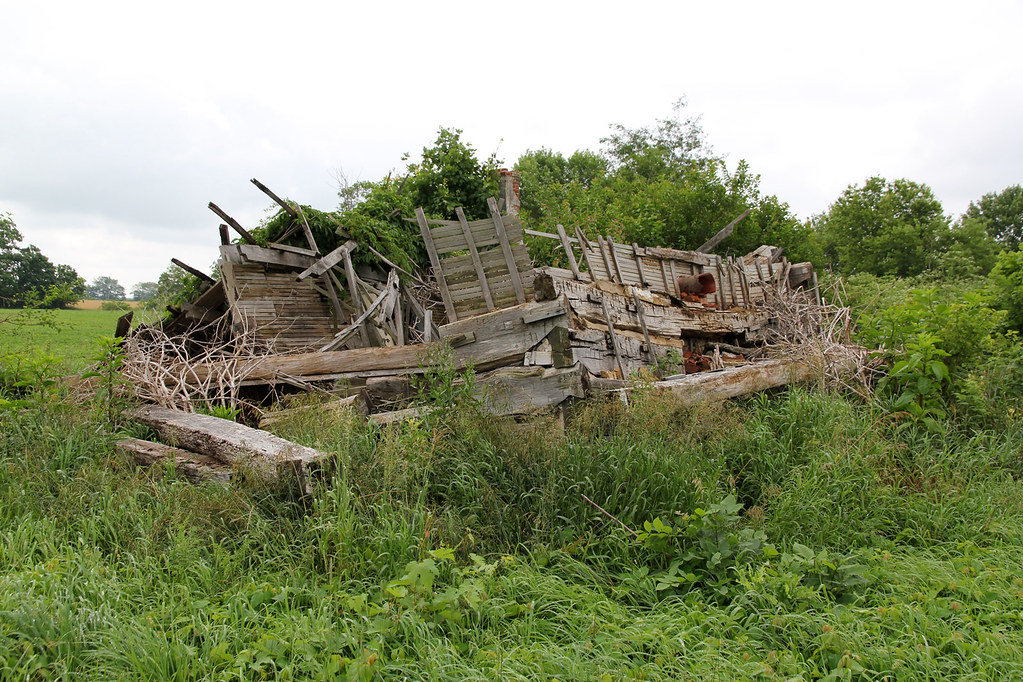
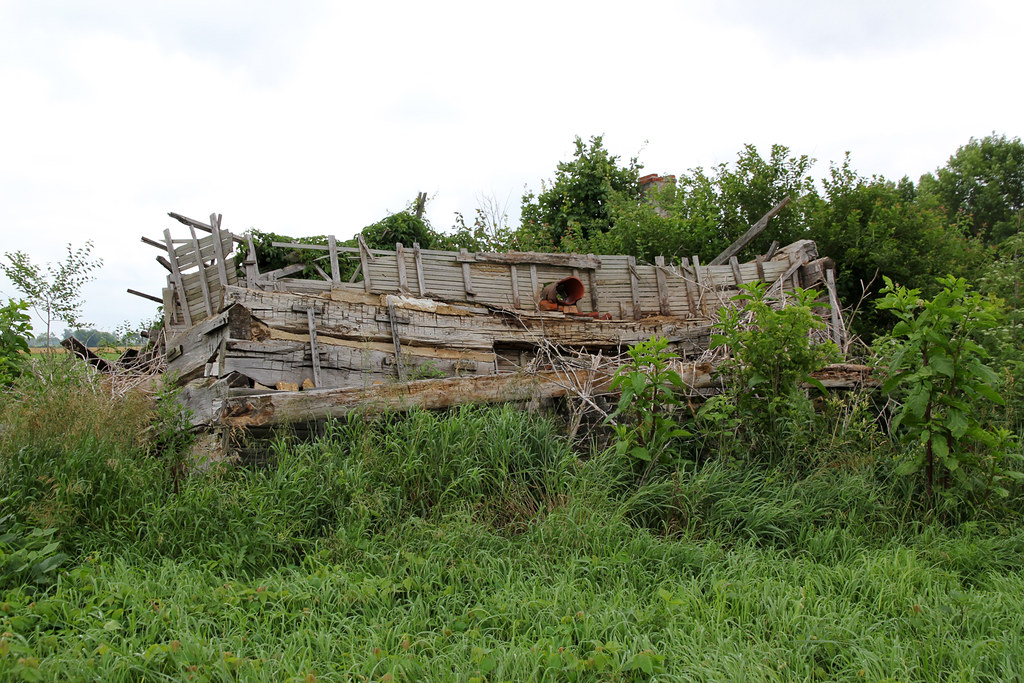
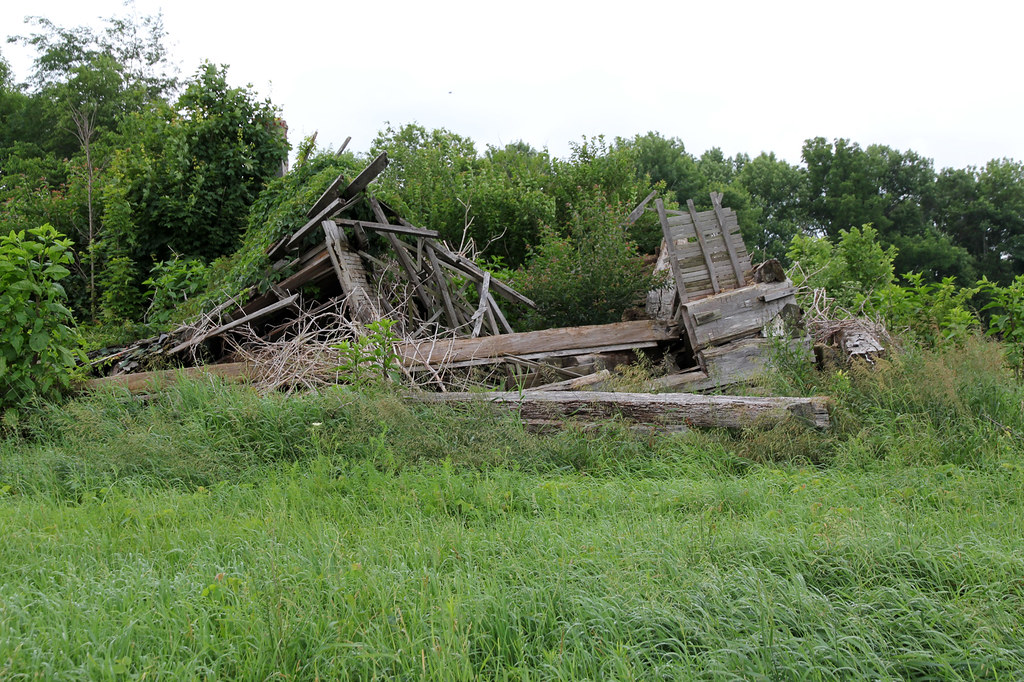
In south-central Fayette County, Ohio, near the unincorporated community of Buena Vista, lie the ruins of a small log home; the structure remained standing, albeit precariously, until at least 2012.

Its history is somewhat mysterious; the 1875 Illustrated Historical Atlas of Fayette County, Ohio, omits the home. Perhaps it was moved from another locality.

George W. Binegar (18271886); a native of Virginia, like most of the county's early residents; owned the 30-acre property in 1875. By 1913, ownership had passed to one R. Jones (either Randolph or Robert), who farmed a mere ten acres.


Though diminutive, the building was well-built. Note the steeple notching, intact daubing, firebox opening, and clay pipe (for an interior stove, which replaced the fireplace). The firebox itself, barely visible, is of stone construction; the chimney was brick. A partition wall divided the plastered interior into two rooms of equal size.


Vacant, little-modified log buildings, many abandoned during and shortly after the Great Depression, weren't an uncommon sight in post-World War II Ohio. Most of these homes, alas, have disappeared; the majority of Ohio's extant log structures remain occupied, with substantial alterations.

Sunday, May 31, 2015

Knoles Log House

Chillicothe, Ross County, Ohio


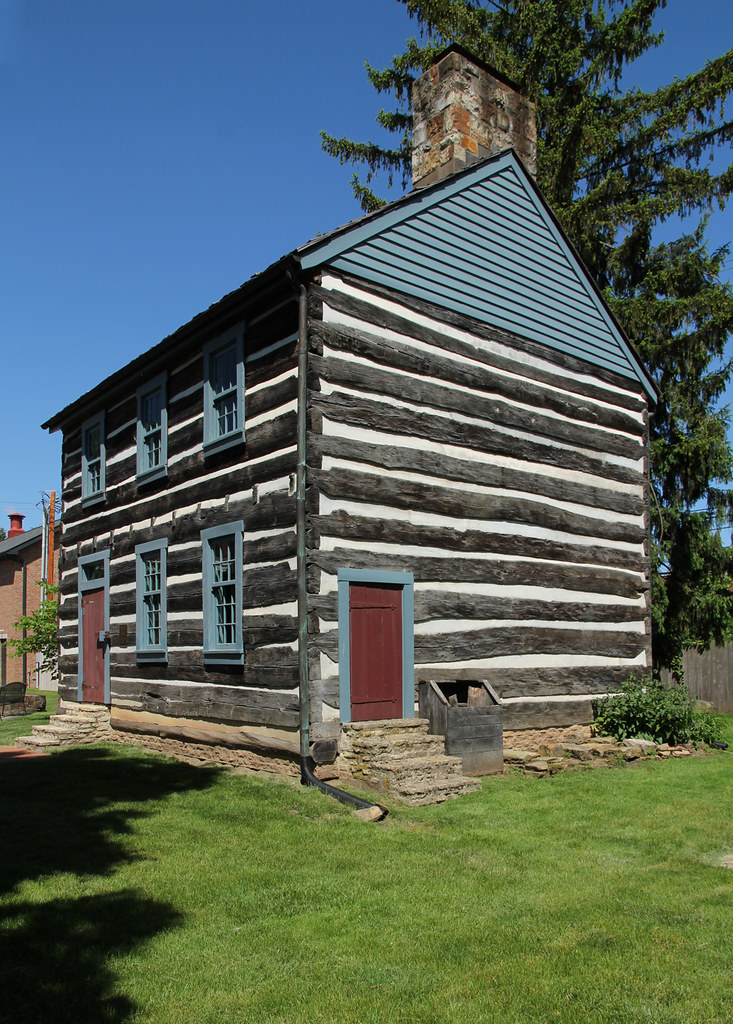
William Knoles, born in Delaware in 1795, likely commissioned this house about 1820. Evidently, Knoles' dwelling was well-known; the 1917 Standard History of Ross County, Ohio mentions "a substantial hewed log house, which has been weatherboarded on the outside, and ceiled on the inside, and now forms a part of the house occupied by [Charles W. Knoles, William's grandson] and his family."

Originally, the house fronted Southern Avenue, just south of its intersection with East 11th Street (an industrial complex now occupies the site). In the 1970s or 1980s, it was moved to the foot of Adena hill. Another relocation occurred in 1992; currently, the home sits behind the Ross County Historical Society museum.

The structure at its second site. Photo by Brian Hackett (?), August 1990, from the Donald Hutslar collection; used courtesy of Jean Hutslar.
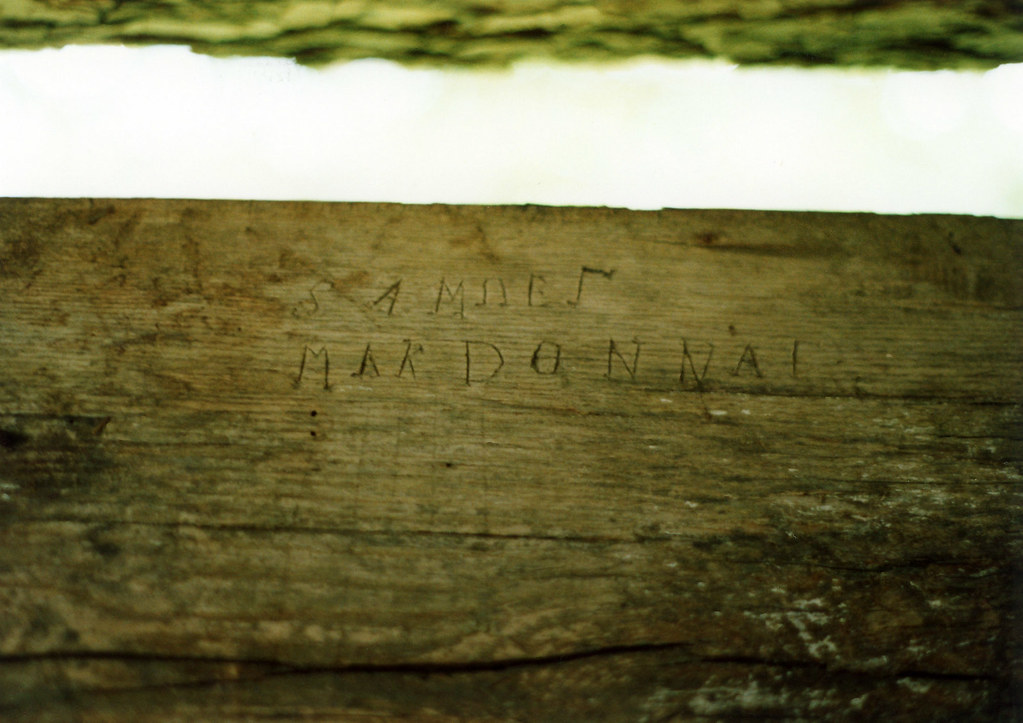
A revealing inscription; presumably, MakDonnal constructed this house for William Knoles. In the 19th century, as now, many better-finished homes were the work of skilled carpenters, rather than owner-builders.

Why Samuel spelled his name "MakDonnal," rather than "McDonnal" or "M'Donnal" (the latter variant was common during the 19th century), is unclear, as is his inversion of the U and L in "Samuel."
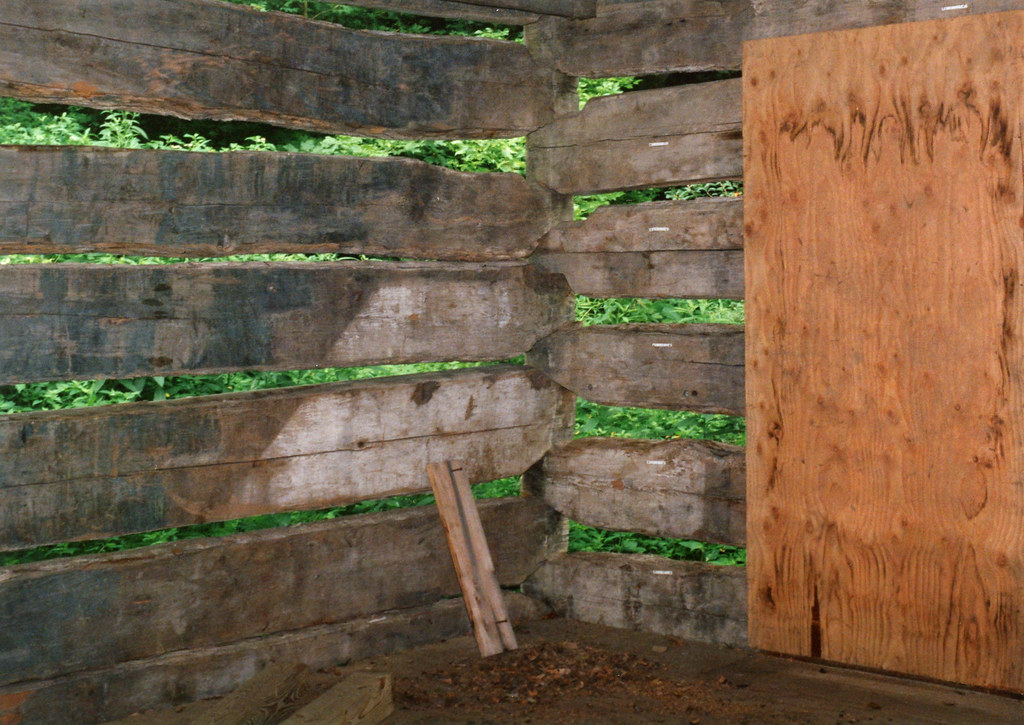
The former stairway's location is obvious. Photo by Brian Hackett (?), August 1990, from the Donald Hutslar collection; used courtesy of Jean Hutslar.
Quite a solidly constructed home, with its large logs and well-handled steeple notching. Evidently, the chimney always existed on the interior.
An unusual treatment; sills are typically squared on all sides.

Tuesday, March 17, 2015

A Double Pen Log House

Ross County, Ohio

Reportedly, this building stood in the Paint Creek valley between Chillicothe and Bainbridge; its precise location, alas, remains a mystery. During a telephone conversation, Donald Hutslar mentioned rumors of a double pen log house in the vicinity of Chillicothe; perhaps this is that structure.

Photos from Log Cabins & Castles: Virginia Settlers in Ohio, produced in 1991 by Ohio Landscape Productions; depicted is Hubert Wilhelm, formerly a professor of geography at Ohio University. Note the whitewashed interior logs.

In central Ross County, at least three other double pen homes survived into the 20th century: the 1828 McConnell residence (presently the Chillicothe Country Club), the now-abandoned Thomas House, and a Huntington Township dwelling (depicted in The Architecture of Migration) which burned in the 1930s.

Saturday, November 15, 2014

Cutright Log House

Twin Township, Ross County, Ohio


A well-built log dwelling of average size (26' by 18'). About a year-and-a-half ago, I identified this building (then sided) as a possible log structure because of its proportions and fenestration; imagine my delight as I first glimpsed the home, stripped of siding, with logs exposed!

The 1860 map and 1875 atlas list Camden Cutright (18191896) as this farm's owner. Camden's father, John, was an early resident of Springfield Township, visiting Ross County with Nathaniel Massie in 1796. Whether Camden erected or purchased the log house is unknown.

Until recently, the log portion and addition were linked by an interesting late Victorian porch.
Standard steeple notching. Note the log damage, required to maintain flush siding, around the furring strips.
The fireplace opening (for an exterior chimney, now removed) is sealed with sandstone (?) blocks. Note the whitewashed logs. The plates overhang the walls, forming a box cornice; oddly, these plates do not rest on extended side logs, but appear to be mortised into side logs running above the plates. I don't know how common this variant is.

Tuesday, October 21, 2014

Scheer Log House

Salem Township, Warren County, Ohio

Southeast elevation.

Double pen log houses are exceptionally rare in Ohio. Though this configuration  two log pens placed perpendicularly, forming an "L"  appears frequently in Kentucky, only a handful of similar buildings stand in Ohio. It seems that Ohioans preferred constructing additions of frame, not log.

The northernmost (front) pen, likely older, measures 23' by 20', while the rear pen is 15' by 18'. A five-foot "breezeway" separates the pens. The front portion's logs average 12" in height and 6" in depth, while the logs comprising the rear section are slightly smaller, about 10" in height.

I know little about the building's history; a defunct Warren County Historical Society webpage provided a construction date of 1803, certainly feasible given the region's early settlement. The 1882 History of Warren County, Ohio mentions one possible origin:
The original Miranda farm embraced 200 acres, including the village of Morrow, a part of East Morrow, the Miranda burying ground (now a part of the cemetery), and the land where the brewery now stands, which was known as 'the old Wilson farm.'
In 1854, John Scheer purchased the property and erected the adjacent stone brewery, now ruined. Scheer immigrated from Germany in 1844, first settling in Cincinnati; apparently, "he [abhorred] drunkenness" and was "a generous, wholesouled man, [who] never turned the cold shoulder in case of charity."

Front (northeast) elevation. With its tall foundation and rotted sill, the house's survival is a miracle.
A large, well-constructed exterior chimney.
Note the discontinuous foundation. The two pens were likely constructed at different times.
Relatively intact; the enclosed corner staircase turns toward the former fireplace opening.
One joist, simply a round trunk notched at both ends, remains. This joist is an exquisite candidate for dendrochronological dating.
The rear pen. Unfortunately, renovations have stripped this room of its woodwork. Note the "breezeway" steps, required because of the offset between the pens' foundations. Both vertical board doors may be original.
This door opening was enlarged; note the original jamb board, visible to the door's left.
Stones and wood slabs are by far the most common chinking materials seen in Ohio. Less frequently, gaps are sealed with long wooden strips, occasionally described as "logs between logs." Once, Donald Hutslar encountered a building chinked with pieces of furniture.
A standard method of support, with logs pegged to the jamb board. Note the haphazard tenon placement.
This plate slightly overhangs the wall.

Sunday, October 19, 2014

Clarridge Log House

Pleasant Township, Madison County, Ohio


One of few log homes extant in southeastern Madison County, and possibly a relocated building. The 1862 map marks no structures at this location, then owned by William J. Creath; Creath's residence stood to the north, on the west side of modern State Route 56. By 1875, ownership had passed to David M. Clarridge (18341913), a corporal in the 30th Ohio Infantry. The 1875 atlas omits Creath's dwelling and indicates the depicted building; perhaps, the two are the same structure, moved between 1862 and 1875.

Southeast elevation. Note the attached brick outbuilding (summer kitchen?).
This steeple notching is somewhat crudely handled, with enormous gaps between logs. The bottom side wall log is missing entirely.
Logs sheltered by porch; facade. Evidently, these logs were exposed and painted prior to the porch's construction.
The uppermost (plate?) log appears to simply rest atop the log below, without notching.
The hewed joists may be original.
The staircase  likely a replacement  stands in the historically correct location, turning toward the fireplace. The mantel, too, is perhaps unoriginal (though I must confess, I'm no mantel expert); a later renovation sealed it with bricks.
Finally, a floor plan.