Showing posts with label double pen. Show all posts

Friday, January 12, 2018

The Cluxton Log House

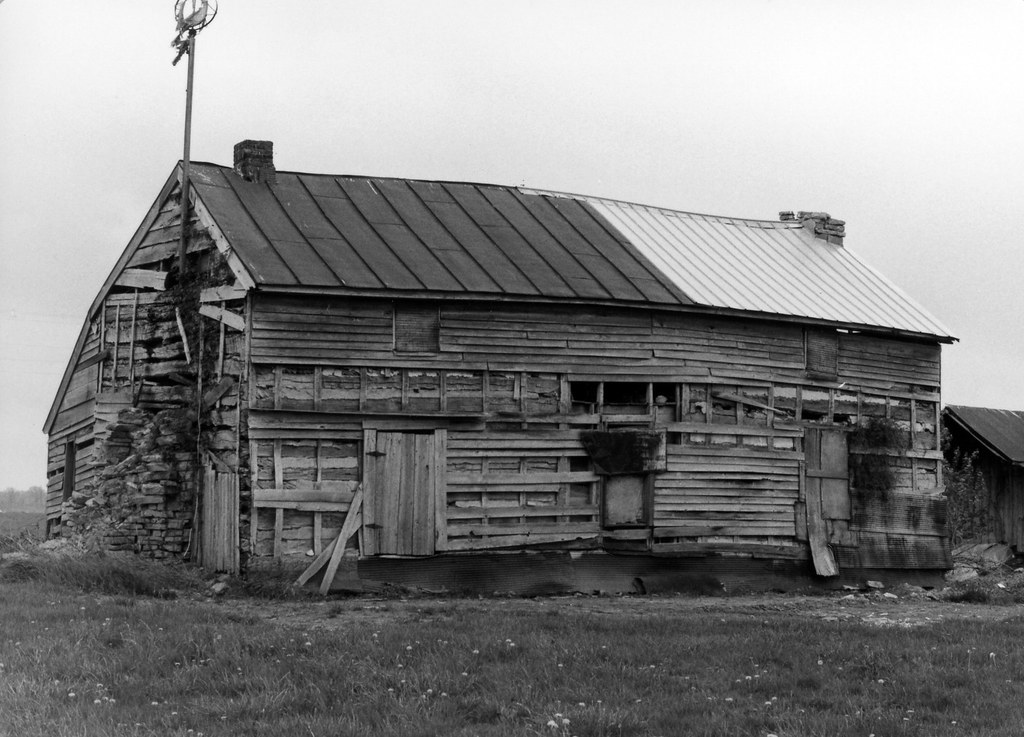
Unlike Kentucky, Tennessee, and other states south of the Ohio River and west of the Appalachians, Ohio boasts relatively few double-pen log buildings. (For those unversed in the arcane art of log-divining, a double-pen building is one which contains two structurally independent units, or pens.*) One of the Buckeye State's finest double-pen dwellings stood, appropriately enough, in one of its most "Southern" counties (geographically and culturally) — Adams — just north of West Union, the county seat. Nestled among billowing pastureland within an agriculturally deficient region known, historically, as the "white oak barrens," the house languished in obscurity and decrepitude until Stephen Kelley, president of the Adams County Historical Society, photographed it in 1977. Kelley's images found their way into Donald Hutslar's hands, and thence into two books (this and this). It's scarcely surprising, then, that state and national surveys of historic buildings neglected to include it — and shall always neglect to include it, since the house disappeared in the 1990s.

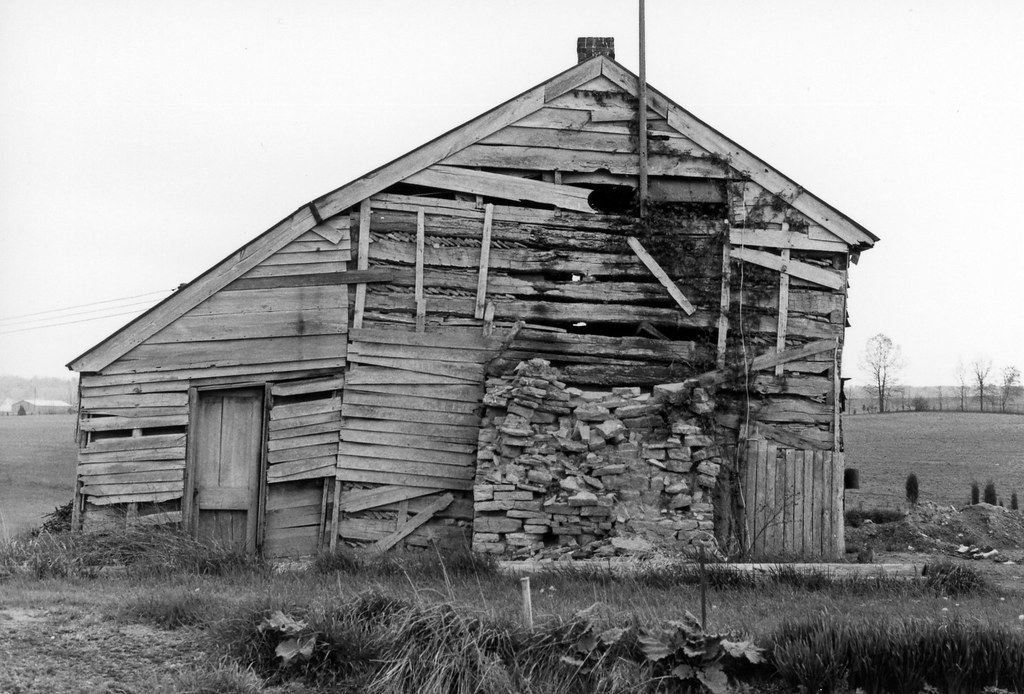
The house's front (northwest) elevation. Image by Stephen Kelley, 1977, from the collection of Donald and Jean Hutslar.

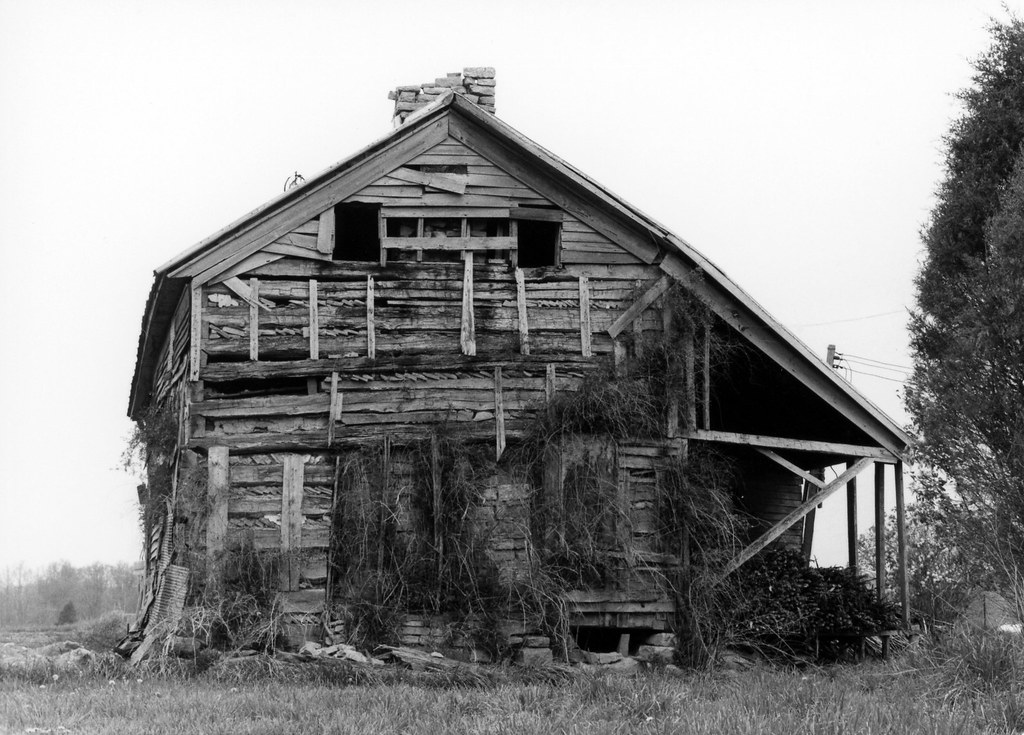
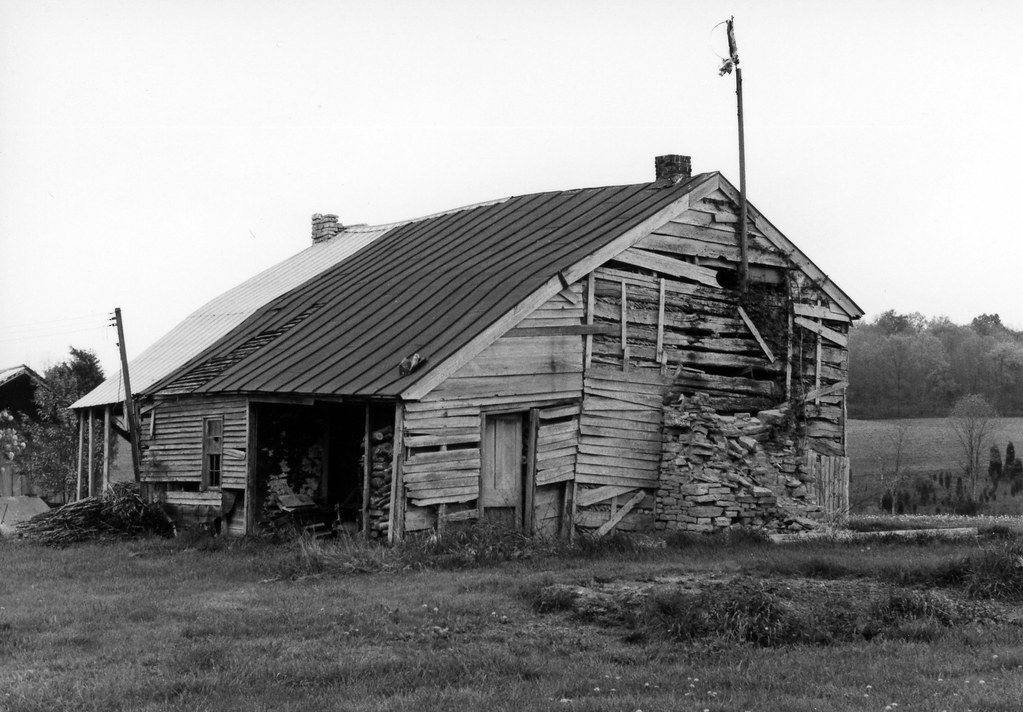
The home was an utterly classic double-pen structure — precisely the sort of building I'd expect to find within the earlier-settled portions of the Upland South. It made use of two one-and-a-half-story pens, each constructed of steeple-notched logs and adorned with a single window opening. It featured two massive rubble-stone chimneys — one exterior, and one interior (with an exposed firebox). In all likelihood, the passage between the pens was always enclosed (unlike in the case of the archetypal "dogtrot" house), and the braced-frame rear rooms, which lent the structure a "saltbox" roofline, might have been planned at the time of construction.
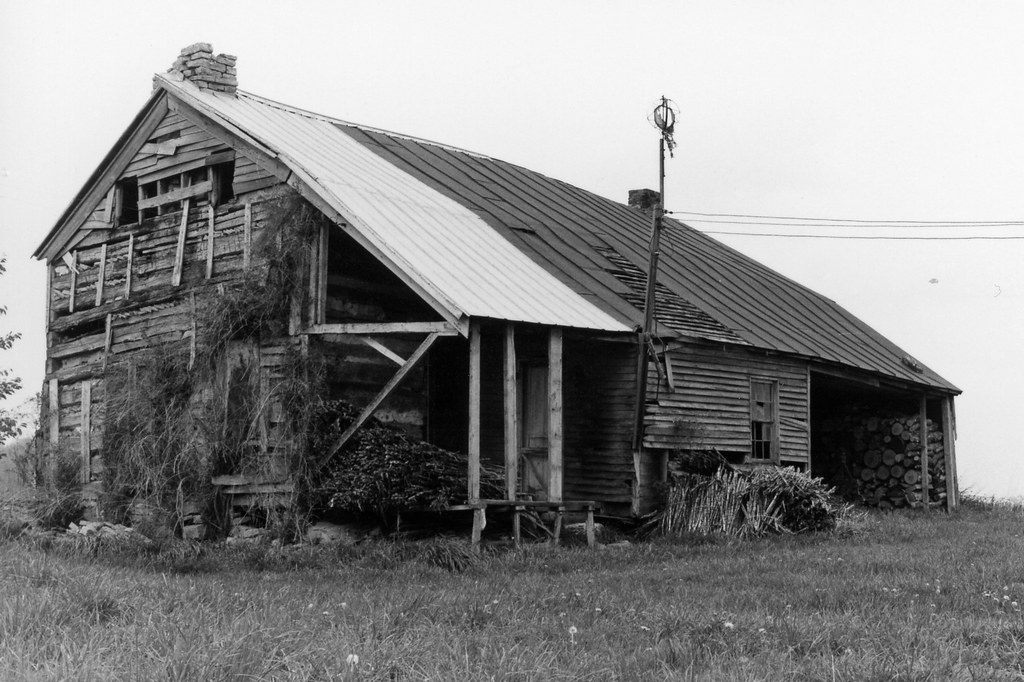
The rear (southeast) and side elevations. Note the square attic windows, rake boards, and cantilevered porch framing. I must say, I'm a bit baffled by the pole-mounted hoop. Was it a DIY television antenna? A massive dream-catcher? A homing device for extraterrestrial spacecraft?

Kelley, it seems, failed to photograph the interior, but he did have the foresight to sketch a floor plan, which I've adapted into a proper CAD rendering.
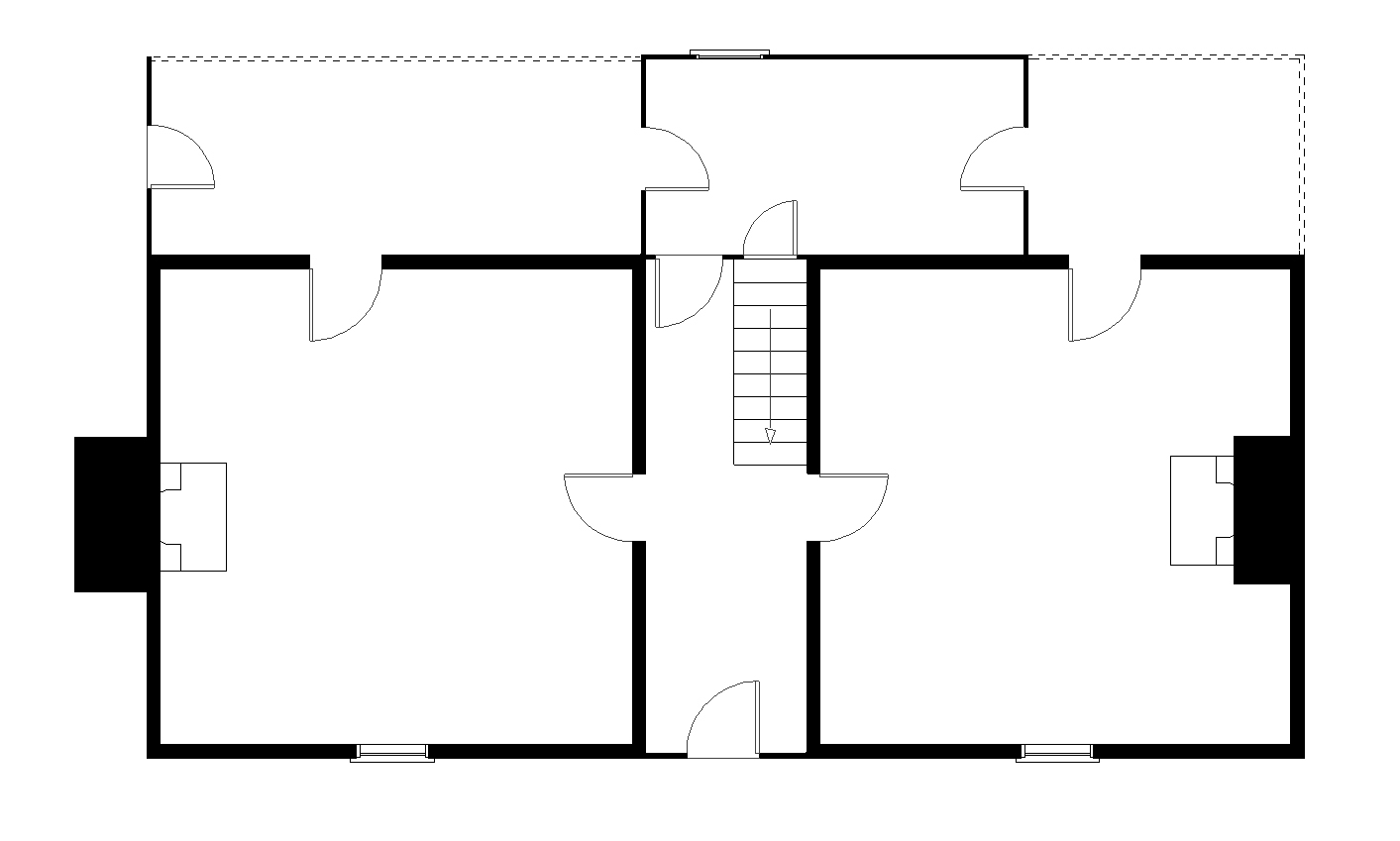

In some ways, the house's oddest feature was its staircase. More often than not, early inhabitants of Ohio's southern half jammed their stairways into the space between the fireplace and exterior wall. This house's builder, by contrast, placed the staircase within the "breezeway," but left it accessible only from the home's rear room. This suggests two possibilities — that (a) the building underwent a massive interior remodeling sometime in the nineteenth century, or that (b) the frame rear portion and the log pens were contemporaneous. Either possibility seems perfectly likely.

Dating the house is a tricky affair. Given its existence in Adams County, site of some of Ohio's earliest permanent settlements, it could have been a statehood-era structure. Then again, its placement on less-than-desirable land may mark it as a late survival of archaic building techniques. Tracing its ownership, alas, provides few answers. In 1880, it belonged to one S.P. Cluxton — perhaps Samuel Page Cluxton (b. 1838), a middle-aged farmer of Scots-Irish descent. It's unlikely that Samuel built or inherited the house; if mid-century census data is any indication, members of the Cluxton family lived exclusively in nearby Liberty Township, and their first place of settlement was the Brush Creek valley, several miles distant. (ApparentlyCluxton is a variant of Clugston, a "habitational name from the barony of Clugston in Wigtownshire," Scotland.)

So, the house's origin will remain a mystery — at least, until someone pays a visit to Adams County's courthouse and slogs through nineteenth-century tax records. I'll end my post with a rendering of how the house may have appeared in better days.
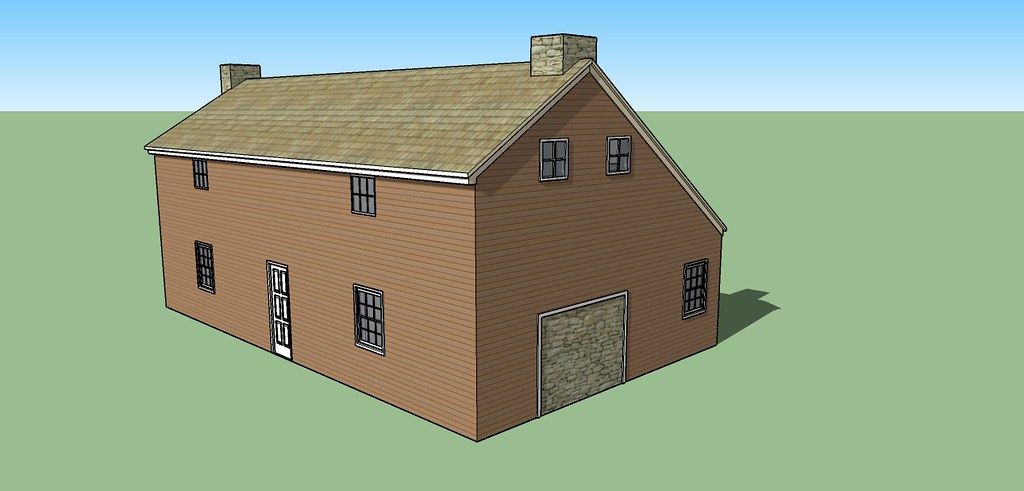
The house reconstructed in SketchUp, from the floor plan pictured above.

* Like all definitions, this one is subject to exception. Some of Ohio's seeming double-pen buildings — Brown County's Erastus Atkins House, for instance — are, in reality, unified structures whose rooms are divided by interlocked log walls.

Friday, October 30, 2015

Overhanging Plates, Again

I've penned a few posts about the mysterious overhanging plate, which, though common in the Upper South and Midwest, remains largely unstudied. Last month, while idling in my college's library, I discovered an early (1952) mention of the overhanging plate in Hugh Morrison's Early American Architecture. On page 168, Morrison writes:
The topmost logs at the ends of the cabin were projected to carry the wall plate forward, thus offering a modicum of protection from rain to the lower wall.
This "cabin" (truly a log house of "saddlebag" plan) stood in Caldwell County, North Carolina, near Blowing Rock. In 1938, Frances Benjamin Johnston photographed the home, then inhabited by one Mrs. Mary Gregg, for her Carnegie Survey of Architecture of the South.

Photo, 1938, by Frances B. Johnston, from the Carnegie Survey of Architecture of the South. Scanned by the Library of Congress.

In Early American Architecture, Morrison suggests the overhanging plate exists to shelter walls from rain, a theory equally plausible as mine (that the overhanging plate evolved from the butting pole). Of course, neither conjecture is provable.

The Gregg residence's logs were unusually well-handled; if I knew no better, I'd describe them as "circular-sawed."

Note the steeple notching, closely-fitted logs, and overhanging plate. The chamfered side log is standard.

Tuesday, March 17, 2015

A Double Pen Log House

Ross County, Ohio

Reportedly, this building stood in the Paint Creek valley between Chillicothe and Bainbridge; its precise location, alas, remains a mystery. During a telephone conversation, Donald Hutslar mentioned rumors of a double pen log house in the vicinity of Chillicothe; perhaps this is that structure.

Photos from Log Cabins & Castles: Virginia Settlers in Ohio, produced in 1991 by Ohio Landscape Productions; depicted is Hubert Wilhelm, formerly a professor of geography at Ohio University. Note the whitewashed interior logs.

In central Ross County, at least three other double pen homes survived into the 20th century: the 1828 McConnell residence (presently the Chillicothe Country Club), the now-abandoned Thomas House, and a Huntington Township dwelling (depicted in The Architecture of Migration) which burned in the 1930s.

Tuesday, October 21, 2014

Scheer Log House

Salem Township, Warren County, Ohio

Southeast elevation.

Double pen log houses are exceptionally rare in Ohio. Though this configuration  two log pens placed perpendicularly, forming an "L"  appears frequently in Kentucky, only a handful of similar buildings stand in Ohio. It seems that Ohioans preferred constructing additions of frame, not log.

The northernmost (front) pen, likely older, measures 23' by 20', while the rear pen is 15' by 18'. A five-foot "breezeway" separates the pens. The front portion's logs average 12" in height and 6" in depth, while the logs comprising the rear section are slightly smaller, about 10" in height.

I know little about the building's history; a defunct Warren County Historical Society webpage provided a construction date of 1803, certainly feasible given the region's early settlement. The 1882 History of Warren County, Ohio mentions one possible origin:
The original Miranda farm embraced 200 acres, including the village of Morrow, a part of East Morrow, the Miranda burying ground (now a part of the cemetery), and the land where the brewery now stands, which was known as 'the old Wilson farm.'
In 1854, John Scheer purchased the property and erected the adjacent stone brewery, now ruined. Scheer immigrated from Germany in 1844, first settling in Cincinnati; apparently, "he [abhorred] drunkenness" and was "a generous, wholesouled man, [who] never turned the cold shoulder in case of charity."

Front (northeast) elevation. With its tall foundation and rotted sill, the house's survival is a miracle.
A large, well-constructed exterior chimney.
Note the discontinuous foundation. The two pens were likely constructed at different times.
Relatively intact; the enclosed corner staircase turns toward the former fireplace opening.
One joist, simply a round trunk notched at both ends, remains. This joist is an exquisite candidate for dendrochronological dating.
The rear pen. Unfortunately, renovations have stripped this room of its woodwork. Note the "breezeway" steps, required because of the offset between the pens' foundations. Both vertical board doors may be original.
This door opening was enlarged; note the original jamb board, visible to the door's left.
Stones and wood slabs are by far the most common chinking materials seen in Ohio. Less frequently, gaps are sealed with long wooden strips, occasionally described as "logs between logs." Once, Donald Hutslar encountered a building chinked with pieces of furniture.
A standard method of support, with logs pegged to the jamb board. Note the haphazard tenon placement.
This plate slightly overhangs the wall.

Saturday, September 6, 2014

What *is* a Log House?

The following is adapted from a yet-unfinished survey report about log construction in Ohio.

A log house, at its most basic, is simply an inhabitable building which derives its structural support from timbers stacked atop one another and notched at the ends.* All log buildings include one or more pens, or self-­supported structures, often enclosing a single room. The designation of a pen as self­-supported is important, for quite a few log buildings contain “crosswalls,” composed of logs running perpendicular to the exterior walls, forming interior divisions. These crosswalls merely interlock with the exterior logs and, though they contribute structural support, they do not form self­-supported units. A large log house, 30 feet by 18 feet and divided by a crosswall, is a single pen — not a double pen  structure.

The arrangement of log pens within a building was limited only by a builder’s imagination and financial situation; understandably, Ohio being in the midst of settlement at the peak of log construction’s national popularity, the state is dominated by single pen houses. Double pen buildings exist in Ohio, no doubt, but are not nearly as common as in earlier-­settled states, like Kentucky or Virginia. I know of no Ohio buildings larger than two pens, though a few could exist.

* A more inclusive definition, befitting the peculiar “corner post” log house, is: “A building whose walls’ planar surfaces are composed primarily of timbers.”

Wednesday, September 3, 2014

A "Saddlebag" Log House!

Hazelwood (formerly Sycamore Township), Hamilton County, Ohio

The house.
At the suburban fringe of Cincinnati, in the midst of railroad tracks and 1970s-era infill, stands this proper "saddlebag" log house. I'm aware of merely four extant "saddlebag" log structures in Ohio, this home included; the others stand at Caesar's Creek Pioneer Village, near Waynesville, and in Tiffin Township, Adams County. Of those, only two are complete, for half the Hawkins house was lost in the mid-20th century.

When I began my survey of log architecture, more than three years ago, I hoped to encounter some great, undocumented example of a rare building type, but, alas, I did not. Until March of 2014.

The Miami Purchase Association's survey of Hamilton County overlooked the house, and, to the best of my knowledge, I was the first individual to recognize its significance. Currently, it is both vacant and listed for sale.

The northern pen (nearest the camera) is a bit taller than the southern pen; the two may not be contemporaneous. Note the prominent overhanging plates.
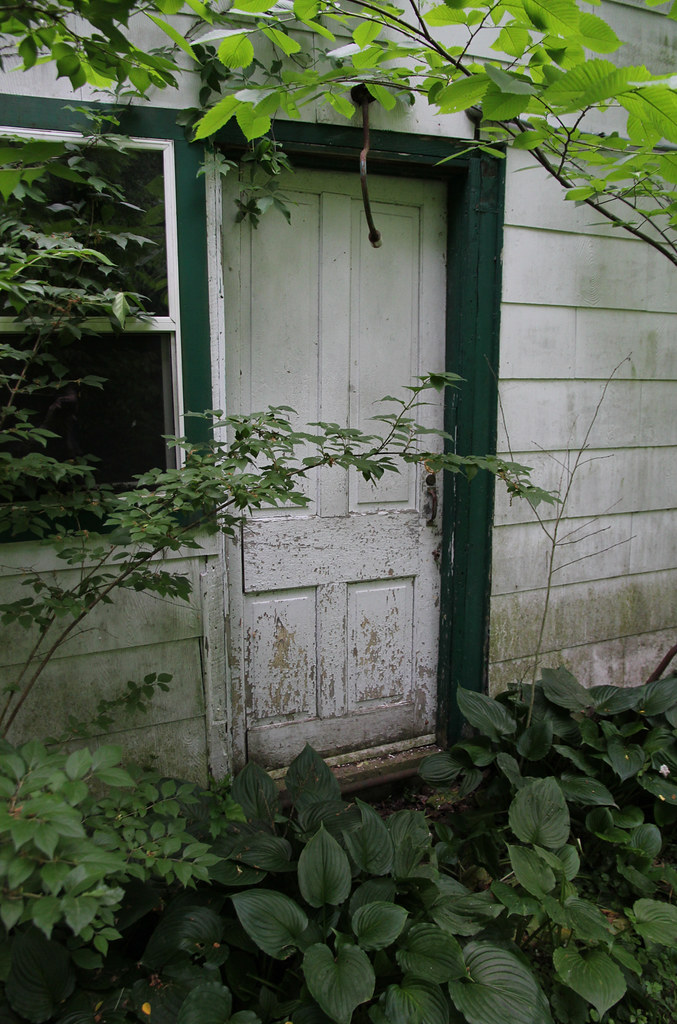
The home's oldest remaining door  historic, but not original.
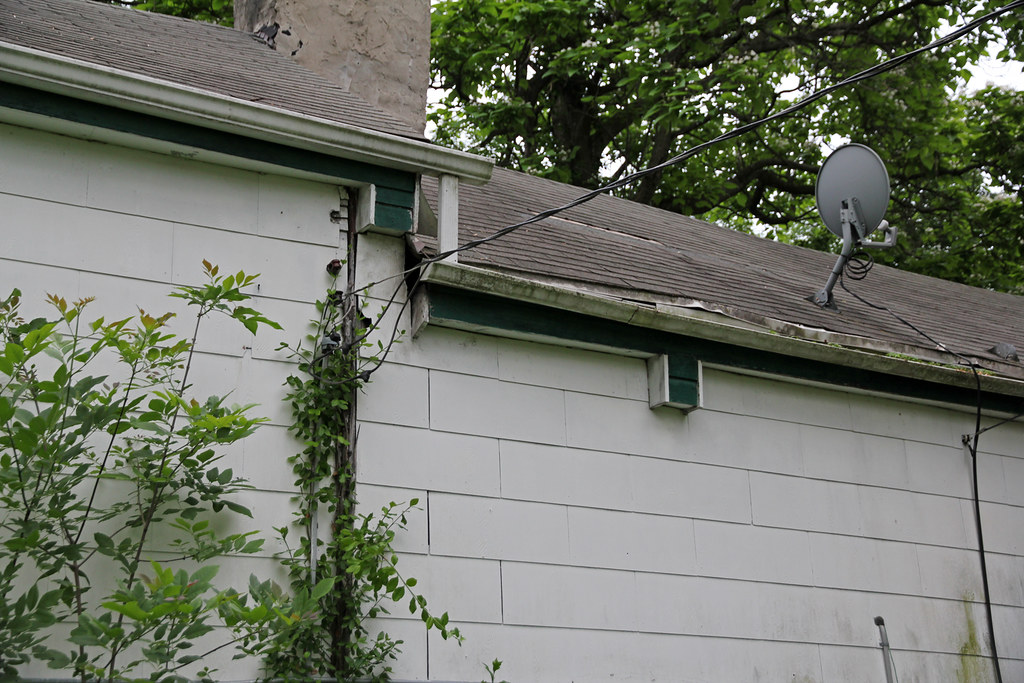
The shorter (south) pen's plates extend past the walls to support the roof; evidently, the space between the pens and chimney was always sheltered.
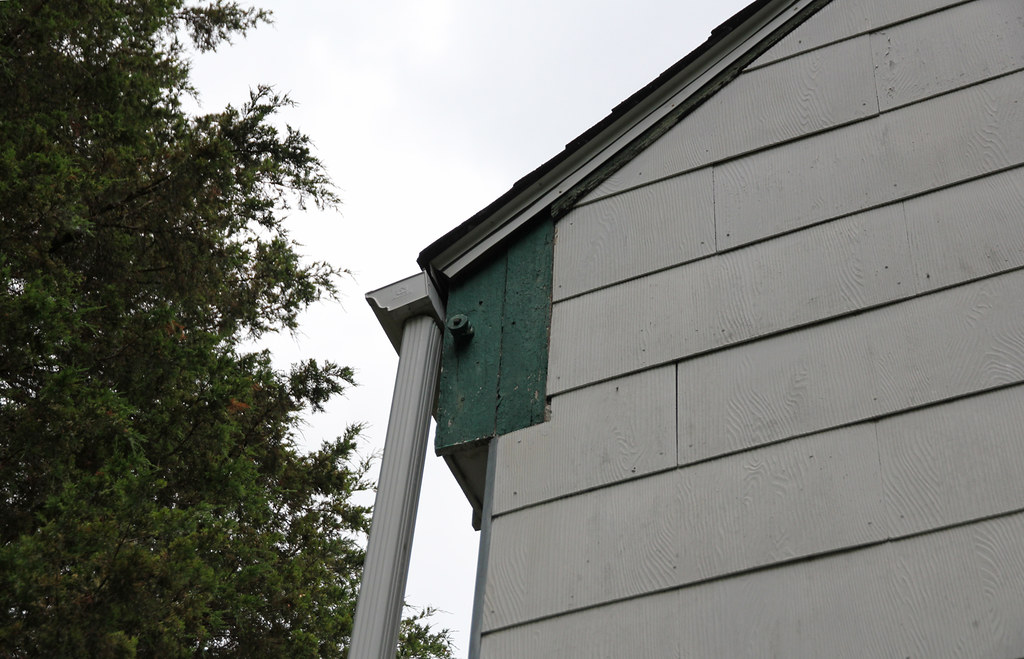
Odd. The plate appears to be pinned to its supporting log (unless, of course, the protruding object is related to electrical wiring; a vestige of WPA-era rural electrification, perhaps).
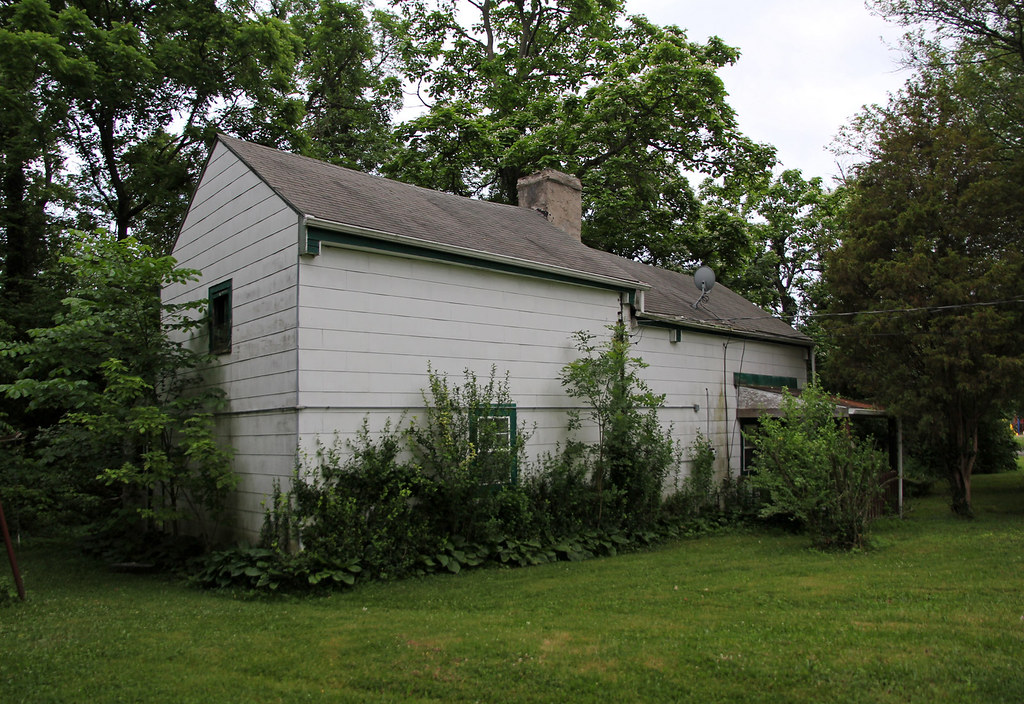
The missing asbestos siding reveals wood clapboards and a side wall log (or joist).
The 1847 and 1856 maps list A. Miller as the 160-acre property's owner. By 1869, ownership had passed to Thomas H. Smith, who sold his farm in 1888; at this time, the property was subdivided and christened "Hazelwood."

The house's precise construction date is unclear. It is, no doubt, a very early building, likely dating to the first decades of the 19th century, or possibly earlier ("ca. 1800" is not an unreasonable conjecture).