Sunday, October 19, 2014

Clarridge Log House

Pleasant Township, Madison County, Ohio


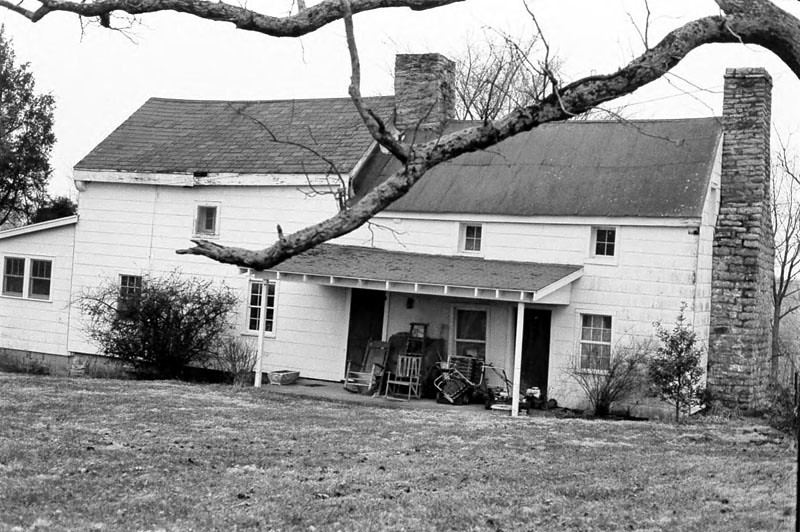
One of few log homes extant in southeastern Madison County, and possibly a relocated building. The 1862 map marks no structures at this location, then owned by William J. Creath; Creath's residence stood to the north, on the west side of modern State Route 56. By 1875, ownership had passed to David M. Clarridge (18341913), a corporal in the 30th Ohio Infantry. The 1875 atlas omits Creath's dwelling and indicates the depicted building; perhaps, the two are the same structure, moved between 1862 and 1875.

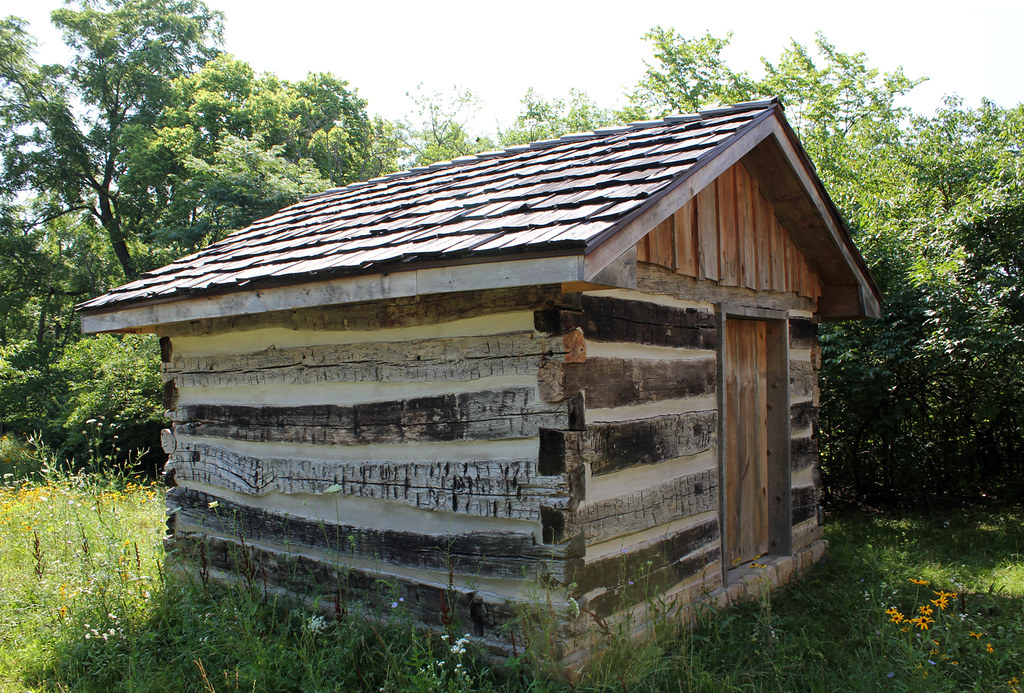
Southeast elevation. Note the attached brick outbuilding (summer kitchen?).
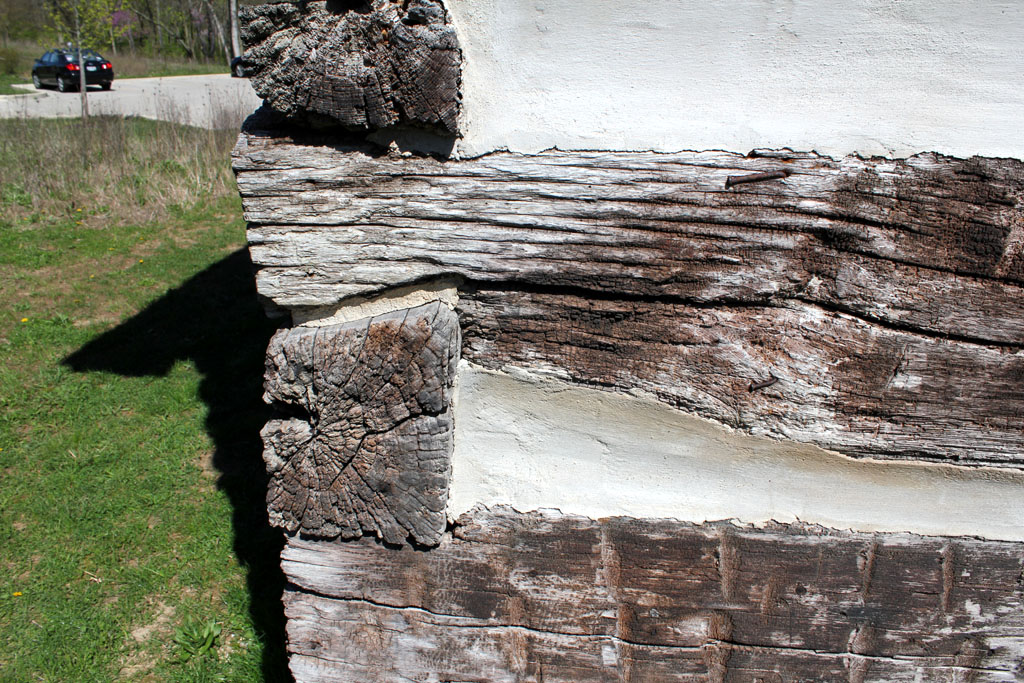
This steeple notching is somewhat crudely handled, with enormous gaps between logs. The bottom side wall log is missing entirely.
Logs sheltered by porch; facade. Evidently, these logs were exposed and painted prior to the porch's construction.
The uppermost (plate?) log appears to simply rest atop the log below, without notching.
The hewed joists may be original.
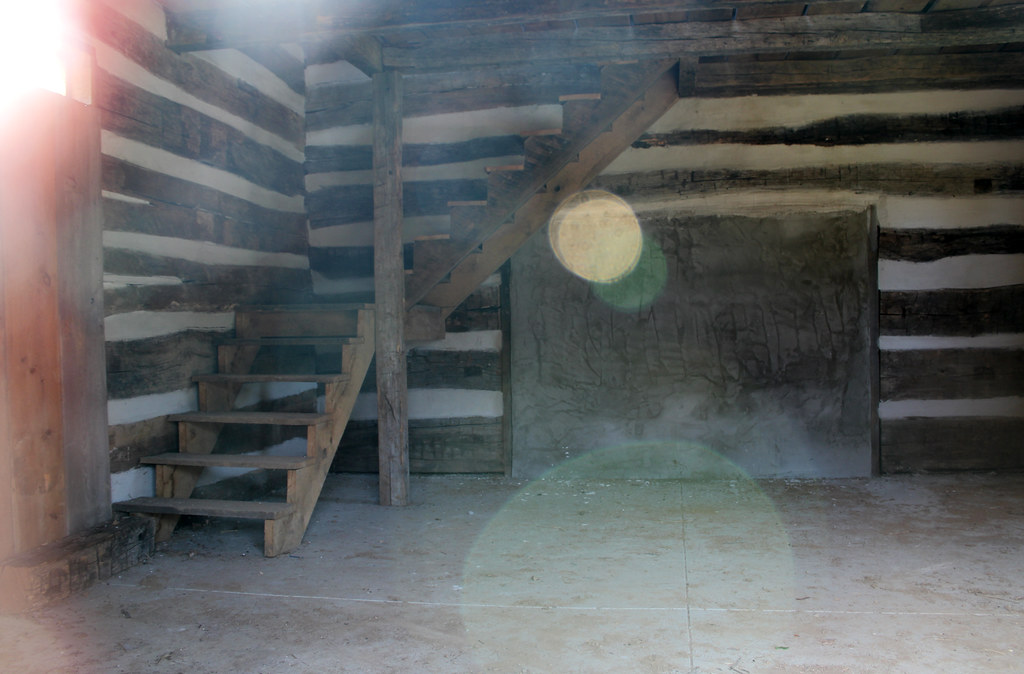
The staircase  likely a replacement  stands in the historically correct location, turning toward the fireplace. The mantel, too, is perhaps unoriginal (though I must confess, I'm no mantel expert); a later renovation sealed it with bricks.
Finally, a floor plan.


Sunday, September 21, 2014

Alexander Davis Log House

Washington Township, Franklin County, Ohio


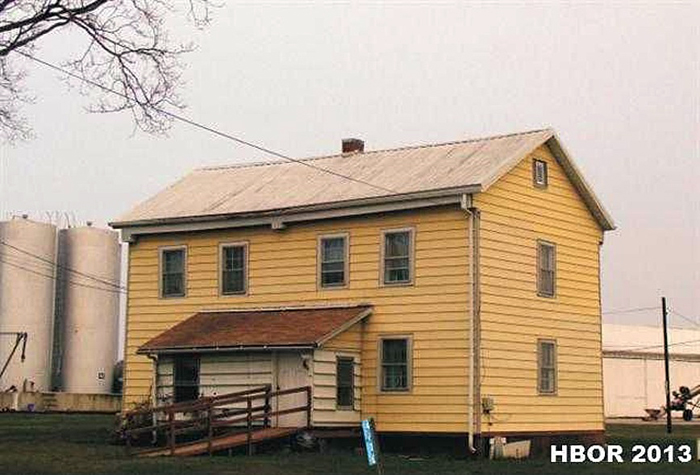
An utterly nondescript building; if forced to illustrate the "standard" Ohio log home, I'd use this structure as an example. Until 2007, 2008, or 2009, it stood behind a late Victorian farmhouse at 5436 Dublin Road, just south of Tuttle Road.

The house, as it appeared in the 1890s (?). Note the exposed logs above the porch roof, and the log springhouse, visible at right. Photo courtesy of Ohio Memory, from the Dublin Historical Society collection.
Alexander Davis, member of a venerable local family, likely erected the home in the 1830s (some sources provide a construction date of 1806; unlikely, given the notching technique). Two remodels, in the 1940s and 1990s (?), destroyed most of the remaining fabric.

The house is notable, in part, because it has survived, and because it remains paired with its outbuilding. Extant settlement-era farm complexes are very rare in Ohio.

The springhouse.
The building is a but a shell, its interior devoid of finish detailing. The open staircase, though likely placed in the correct location, is historically inaccurate and ill-proportioned. No doubt, a mantel framed the fireplace opening.
Half-dovetail notching.

Saturday, September 6, 2014

What *is* a Log House?

The following is adapted from a yet-unfinished survey report about log construction in Ohio.

A log house, at its most basic, is simply an inhabitable building which derives its structural support from timbers stacked atop one another and notched at the ends.* All log buildings include one or more pens, or self-­supported structures, often enclosing a single room. The designation of a pen as self­-supported is important, for quite a few log buildings contain “crosswalls,” composed of logs running perpendicular to the exterior walls, forming interior divisions. These crosswalls merely interlock with the exterior logs and, though they contribute structural support, they do not form self­-supported units. A large log house, 30 feet by 18 feet and divided by a crosswall, is a single pen — not a double pen  structure.

The arrangement of log pens within a building was limited only by a builder’s imagination and financial situation; understandably, Ohio being in the midst of settlement at the peak of log construction’s national popularity, the state is dominated by single pen houses. Double pen buildings exist in Ohio, no doubt, but are not nearly as common as in earlier-­settled states, like Kentucky or Virginia. I know of no Ohio buildings larger than two pens, though a few could exist.

* A more inclusive definition, befitting the peculiar “corner post” log house, is: “A building whose walls’ planar surfaces are composed primarily of timbers.”

Wednesday, September 3, 2014

A "Saddlebag" Log House!

Hazelwood (formerly Sycamore Township), Hamilton County, Ohio
The house.
At the suburban fringe of Cincinnati, in the midst of railroad tracks and 1970s-era infill, stands this proper "saddlebag" log house. I'm aware of merely four extant "saddlebag" log structures in Ohio, this home included; the others stand at Caesar's Creek Pioneer Village, near Waynesville, and in Tiffin Township, Adams County. Of those, only two are complete, for half the Hawkins house was lost in the mid-20th century.

When I began my survey of log architecture, more than three years ago, I hoped to encounter some great, undocumented example of a rare building type, but, alas, I did not. Until March of 2014.

The Miami Purchase Association's survey of Hamilton County overlooked the house, and, to the best of my knowledge, I was the first individual to recognize its significance. Currently, it is both vacant and listed for sale.
The northern pen (nearest the camera) is a bit taller than the southern pen; the two may not be contemporaneous. Note the prominent overhanging plates.
The home's oldest remaining door  historic, but not original.
The shorter (south) pen's plates extend past the walls to support the roof; evidently, the space between the pens and chimney was always sheltered.
Odd. The plate appears to be pinned to its supporting log (unless, of course, the protruding object is related to electrical wiring; a vestige of WPA-era rural electrification, perhaps).
The missing asbestos siding reveals wood clapboards and a side wall log (or joist).
The 1847 and 1856 maps list A. Miller as the 160-acre property's owner. By 1869, ownership had passed to Thomas H. Smith, who sold his farm in 1888; at this time, the property was subdivided and christened "Hazelwood."

The house's precise construction date is unclear. It is, no doubt, a very early building, likely dating to the first decades of the 19th century, or possibly earlier ("ca. 1800" is not an unreasonable conjecture).

Saturday, March 29, 2014

Overhanging Plates: An Answer?

While browsing The Architecture of Migration (for about the seven-hundredth time), I encountered the following description concerning cabin construction, from Joseph Doddridge's Notes on the Settlement and Indian Wars, of the Western Parts of Virginia and Pennsylvania from 1763 to 1783:
At the square, two end logs projected a foot or eighteen inches beyond the wall to receive the butting poles, as they were called, against which the ends of the first row of clap boards were placed . . .
In configuration, the "butting poles" of cabins seem remarkably similar to the overhanging plates exclusive to hewed log buildings. It seems quite possible that, following the transition from round to hewed log construction, settlers retained "butting poles" in altered form. Perhaps the overhanging plate is simply a relic!

Sunday, March 9, 2014

Minutiae of Log Architecture: Overhanging Plates

Scattered throughout the southwestern portion of Ohio are examples of a peculiar type of eave construction, in which the plates (the uppermost logs of a non-gabled elevation), supported by extended side wall logs, overhang the walls themselves. This configuration is not easily sided and is thus a diagnostic characteristic of log architecture; even a remodeled building is easily identifiable, provided it features overhanging plates.

The technique's origin remains unknown. I've identified examples in Indiana, Kentucky, Missouri, and Ohio; of these states, Kentucky contains the greatest number by far (in fact, the overhanging plate seems dominant in the state).

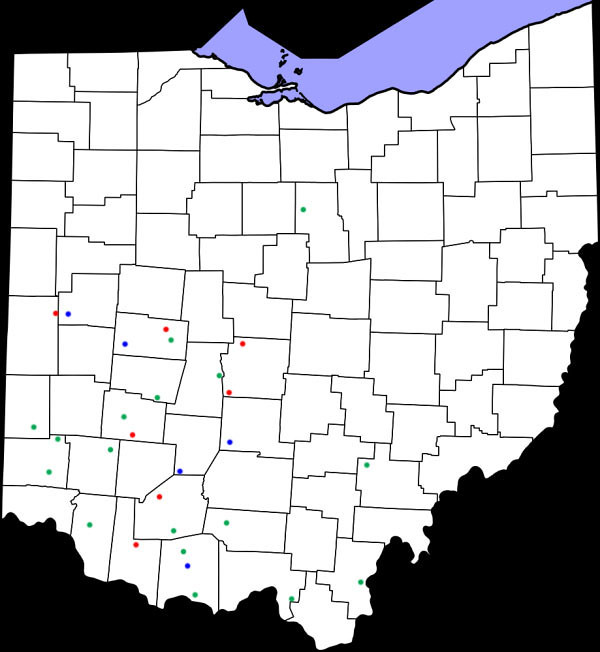
Distribution of log buildings with overhanging plates, Ohio. Though outdated (since November 18, 2012, when I produced this map, I've discovered many more structures), the illustration is clear enough: overhanging plate construction dominates the state's southwestern quadrant.
Diagram, showing a simplified overhanging plate eave. Ignore my amateurish steeple notching!

In most cases, the plate itself is hardly noticeable. What lends distinction to this construction type is the supporting side log, which punctures the wall plane. Often, the ends of such logs are rounded or chamfered.

Overhanging plate eave, Rockcastle County, Kentucky.  Photo by William Gus Johnson, 1984, for the National Register of Historic Places. A well-constructed eave with chamfered side log. Note the rake board.
Log house (ca. 1812), Shelby County, Kentucky. Photo by Charlotte Worsham, 1986, for the National Register of Historic Places. A large residence of "saddlebag" form. Though both pens feature overhanging plates, each is handled differently.
Log house (1833), owned by J.F. Hardsock (or Hartsook) in 1874; Caesars Creek Township, Greene County, Ohio. Demolished. Photo by Donald Hutslar, 1971, from The Architecture of Migration. A log crosswall divided the first floor into two rooms. Compare this home with the one depicted below.
Log house, Washington Township, Brown County, Ohio. Demolished. Photo by Susannah Lane (?), 1969, for the "Southwest Ohio Survey." A fine building, exhibiting both prominent overhanging plates and a centered frieze window. A stone chimney, which may have served a summer kitchen, second log pen, or addition, stood to the west.
Log house, Jefferson Township, Logan County, Ohio. Photo from the Logan County Auditor's website, 2012. In its proportions, a late 19th century building; the overhanging plates suggest otherwise.

The overhanging plate also appeared in French-settled portions of Darke and Shelby counties. These houses, though typologically distinct from southwestern Ohio buildings, use similar eave construction.

Log house, New Riegel, Seneca County, Ohio. Photo from Zillow. Quite a fascinating structure, clearly divided by a full-height crosswall. In form, it resembles the French homes of Darke and Shelby counties; a few French individuals settled in Big Spring Township (in which New Riegel is located), so a connection between the regions is feasible.

Thursday, January 16, 2014

Cabins and Houses

Perhaps the largest conflation in the study of early architecture is that between log cabins and log houses. Though interchangeable in modern usage, these terms describe slightly different structures; the cabin is an exceptionally crude residence bereft of architectural ornamentation, constructed of round logs (in the 18th and early 19th centuries, “blockhouse” often referred to a hewed log building, while “cabin” implied crudeness, ephemerality, and round log construction) and intended for temporary use. Accordingly, cabins existed during a locality’s settlement, but were usually replaced by better-finished log homes (or frame, brick, or stone structures) when a settler was financially able. Early residents in every portion of Ohio constructed cabins, but only regions with well-built log houses contain extant structures, as cabins have disappeared from the landscape.

Nevertheless, a few cabin-like buildings survived into the 20th century. Ohio's southeastern quadrant, especially, contains several round log structures, though none are true cabins.

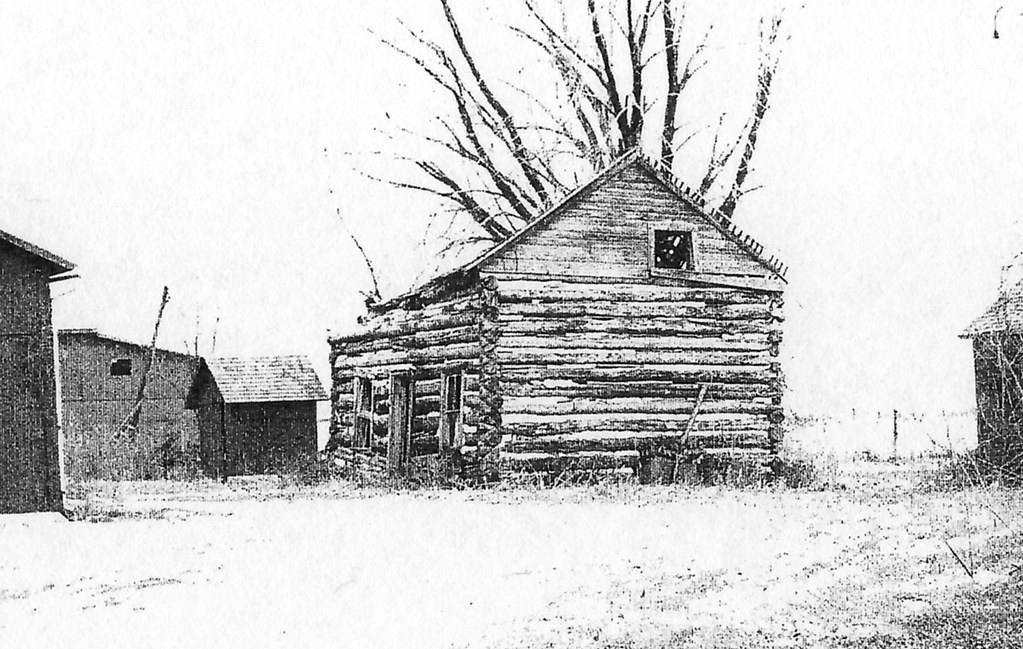
Log house, Stokes Township, Logan County, Ohio. Photo by Susannah Lane (?), 1969, from the "Southwest Ohio Survey." According to the survey report, four historic round log dwellings stood in Ohio in 1970; the source of this number remains unknown.
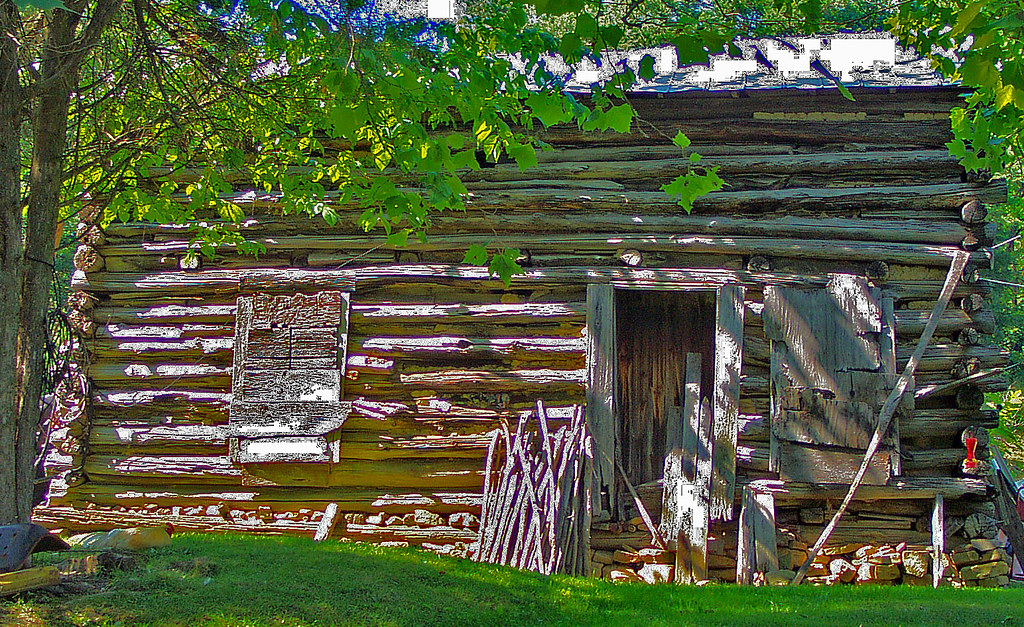
Crude log house, Pike County, Ohio. Photo by Don O'Brien, 2005. Shoddily constructed, this structure may date from the 20th century; such houses are scattered throughout southeastern Ohio, where traditional building practices persisted long after falling out of favor elsewhere.