Showing posts with label history. Show all posts

Friday, May 18, 2018

Ohio Architectural Profiles: Adams County


One of these decades, I'll summon the energy to write a book about Ohio's cultural landscape — something akin to the excellent Roadside Geology series, but for buildings. It'll no doubt contain a county-by-county discussion of architectural trends. Such chapters will probably resemble this blog post.

Organized in summer 1797 and named for the sitting U.S. president, Adams is Ohio’s third-oldest county — and its cultural landscape betrays the fact. It is, in its natural geography, a place of variety. From west to east, the clayey and mildly broken landscape gives way to thin-soiled knobs (north of West Union), cliff-rimmed plateaus, the deep valley of Brush Creek, and the most rugged portion of Appalachian Ohio. To the south flows the Ohio River, whose fertile bottomlands supported Adams County’s earliest settlements. In the southwest, near Bentonville and in Sprigg Township, limestone outcroppings dot the rolling, sinkhole-pockmarked countryside — a rare region of karst topography and part of a small incursion of the Bluegrass into the Buckeye State.

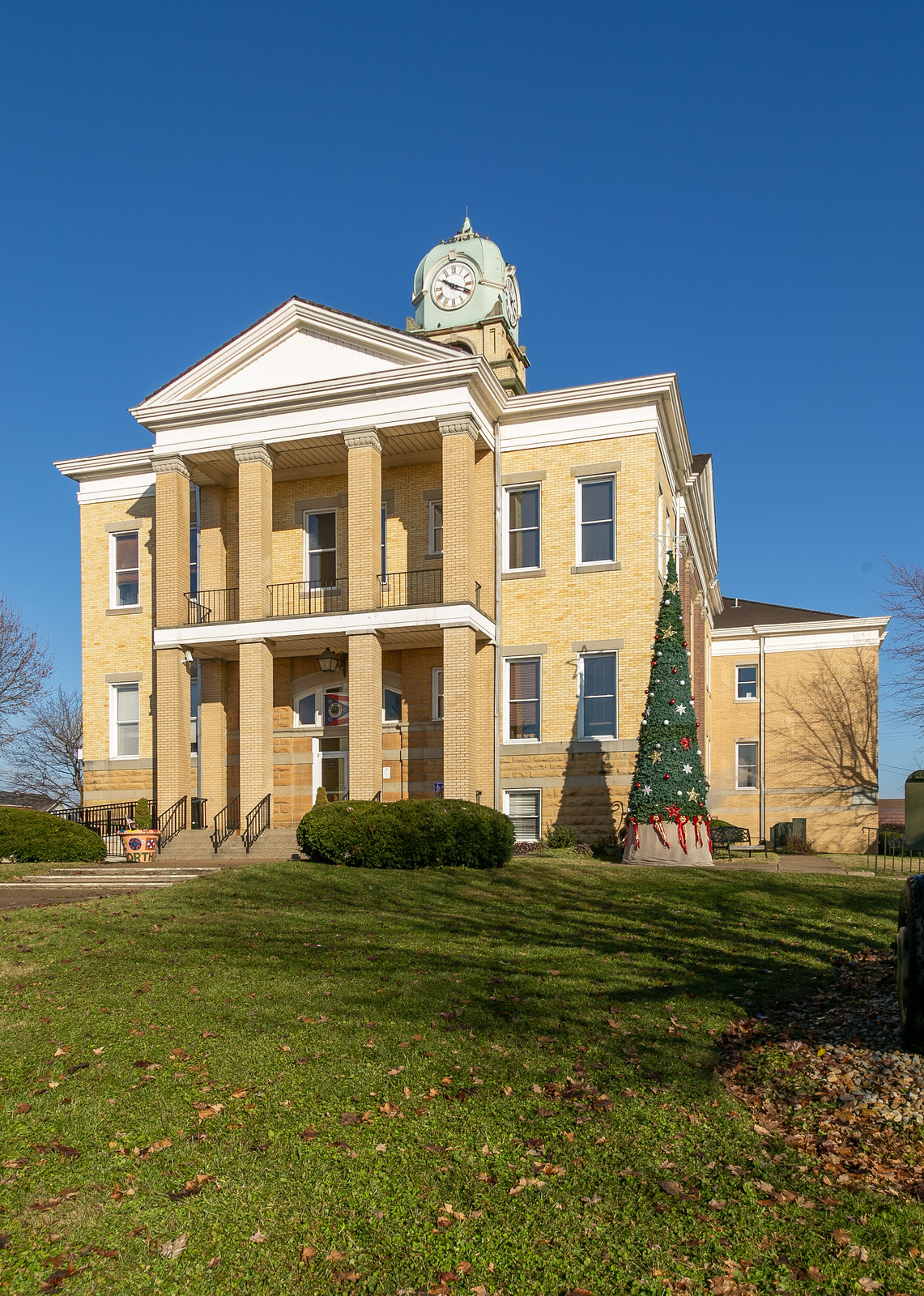
Adams County Courthouse, 1911; West Union.

Historically, Adams County’s agricultural situation varied as much as its landscape. One early Ohio gazetteer notes that “[t]he land . . . embraces a variety of soils, from the best to the worst.” This is plainly true. Into the latter category falls the valley of the Ohio River — relatively narrow except near Sandy Springs, at Adams County’s southeastern corner. The passably fertile land surrounding Cherry Fork, Winchester, and Seaman, in the west, supported the crops common to southern Ohio. Throughout the county, pasture was (and is) common. As in nearby Brown and Clermont counties, tobacco cultivation flourished after the Civil War — particularly in the narrow eastern stream valleys, which remained sparsely populated until the nineteenth century’s closing decades.

European settlement began in Adams County well before the subdivision received its name. In 1790, Nathaniel Massie (1763–1813), a Virginia-born surveyor, crossed the Ohio River near the mouth of Isaac’s Creek and established an outpost, known first as Massie’s Station and soon rechristened Manchester. With Massie came a contingent of settlers — the first legal residents of the Virginia Military District, in which Adams County wholly lies. Not until the Treaty of Greenville (1795), though, could settlers live without fear of Native American retaliation. Between 1790 and 1795, several Manchesterites — including members of the Ellison and Edgington families — were either attacked or captured by local tribes. In the ensuing decade, Europeans trickled into the area, mostly establishing subsistence farms in the valleys of the Ohio River and Brush Creek. In 1796 and 1797, Colonel Ebenezer Zane cut the eponymous Zane’s Trace through the soon-to-be county from northeast to southwest. About this time, when the Northwest Territory’s legislature decided to establish Adams County, it selected Manchester, naturally, as the seat of government.

This decision proved fractious. Within a year, and after much bickering, the county commissioners had uprooted and repositioned themselves twice — first from Manchester to Adamsville, a comparatively remote site on the banks of Brush Creek; and thence to a two-story log courthouse in Washington, a nascent Ohio River community. In 1804, the Adams County government moved yet again, this time to West Union, a newly platted village perched on a hilltop several miles inland. For once, the choice stuck. Adamsville and Washington faded to nonexistence, while West Union prospered. By 1810, 229 souls called the community home. Future Kentucky governor Thomas Metcalfe (1780–1855), a mason by trade, built a new courthouse — a two-story stone structure of almost residential appearance, with exterior chimneys and a round-arched Federal-style entry — in 1811.  West Union’s rapid growth and mid-century stagnation (its population remained almost unchanged between 1830 and 1870) left behind a well-preserved early townscape — one rich in Federal-era commercial buildings and residences, and even a smattering of log structures. Since the 1960s, though, waves of remodeling and demolition have robbed the village of most of these buildings.

As West Union’s fortunes declined, Manchester’s rose — thanks to its riverside siting, which allowed it to become a shipping point for tobacco and other agricultural goods — and its population leaped from scarcely 400 (at mid-century) to nearly 1,000 (two decades later). The 1900 census recorded a population of 2,003. Thereafter, the village’s economy suffered. Both demolition and repeated flooding have left Manchester’s cultural landscape pockmarked, with mobile homes and vacant lots in lieu of a historic housing stock. Other sizable Adams County communities — including Winchester, Seaman, and Peebles — owe their economies, if not their existence, to the Norfolk and Western Railway, which was constructed in the 1870s. Smaller communities, some unplatted, dot the Adams County landscape.

At least two distinct migration waves peopled Adams County. The first occurred between 1797 and 1820; the second spanned the 1840s. In both cases, the waves brought a relatively homogenous contingent of settlers, predominantly Presbyterians of Scots–Irish descent. The majority came from Pennsylvania (both the southeast and southwest) and northwestern Virginia, and a sizable minority immigrated directly from Northern Ireland. A few Kentuckians spilled across the Ohio River into the southern townships, and a smaller number of Germans scattered themselves across the county. In the 1870s and 1880s, a third, mostly internal migration occurred; inhabitants of southern Clermont County and Brown County, Ohio — where burley tobacco had become a staple crop — flooded into the mountain hollows surrounding Blue Creek and Wamsley, in Jefferson Township. The Adams County settlement landscape is not as diverse as those of other Ohio counties. In general, Virginians tended to dominate in the north, whereas Pennsylvanians and Kentuckians formed a majority in the south. By the end of the nineteenth century, foreign-born Scots–Irish populations were confined mostly to pockets around West Union and in Monroe Township.

Adams County retains an unusual number of early buildings — perhaps an unsurprising fact, given that it functioned as a locus of settlement during the territorial period. For the most part, these structures make use of common vernacular forms. On the banks of Brush Creek, not far from the Zane’s Trace right-of-way, stands a single-pen log house reportedly built by Peter Shoemaker (d. 1804 or 1809), who settled in Meigs Township in 1796. In appearance, the house is standard — one-and-a-half stories in height, three bays in width, and adorned only with an external brick chimney. A two-story braced-frame addition, built at an early date by a member of the Sproull family, significantly enlarges the building. Though evidence for the claim is circumstantial, Shoemaker’s home may be Adams County’s oldest surviving residence.
Shoemaker–Sproull House, circa 1796 (?); Meigs Township.

Another surviving eighteenth-century log structure is the National Register-listed Treber Inn, built by John Treber, a Pennsylvanian, along Zane’s Trace in 1798. The single-pen building — notable for both its two-story front porch (perhaps original) and its rear stone addition, appended about 1810 — functioned as a tavern for much of the nineteenth century. Thankfully, it remains more-or-less unaltered, preserved in almost museum-esque fashion by its present owners.

Treber Inn, 1798; Tiffin Township.

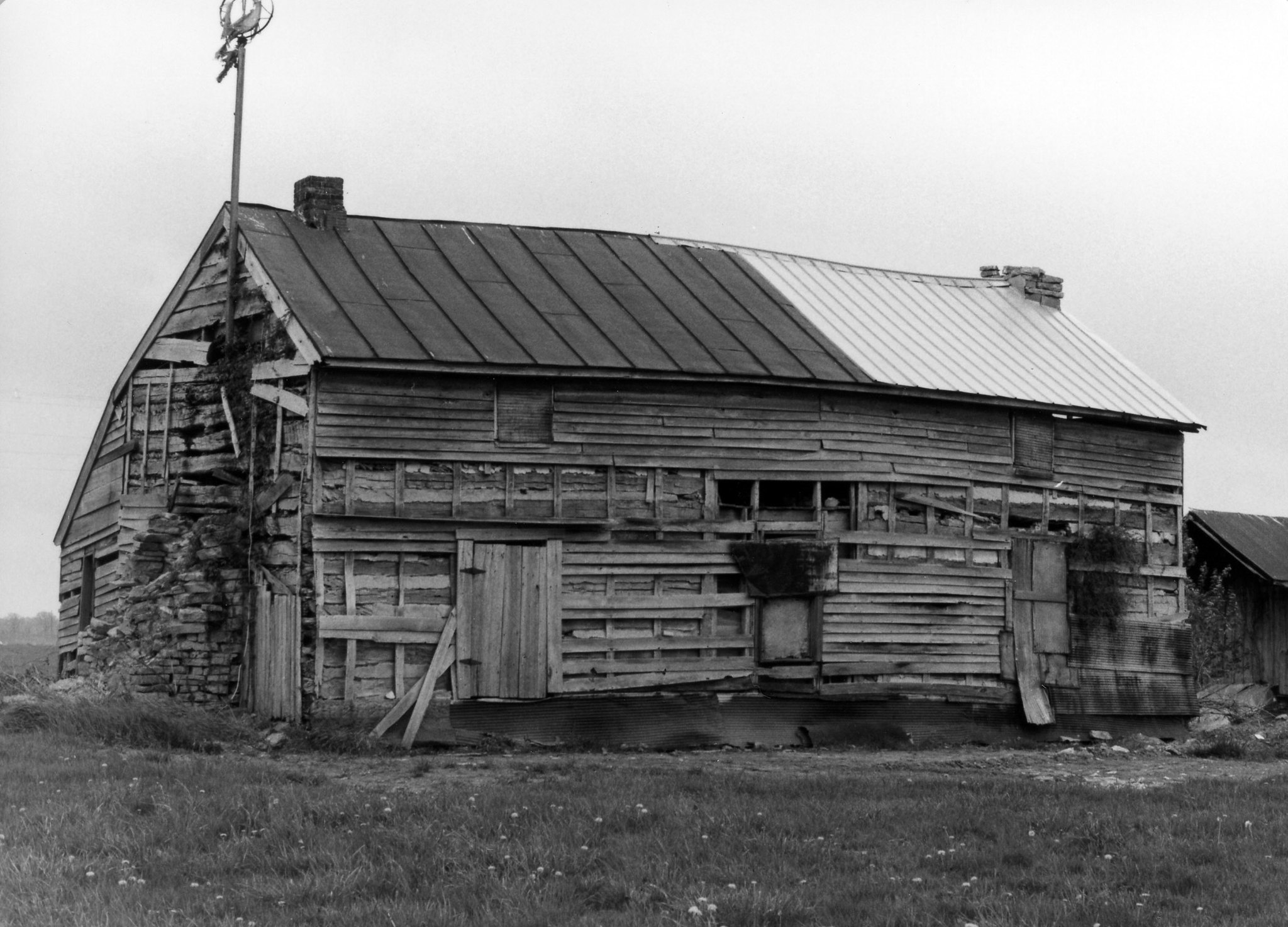
More typologically distinct was Buckeye Station, a residence surveyor Nathaniel Massie erected on a Monroe Township bluff in 1797. The house was a one-story, two-bay braced-frame structure of L-shaped plan, its front section divided by a massive central chimney — possibly an early variant of the “saddlebag” plan. A second stone chimney, placed on the exterior, accompanied the kitchen wing. What little interior ornamentation Massie’s abode boasted disappeared during its long life as a tenant house, but the exterior remained almost unchanged. The building’s eaves may have employed a system of framing more common to the eastern seaboard than to Ohio.  Alas, a half-century of neglect has reduced Buckeye Station to little more than a pile of moldering boards punctured by a pair of stone chimneys.
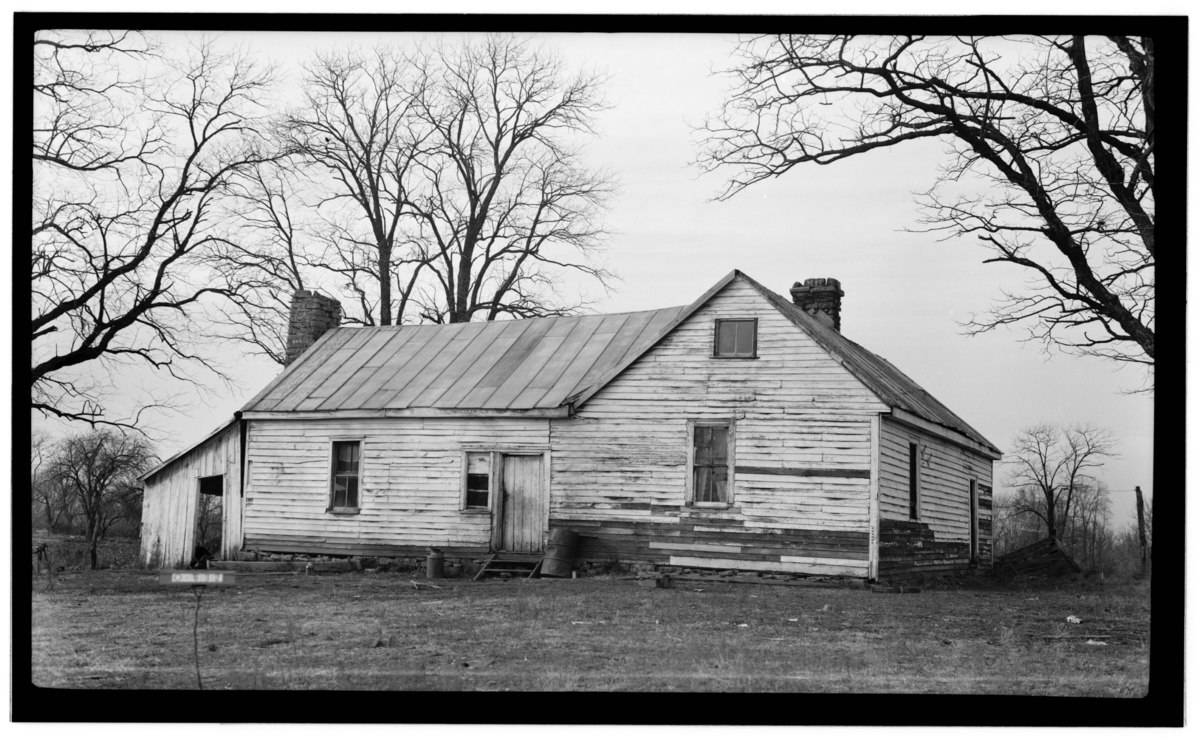
Nathaniel Massie House (Buckeye Station), 1797; Monroe Township. Photo by E.F. Schrand and A.R. Arend, 1936, from the Historic American Buildings Survey collection.

Adams County retains several early limestone dwellings. The oldest among these is no doubt the 1798 Andrew Ellison House, which stands in a narrow hollow northeast of West Union and scarcely a mile from Zane’s Trace. Ellison, born in County Tyrone, Ireland, was among the early residents of Manchester. With its single-pen form, wide-based exterior chimneys, and primitive appearance, the one-and-a-half-story home betrays its pre-statehood origin. Its low-pitched roof and relatively lengthy side walls give it an appearance like that of other stone dwellings in nearby northern Kentucky — evidence of a regional trend, perhaps. A slightly smaller, slightly later (1805) stone farmhouse stands in Liberty Township on land homesteaded by Thomas Kirker (1760–1837), another Tyrone native who later served as Ohio’s second governor. Like the Ellison House, Kirker’s residence is of essentially hall-and-parlor plan, albeit with a central (rather than a gable-end) chimney. In the 1850s, Kirker’s descendants enlarged the home with a two-story frame addition of “I-house” form. Two other Adams County stone homes survived into recent decades — a small, single-pen farmhouse in Scott Township, and a two-story stone-and-frame tavern built by one Isaac Aerl before 1810, just north of Peebles. Aerl’s tavern is noteworthy for its crude Flemish-bond stonework.


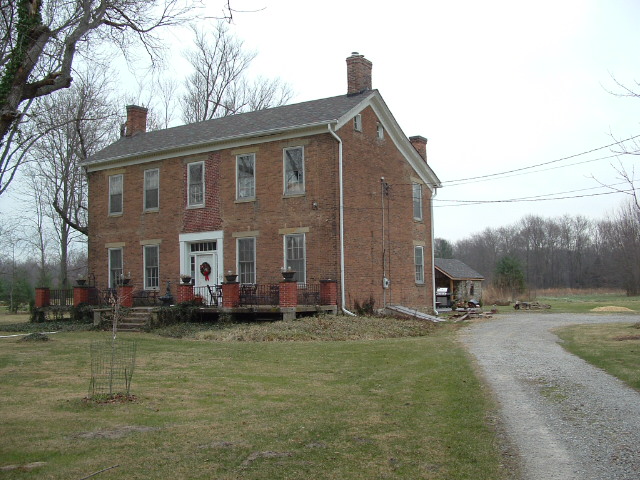
Andrew Ellison House, 1798; Tiffin Township.


Isaac Aerl House, circa 1809; Meigs Township.

Because of Adams County’s isolation and relative poverty, log construction remained popular in the area well into the nineteenth century. (Indeed, a few log homes date from the twentieth century.) By far, the majority of the county’s surviving log buildings are one-and-a-half- and two-story single-pen residences; double-pen structures and outbuildings are considerably rarer. If preliminary surveys are any indication, the number of log homes surviving in Adams County exceeds 100. A WPA survey of farm residences, conducted in 1934, located 250 log homes — about 11 percent of Adams County’s total. No features distinguish the county’s log houses, in general, from those elsewhere, but overhanging plates and exterior chimneys seem to have been common. One double-pen home of “saddlebag” form, exceedingly rare in Ohio, stands in Sprigg Township. Another double-pen farmhouse once sat north of West Union, in Tiffin Township. Though its configuration — two one-and-a-half-story pens separated by a wide stair hall — suggested an early construction date, the building’s placement in an agriculturally marginal area makes this conjecture less likely. Whatever its origin, the house was a stellar example of early-nineteenth-century construction practices, with interior and exterior chimneys, rake boards, wide clapboard siding, and an integral rear porch tucked between enclosed corner rooms. This building, owned in the 1880s by a member of the Cluxton family, survived into the mid-1990s.
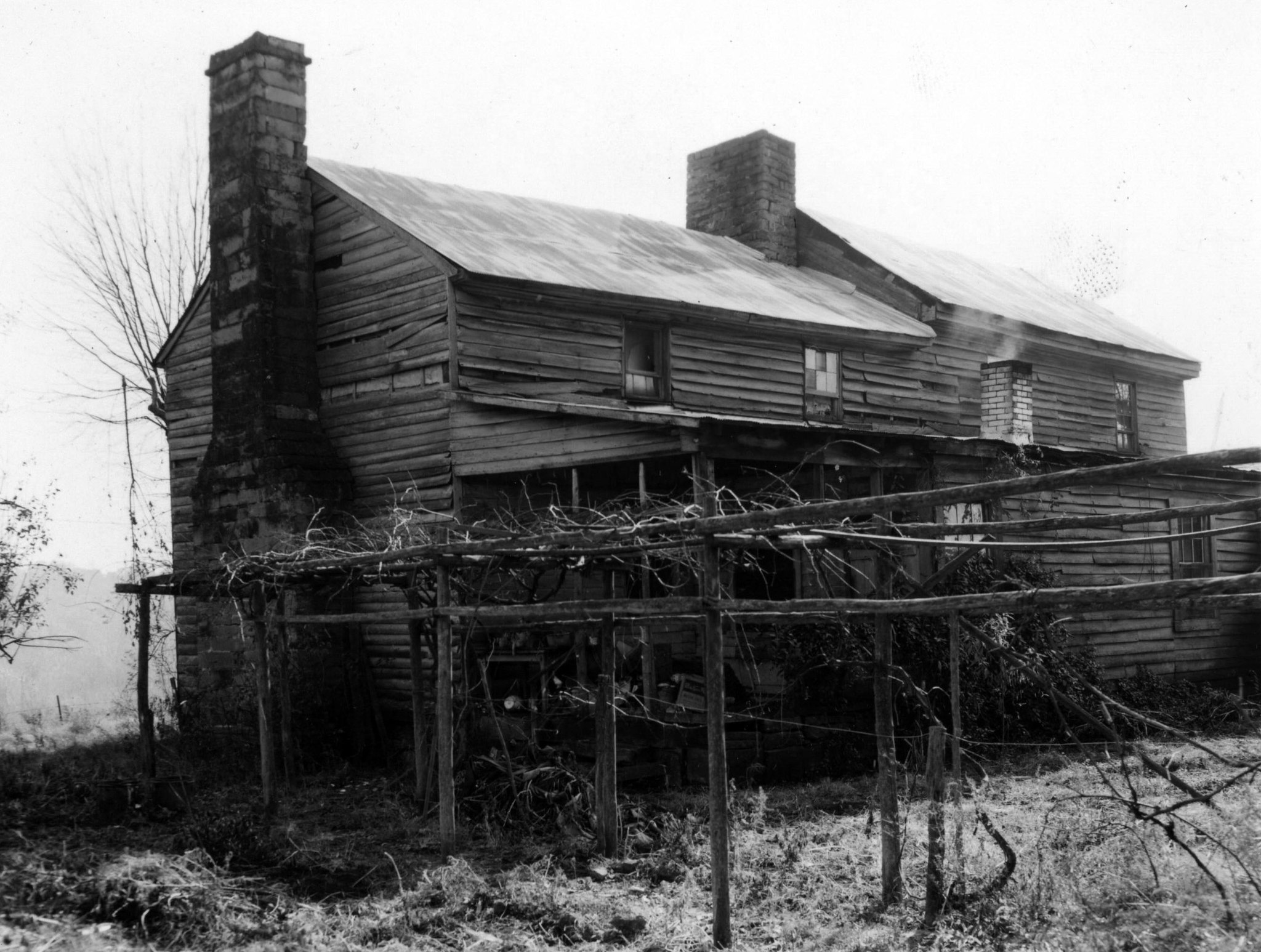

Daniel Collier House, 1802; Tiffin Township. Razed. Photo by Rita or Leland Puttcamp, from Historic Landmarks in Ohio: Volume III, compiled by several chapters of the United States Daughters of 1812 in 1955.

Cluxton Log House; Tiffin Township. Razed. Photo by Stephen Kelley, 1977, from the collection of Donald and Jean Hutslar.

Like other Ohio River counties, Adams County contains a few examples of plank construction—an uncommon variant of the usual notched-log system which uses narrow, sawed boards instead of hewed timbers. In two cases, such plank structures were mere additions to more traditional log houses. In another case, notched planks constituted the entire single-pen home. Only one of these three buildings remains standing — on U.S. Highway 52, just southwest of Manchester.

As is the case elsewhere in Appalachia, wood is, by far, the most common construction material among Adams County structures. Some homes use hewed logs; at least one, round logs. Most surviving pre-World War II residences, though, employ one of the two systems of framing common in America — braced framing, with its mortise-and-tenon joinery; and balloon framing, which reached Adams County after the Civil War. The county retains fewer than half a dozen stone structures, all ancient by state standards. Brick buildings — mostly built between the 1820s and 1850s — tend to cluster in the northwest (around Seaman), and in the upland valley which shelters Peebles. The county’s oldest brick structure, the 1801 Wickerham Inn — a low two-story, three-bay Flemish-bond structure, slightly altered — stands along the old Zane’s Trace between Peebles and Locust Grove.
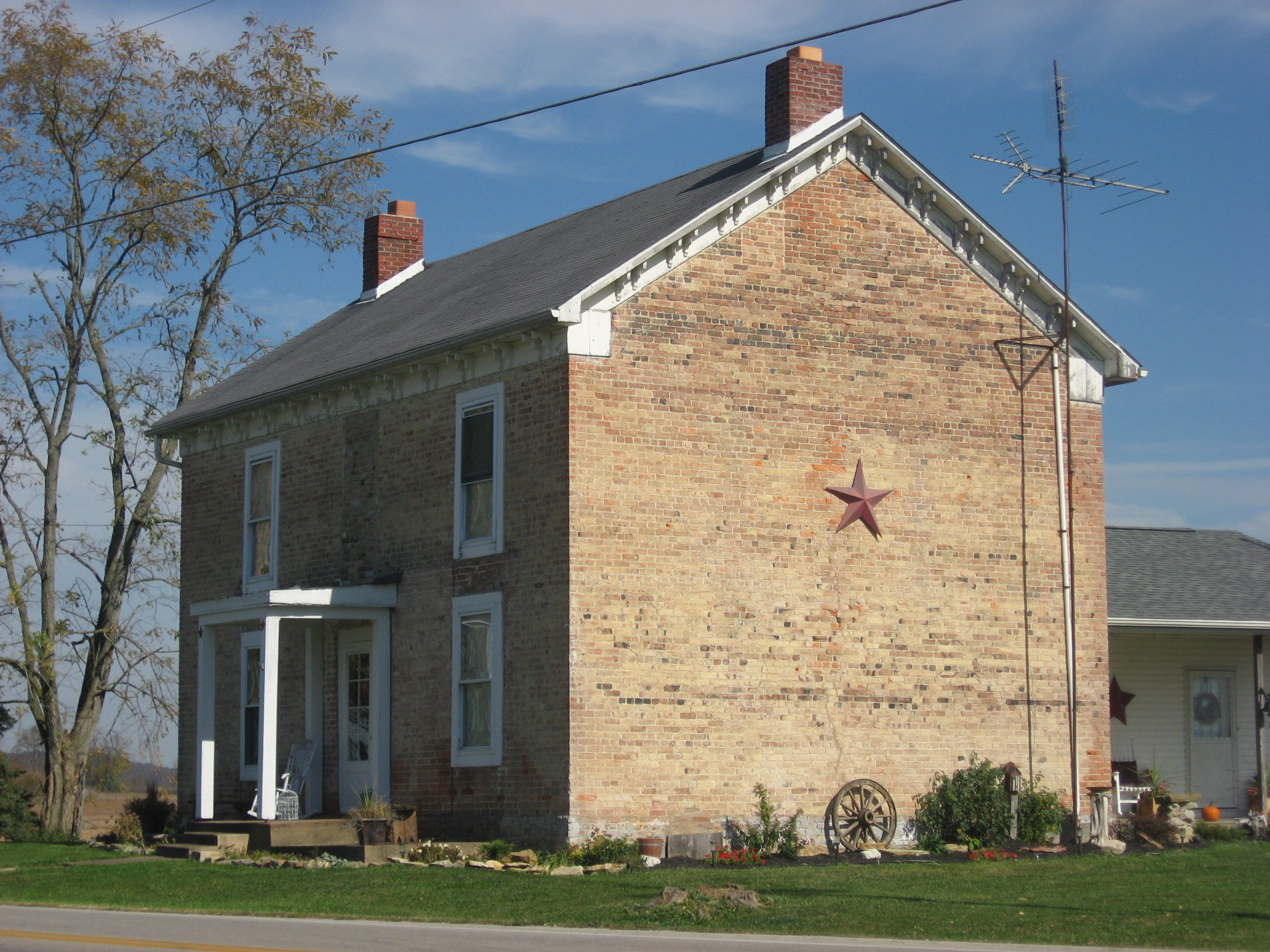

Wickerham Inn, 1801; Franklin Township. Photo from Wikimedia Commons, courtesy of Nyttend.

Typologically, Adams County’s buildings fall firmly into the architectural tradition of the greater Upper South. Single-pen and hall-and-parlor homes, typically one-and-a-half stories in height, abound. Two-story residences of linear plan — so-called “I-houses” — constitute more than a third of the county’s surviving farm dwellings. Also common are one-and-a-half-story, double-pile homes of a type seemingly common to areas settled by the Scots–Irish. These buildings often consist of four rooms arranged around a central hallway, with chimneys (generally four, and sometimes two) placed at the periphery. The upper half-story invariably lacks a knee wall. Such homes, it seems, were constructed in great numbers about the time of the Civil War, and many feature (or featured) simplified Gothic Revival ornamentation — centered gables, lancet-arched windows, and bargeboards. In a few cases, the gable is front-facing. Of the homes depicted in Caldwell’s 1880 Illustrated Historical Atlas of Adams County, Ohio, more than a dozen fall into this category. Common late-nineteenth-century building-types also make an appearance — “gabled ell” cottages, cube-shaped dwellings, and whatnot.

Few Adams County homes merit stylistic classification. Ornamentation tends to be vernacular, and not high-style, in nature. Among frame buildings, clapboard siding and simple frieze boards are omnipresent. The Federal mode, for the most part, is evident only in interior woodwork and the occasional use of Flemish-bond masonry. Nods to the later Greek Revival style are only slightly more common. In Bratton Township, not far from the Highland County border, stands a five-bay frame “I-house” marked by a pedimented two-story porch with paired columns. Identical doorways, each surrounded by sidelights and a transom, open onto both of this porch’s levels. Members of the Gore family, who built the dwelling, hailed from northern Virginia, where such porches are commonplace. Similar porches adorn farmhouses in the townships of Bratton, Franklin, Green, Scott, and Tiffin. Also taking its inspiration from ancient Hellas is Liberty Township’s Gibboney House, a one-story, four-bay, L-shaped frame cottage with a pedimented porch and sidelight-flanked doorway.


Gore House, circa 1845; Bratton Township.


Gibboney House, circa 1850; Liberty Township.

By far, the most inventive of rural Adams County’s abodes is the Oliver Tompkins House — known informally as the “Counterfeit House” — in Monroe Township. A counterfeiter by trade, Tompkins purchased a farm on Gift Ridge (not far from Buckeye Station) in 1840, then erected a home designed to conceal his moneymaking operation. In form, the structure is unique enough. It employs the usual center-hall plan, but its roof is hipped (rather than gabled), and its windows are framed by paneling and wide, crossette-endowed trim. The chimneys’ stacks are turned 45 degrees from the perpendicular, and the central hallway terminates at a recessed, trabeated doorway (with sidelights and a transom). Tompkins outfitted his home with features intended to hide his scheme: deceptively locked doorknobs, a slot where patrons could insert cash, and a concealed second-floor room where the actual counterfeiting occurred. For decades, the Tompkins House doubled as a private residence and an impromptu museum. But now, alas, the building stands abandoned, overgrown, and tornado-damaged.


Oliver Tompkins House ("Counterfeit House"), 1840; Monroe Township. Photo from Wikimedia Commons, courtesy of Aesopposea.

Outside West Union and Manchester, high-style Italianate structures are as rare as Greek Revival ones. A few Adams County builders applied minor Italianate detailing — bracketed cornices and hip roofs, usually — to the common “I-house” form. One farmhouse, built by the Grimes family amid Ohio River bottomland (not far from the site of Washington), managed to capture the irregularity that typifies the Italianate mode. This home, built of brick and restrained in its ornamentation, disappeared during construction of the Killen Generating Station. For the most part, the Italianate (and the Gothic) made an appearance only at the periphery — in minor details and porches, which often featured scrollwork, spandrels, and brackets.
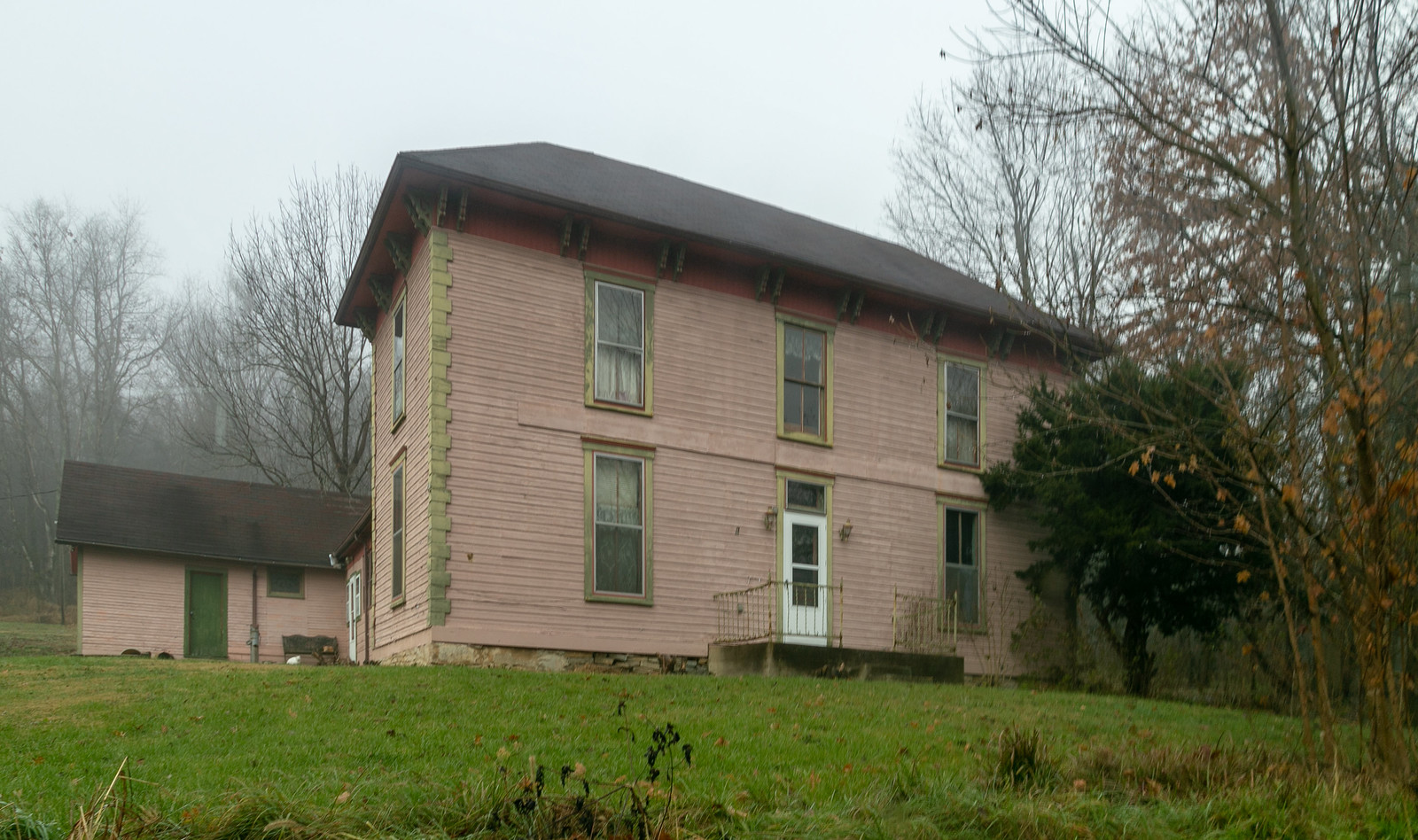

Italianate farmhouse, circa 1885; Scott Township.

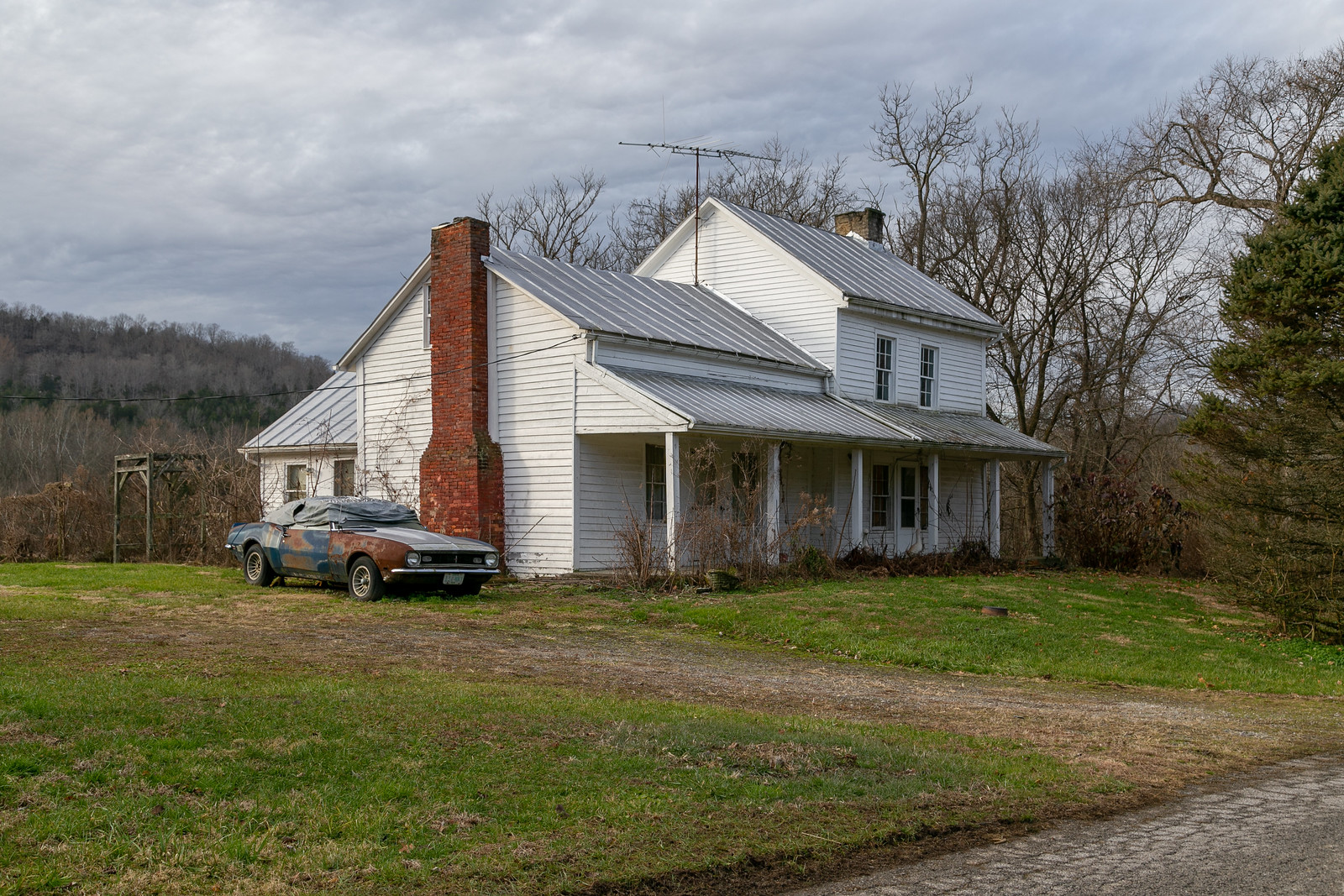
In rural Adams County, at least, most late-nineteenth-century homes are firmly astylistic. Elements associated with the greater “folk Victorian” vocabulary — exterior strapwork and shingling, stylized window trim, bargeboards and gable-end trusses, and spindlework—appear occasionally and in small numbers. A vacant balloon-frame farmhouse on State Route 136, in Liberty Township, employs most of these tropes. After about 1900, residual classical ornamentation again gained popularity. Nonetheless, the overwhelming majority of notable Adams County buildings date from the nineteenth — and not the twentieth—century.


Abandoned farmhouse, circa 1890s; Liberty Township.

Wednesday, July 19, 2017

The Albert J. Ewing Collection: Glimpses of a Long-Lost Landscape

Cross-posted from the Ohio History Connection's blog.

In 2017, it's not difficult to document the world. Storage space is cheap, and opportunity cost is practically nonexistent. Cameras and computers allow geographers and architectural historians — amateur and professional alike — to capture, store, and edit a thousand images of whatever strikes their fancy. Thanks to Google and Bing, a person needn't visit a place to understand its atmosphere, to sample its je ne sais quoi.

But finding visual documentation from before the era of abundant information remains an ordeal. Everyone who owns a historic home dreams of discovering some glorious daguerreotype showing the structure as built, but few succeed. In the nineteenth century, portrait photography outshone landscape photography. Then, as now, people tended to overlook the ordinary. In far-flung places — rural Appalachia, for instance — the problem was particularly acute. The Ohio History Connection, though, holds one collection unmatched in its ability to give a glimpse of the turn-of-the-century landscape: a store of more than 5,000 plate-glass negatives, gloriously detailed, captured by the wandering photographer Albert Ewing.

Albert J. Ewing (1870–1934) spent his early years near Marietta, the first permanent settlement within the Northwest Territory, founded by the Massachusetts-based Ohio Company of Associates in 1788. The fertile valleys of the Ohio River and Muskingum River attracted plenty of early settlement, but the rugged, stream-dissected Allegheny Plateau remained sparsely populated until the nineteenth century’s closing decades. For the most part, the land of southeastern Ohio and central-western West Virginia allowed only subsistence agriculture. Homesteaders lived in relative squalor and farmed sloping plots within isolated mountain hollows. But turn-of-the-century oil exploration brought prosperity to the region and, in turn, triggered a building boom. It is this landscape — a landscape newly transformed by mineral wealth, dotted with derricks and oddly exuberant dwellings — that Ewing’s images allow us to glimpse in unparalleled detail.

http://www.ohiomemory.org/cdm/singleitem/collection/p16007coll19/id/797/rec/149
A newly constructed farmhouse of standard turn-of-the-century appearance. Location unknown. Despite its hilliness, the land surrounding the house is largely cleared for agriculture; today, the same spot is probably densely forested.

Some of the houses in Ewing’s photos seem strikingly new — coated with unblemished paint, constructed of unweathered wood, and adorned with unbroken scrollwork, spandrels, and medallions. This is hardly surprising. Many of them are (or were) new. They tend to display the hallmarks of turn-of-the-century domestic architecture: an affinity for traditional forms, liberal use of lathe-turned woodwork, and a repetition of certain types of ornamentation. Ewing’s camera even captured some buildings during construction, and one pair of plates depicts the same home before and after a renovation.

http://www.ohiomemory.org/cdm/singleitem/collection/p16007coll19/id/611/rec/593
A plain farmhouse of "saltbox" form — likely a frame building, but possibly log. Location unknown.
http://www.ohiomemory.org/cdm/singleitem/collection/p16007coll19/id/686/rec/582
The same house — a decade or two later, and after a reroofing and the addition of a two-story porch.

Other photos show the poverty for which Appalachia is (rightly or wrongly) famous. Ewing's images of log buildings, in particular, are among his collection's most valuable. One — labeled "rural life," perhaps ironically — depicts a small log house and its accompanying log outbuilding. The outbuildings's roof is supported by purlins — a construction method common to Ohio's earliest cabins. (Yes, there is a difference between a log cabin and a log house, but that's a subject for another post.) In another image, the log house stands, encircled by a picket fence, among unkempt-looking fields. Additions obscure two of the log pen's four sides, the roof is clad with wood shingles, and the house's plates overhang the walls. Had Ewing jumped into H.G. Wells's time machine and emerged in the year 1830, he might still have returned with (almost) identical-looking images.

http://www.ohiomemory.org/cdm/singleitem/collection/p16007coll19/id/1124/rec/2
http://www.ohiomemory.org/cdm/singleitem/collection/p16007coll19/id/663/rec/166


Still other photos depict buildings within a broader context. In one, the farm complex, rimmed by sloping pastureland and split-rail fences, straddles a small stream; in the other, the house and outbuildings stand on a level upland. One farmhouse is rather crudely constructed and sided with boards and battens (and, thus, might be a remodeled log building); the other, a balloon-frame structure of "I" form, was likely built within a few years of Ewing's visit. (The second-floor entries suggest that the owner planned to grace his abode with a two-story porch.) In both cases, the homes' chimneys send forth puffs of smoke — not surprising, for Ewing captured a great many of his images in the autumn, winter, and early spring.

The two photos, like all within the collection, are deliciously detailed, and they permit the curious to see the long-dead accoutrements of Appalachian agricultural life: carts, carriages, millstones, chickens, cattle, orchards, dirt lanes, split-rail fences, and sloping fields — and, of course, the owners themselves, often proudly standing by those marks of civilization they helped wrench from nature.

http://www.ohiomemory.org/cdm/singleitem/collection/p16007coll19/id/818/rec/165
http://www.ohiomemory.org/cdm/singleitem/collection/p16007coll19/id/639/rec/166

But enough rambling. 1,435 of Ewing's 5,055 negatives are available, in 5,000-by-4,000-pixel glory, via Ohio Memory. As the old saw says, a picture is worth a thousand words. Do take a look!

Friday, July 14, 2017

Brick Columns in Warren County

It's not difficult to spot similarities between, say, the boxy braced-frame (and log) farmhouses of Wayne County and dwellings in southeastern Pennsylvania's Amish heartland, but finding direct connections between Ohio buildings and their East-Coast antecedents is a more arduous task. Still, some have managed it. Frary traces floral woodwork in one Western Reserve farmhouse to a home in rural Maine, and Asher Benjamin's designs are duplicated in countless structures — residential, commercial, and public alike. I suspect that most comparisons between individual buildings are, in all likelihood, mistaken, but the temptation remains.

In suburbanizing Hamilton Township, Warren County (one of Ohio's finest counties, if I may say so), are two Federal-era residences with peculiar similarities to at least one Virginia plantation home. One stands on Schlottman Road, just north of the township's southern boundary and a stone's throw from Benjamin Butterworth's hillside farmhouse (1815); the other sits on a sloping, stream-side lot, south of Maineville (a community founded, as its name suggests, by ex-citizens of New England's northeasternmost state).

The Schlottman Road house was owned, during the nineteenth century's second quarter, by members of the Hill family, but its exact history is murky. The building's facade is standard transitional Federal–Grecian fare — five bays in width, with a narrow frieze board, trabeated doorway, and rectangular stone lintels and sills. What lies behind the facade is a bit odder. Unlike most "I" houses (dwellings multiple rooms in width, but only one in depth), the Hill House features an additional row of rooms, which allow for extra fireplaces and a two-story inset porch (now enclosed), and which lend the house a "saltbox" roofline.

The Hill House (WAR-631-11), supposedly constructed in 1817; expanded circa 1845. Photo from the Warren County Auditor's website.

At the home's rear, though, is its truly intriguing feature. Extending from the two-story section is a one-and-a-half-story wing (not an oddity in itself), constructed of Flemish-bond brick. According to local lore, this wing predates the "I" portion by several decades — a claim I'm more than willing to believe. A two-bay section of this wing is recessed, and the resulting porch is supported by polygonal brick columns with blocky capitals and plinths. Clunky though they may be, these columns are distinctive. Ohio has a plethora of recessed porches, but few — if any — use brick as a supporting material (though I know of two arcaded porches in Lawrence County).

The home's rear (more interesting, I think, than its facade). The 1817 section lies to the right. Note the fieldstone springhouse. Photo from the Warren County Auditor's website.

Campbell County, Virginia's Green Hill Plantation, built about 1800, features a similar porch. As might be expected, Green Hill's columns are more sensitively handled; they're round, rather than polygonal, and they're topped with more typologically accurate capitals and plinths. Unfortunately, some of the many outbuildings and dependencies which once encircled Green Hill have disappeared, but the house remains, thank goodness.

Porch, Green Hill (circa 1800); Long Island vicinity, Campbell County, Virginia. Photo from the Historic American Buildings Survey collection. Photographer and date unknown.

A few miles northeast of the Hill House; in Warren County, Ohio; stands a second dwelling — this one omitted from the Ohio History Inventory — with a brick-columned porch. In this case, the porch is two stories in height, and, instead of being tucked into a rear wing, it boldly graces the facade. The columns are circular (rather than polygonal), but their capitals are no more elegant than the Hill House's. An 1875 property atlas lists a J.E. Murdock as the farm's owner. Murdock's family lent its name to a crossroads community just south of the residence.

Murdock House; circa 1835 (?). Photo from the Warren County Auditor's website.

Sunday, July 2, 2017

The Residences of Rural Sandusky County, Ohio

Last week, I finished my survey of rural Sandusky County, Ohio. Rather than merely silently posting a link to the Fusion Table on the usual page, I'll also write about what I've discovered. For those who care not to read, here's the map:


A Slapdash History

In 1820, Sandusky County was carved — along with a dozen other northwestern-Ohio counties — from ex-Shawnee territory confiscated by the Treaty of Fort Meigs (1817). At the time, a mere 852 souls called the county home. The area remained sparsely populated until two waves of migration — the first in the 1830s, the second between 1850 and 1860 — sent settlers into its lands. The earliest settlement occurred along certain streams: the Sandusky River (which bisects the county), the Portage River, and other, smaller waterways. Modern-day US Highway 20, an early road connecting Perrysburg and the Western Reserve, also functioned as an artery of settlement. Like most northwestern-Ohio counties, Sandusky encompassed much waterlogged land, and its landscape reached a stable state of development only during the nineteenth century's closing decades. The second migration wave contained a great many Germans — from a variety of principalities, including Baden and Bavaria — as well as a slew of Swiss.

Fremont (no, not Sandusky), once a frontier outpost adjoining Fort Stephenson, has always served as the county seat. Before and after the county's formation, the city was (rather confusingly) known as Lower Sandusky, no doubt because of its location near the Sandusky River's mouth. In 1849, the village's residents chose to rechristen their home in honor of John C. Frémont (1813–1890), then known as an explorer and military man (and not the Republican Party's first candidate). The first Sandusky County courthouse — perhaps Ohio's only log civic building for which plans survive — served between 1826 and 1843. In 1844, a Greek Revival edifice replaced the log structure.

Sandusky County's current courthouse — built in 1844, and expanded, with unusual sensitivity, in 1936.

Survey Results

During my survey, I discovered 273 rural homes worthy of note — a higher number than I'd expected, though not terribly surprising, given Sandusky County's predominantly Germanic settlement geography.* A fair number of buildings are already included in the Ohio Historic Inventory and National Register, mostly because of a 1984 survey conducted by Andrew Gulliford. Still, the OHI and NRHP include only 63 homes, about 23 percent of my total. The overwhelming majority of rural Sandusky County's buildings (perhaps 80 percent) postdate the Civil War. As always, my survey favors brick structures, which — thanks, again, to the county's Germanitas — exist in abundance. Many rural homes adhere to familiar formulas; the terms "upright-and-wing" and "gabled ell" appear, by the dozens, in my table. The Italianate style, too, was popular among nineteenth-century Sanduskyites. This isn't surprising. The county's greatest period of development happened to coincide with the style's peak in national popularity (outside the cities, between 1865 and 1885).

I can (crudely) divide Sandusky County into three architectural regions. The first comprises the easternmost townships — Townsend and York, as well as portions of Riley and Green Creek; the second stretches, in an "L" shape, from the county's center to its northwestern corner, near Woodville; the last covers the southwestern quadrant.

The East

In Townsend and York townships, Yankee, Pennsylvanian, and Germanic architectural traditions collided in interesting ways. This region, populated by the aforementioned 1830s wave, contained many of Sandusky County's wealthiest and oldest farms. (It was also the least swampy.) Remodeled braced-frame buildings, some with frieze windows and vestigial Greek Revival flourishes, are scattered, willy-nilly, across the area's farms. A few limestone houses stand near the Huron County–Erie County border, due south and north of Bellevue. In eastern Sandusky County, the so-called "upright-and-wing" house-type — so popular in the Western Reserve — is a common sight. A number of "upright-and-wing" homes in York Township display Gothic Revival quirks: gabled wall-dormers, lancet-arched windows, scrollwork, and bargeboards.

Smith House, York Township. 6710 Billman Road. Note the "upright-and-wing" form, wall dormers, and lancet-arched windows. Photo from the Sandusky County Auditor's website.

Deyo House (SAN-448-12), York Township. 2895 Flat Rock Road. One of the county's few stone buildings. Photo from the Sandusky County Auditor's website.

Winters House, Townsend Township. 6201 US Highway 6. A Gothic–Grecian fusion par excellence. Photo from the Sandusky County Auditor's website.

Perhaps eastern Sandusky County's most interesting dwellings are those which use an odd form of brickwork called, variously, "double Flemish bond" and "monk bond." Oddly enough, this method of construction seemed to be popular among New Englanders and Germans in the vicinity of Bellevue; examples exist in Erie, Huron, Sandusky, and Seneca counties. The homes are too numerous to be the products of a single builder.

Sparks House, York Township. 5821 State Route 101. The brickwork is exceptional. Photo from the Sandusky County Auditor's website.

The Middle (and Northwest)

Sandusky County's vast midsection — the lands bordering the Sandusky River; much of Ballville, Sandusky, Rice, and Riley townships — received the majority of its German settlers. Others purchased tracts in the county's northwestern quadrant, in Woodville and Washington townships. The area's dwellings vary in age, pretension, and appearance. Brick "gabled ell" farmhouses, often unadorned (sans the ubiquitous segmental arches), are commonplace. The region's Italianate homes tend to feature severely truncated hip roofs (almost, but not quite, mansard) and intricately carved stone window hoods. Half-circle- and quarter-circle-shaped attic vents and windows are also oddly common.

Weber House, Sandusky Township. 3323 Werth Road. A well-preserved, unabashedly Germanic farmhouse. Image from the Sandusky County Auditor's website.
King House, Rice Township. 680 Overmyer Road. Image from the Sandusky County Auditor's website.
Batzine House, Rice Township. 331 Woodrich Road. A plain "gabled ell" with segmental-arched windows and a tall foundation. Photo from the Sandusky County Auditor's website.
Hetrick House, Rice Township. 2959 Four Mile House Road. Similar to 331 Woodrich Road, but with quarter-circle (or half-lunette) attic windows. Photo from the Sandusky County Auditor's website.
Philip Overmyer House (1862), Washington Township. 654 State Route 590. Luckily, this splendid home is NRHP-listed. Photo from the Sandusky County Auditor's website.

In Washington Township, just south of Elmore, stand two nearby identical brick cottages, undistinguished except for a pair of peculiar elliptical windows squeezed above the porch roof.

Burgman House, Washington Township. 3910 Swartzman Road. Photo from the Sandusky County Auditor's website.

Mellman House, Washington Township. 3806 Damschroder Road. Image from the Sandusky County Auditor's website.

A few Queen Anne houses; constructed for wealthy, non-German landowners; stand on the banks of the Sandusky River, south of Fremont.

Ballville Township. 4319 Darr Road. Photo from the Sandusky County Auditor's website.

One of Sandusky County's few extant log buildings stands in Rice Township.

Zitles House (?), Rice Township. 3184 Weickert Road. Removal of the porch has exposed the logs. The central chimney is a Germanic trait. Photo from the Sandusky County Auditor's website.

The Southwest

The lands lying south of the old Maumee and Western Reserve Road (US Highway 20) and west of the Sandusky River; near Gibsonburg, Helena, and Burgoon; harbor Sandusky County's least-pretentious buildings. Here, the architectural landscape is defined by remodeling, demolition, and abandonment. The limestone barrens running between Woodville and Fremont (part of the larger "Oak Openings" microregion) are unsuitable for agriculture, and portions of Madison, Scott, and Jackson townships remained ill-drained until the late nineteenth century, when ditching and tiling efforts opened the area to settlement. Frame farmhouses, many of "gabled ell" form, predominate, though plenty of brick structures exist here, too.

Fairbanks House, Madison Township. 4810 US Highway 6. The quintessential Sandusky County farmhouse. Photo from the Sandusky County Auditor's website.
Scott Township. 5910 Girton Road. Another "gabled ell" dwelling — this one clad in brick veneer, with a bit of gable ornamentation. The house dates from the turn-of-the-century. Photo from the Sandusky County Auditor's website.

I'll end my post with a table listing Sandusky County's townships, the number of buildings in each township included in my survey, the estimated age of surveyed structures found in each township, and the ratings I've assigned. (I've adopted Indiana's system. A "1" denotes a superlative building; a "2," a notable one; a "3," one significant enough only to appear in my survey.)

Township:
Number:
Date Range:
1:
2:
3:
Ballville Twp.
23
c. 1855 – c. 1920
2
2
19
Green Creek Twp.
24
c. 1865 – c. 1925
0
6
18
Jackson Twp.
23
c. 1855 – c. 1925
0
2
21
Madison Twp.
6
c. 1860 – c. 1900
0
0
6
Rice Twp.
20
c. 1850 – c. 1925
0
2
18
Riley Twp.
26
c. 1860 – c. 1915
1
1
24
Sandusky Twp.
24
c. 1855 – c. 1925
1
2
21
Scott Twp.
15
c. 1855 – c. 1900
0
1
14
Townsend Twp.
20
c. 1850 – c. 1925
2
0
18
Washington Twp.
32
c. 1840 – c. 1920
4
7
21
Woodville Twp.
25
c. 1855 – c. 1925
1
2
22
York Twp.
35
c. 1845 – c. 1925
3
5
27

* I've noticed, after much exploring, that (a) Germans preferred brick construction to frame (so long as local geography provided a suitable source of clay), and that (b) Germans tended, ceteris paribus, to build more pretentiously than did other cultural groups.