Showing posts with label pontus. Show all posts

Wednesday, May 10, 2017

Pontic Vernacular Architecture

After translating Vitruvius, I found myself scouring Wikimedia's "Provinces of Turkey" page for evidence that Pontic architectural traditions outlived their parent ethnic groups. Alas, the tower-like mossunōn built by the Heptacometae have (not surprisingly) disappeared from Turkey, but log construction remains common enough in the Heptacometae's homeland: a strip of relatively lush, rugged, forested — indeed, almost alpine — land bordering the Black Sea. (Pontus was roughly coterminous with today's East Black Sea Region.) The log buildings endemic to this area are, as far as I know, the only such structures erected outside Europe (minus those built in the United States, of course). I doubt the people of Pontus had any inkling that their abodes resembled homes elsewhere, in Germanic, Slavic, and Finno-Ugric lands.

The residences of northern Anatolia — stone, brick, frame, and log alike — seem to share certain characteristics. Often hip-roofed and set on tall masonry foundations (and, in more mountainous locales, built into hillsides), Pontic houses tend to use a latticework of half-timbering, with stone nogging and projecting overhangs.

Half-timbered house with tile roof. Budak, Çamaş District, Ordu Province. Image by Yılmaz Kilim, March 2010, from Wikimedia Commons.
Hillside half-timbered dwelling. Note the generous second-story overhang. Tuğlacık, Yağlıdere District, Giresun Province. Photo by Zeynel Cebeci, September 2015, from Wikimedia Commons.
One-story half-timbered house. Kemaliye, Giresun Province. Photo by Hüsamettin Alpaslan, July 2011, used courtesy of Wikimedia Commons.

The region's better-constructed log buildings are similar, in size and form, to their half-timbered counterparts. Many, it seems, are fashioned from closely fitted planks. (I'm aware, of course, that classifying plank construction as a subtype of log construction is problematic.) Some Pontic domiciles would look quite at-home in the Swiss Alps.

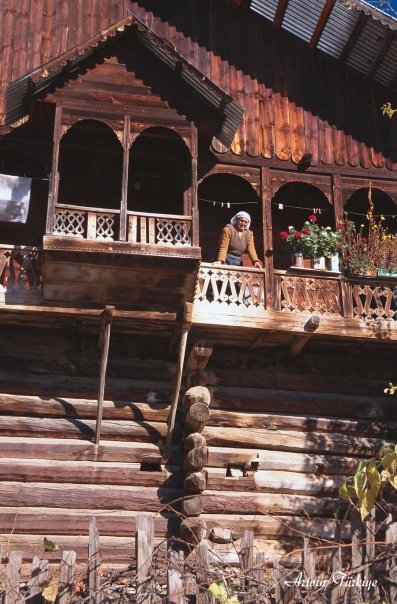
Round-log house with cantilevered upper story. Şavşat District, Artvin Province. Artvin Province borders Georgia and harbors a significant Georgian (and Laz) population. Image by Sairzamanlar, used courtesy of Wikimedia Commons. Date unknown.
Two-story plank house. Despite its size, the building is haphazardly constructed — note the jutting floor joists, untrimmed planks, and wide roof overhang. Taşören, Çaykara District, Trabzon Province. Photo by İhsan Kılıçoğlu, July 2010, from Wikimedia Commons.
Hillside buildings in Tamdere, Dereli District, Giresun Province. At least nine log structures are visible. Some are houses (with cantilevered porches); others, round-log barns oddly reminiscent of eastern Ohio's tobacco kilns — replete with roof purlins. Image by Zeynel Cebeci, September 2016, from Wikimedia Commons.
Pınarlar, Dereli District, Giresun Province. Compare these buildings to the ones depicted above. Pınarlar lies about 12 miles north of Tamdere. Image by Zeynel Cebeci, September 2016, courtesy of Wikimedia Commons.

Still other Pontic structures rest on stilt-like wooden supports. These may be granaries or storage sheds, elevated to prevent wildlife from devouring valuable food stores.

Lilliputian plank house (or shed). Sancaklıtepe, Keşap District, Giresun Province. Photo by HuSeYiN, August 2009, from Wikimedia Commons.
Connected plank buildings of unknown use. Coşandere, Maçka District, Trabzon Province. Photo by Haluk Comertel, April 2008, from Wikimedia Commons.

If my explorations are any indication, Artvin Province, which borders Georgia, deserves the epithet "log building capital of Turkey." Atop the rocky Kaçkar highlands, well above the tree line, stand clusters of particularly tiny log dwellings, no doubt constructed of timber sourced from lower altitudes. Scattered across Artvin Province are innumerable chalet-esque homes; a quick Google search reveals hundreds of photos of such buildings.

Crude log houses. Kocabey, Şavşat District, Artvin Province. Photo by Sairzamanlar, October 2014, from Wikimedia Commons.

Precisely what relationship connects modern Turkey's homes to classical-era Pontic abodes, I can't say. But it's likely, given the region's isolation, that its residents could trace their traditions — directly or indirectly — to the time of Strabo and Vitruvius.

Friday, May 5, 2017

A Selection from Vitruvius

I've written a few posts about the fearsome and enigmatic Heptacometae (or Mosynoeci), who lived along the Black Sea in today's Turkey and Georgia (and who may be related to Kartvelian-speaking ethnic groups). The Heptacometae constructed tall log homes, and Greek and Roman accounts of their abodes constitute the world's oldest surviving descriptions of stacked-log construction. Of these accounts, Vitruvius's — part of his De Architectura — is certainly the finest.

Having spent a few semesters studying Latin, I thought I'd try to translate Vitruvius's text — with the help of a dictionary, of course. After all, the best way (and arguably the only true way) to understand an author is to read his writing. Perhaps Vitruvius himself mentions something his translators miss . . . or vice versa. Here's the Latin (from The Latin Library):
Apud nationem Colchorum in Ponto propter silvarum abundantium arboribus perpetuis planis dextra ac sinistra in terra positis, spatio inter eas relicto quanto arborum longitudines patiuntur, conlocantur in extremis partibus earum supra alterae transversae, quae circumcludunt medium spatium habitationis. Tum insuper alternis trabibus ex quattuor partibus angulos iugumentantes et ita parietes arboribus statuentes ad perpendiculum imarum educunt ad altitudinem turres, intervallaque, quae relinquuntur propter crassitudinem materiae, schidiis et luto obstruunt. Item tecta, recidentes ad extremos transtra, traiciunt gradatim contrahentes, et ita ex quattuor partibus ad altitudinem educunt medio metas, quas fronde et luto tegentes efficiunt barbarico more testudinata turrium tecta.
After several hours of slogging, I managed to produce this:
Within the nation of Colchis, in Pontus, of abounding woods, uncut trees are put down, level, on the earth, on the right and left, with such an area left between them as the lengths of the trees allow; the others, which enclose the middle area of a dwelling, are arranged side-to-side, extending beyond the walls. Next, on top, successive trunks are fastened together at the four corners, and thus walls of trees are built up, each perpendicular to the last. The Colchians bring these up to tower-height, and the spaces, which are always left equal to the thickness of the wood, they stop up with wood-chips and mud. They place their roofs likewise, drawing them together step-by-step, the crossbeams stepping back to the walls; and thus, from the four walls, they build up their homes in the middle to the height of pyramids, which they cover with leaves and mud; and in this foreign land, by this custom, they create the vaulted roofs of their towers.
It's earthy, literal, and a bit stilted. Compare it to Joseph Gwilt's 1826 translation:
The woods of the Colchi, in Pontus, furnish such abundance of timber, that they build in the following manner. Two trees are laid level on the earth, right and left, at such distance from each other as will suit the length of the trees which are to cross and connect them. On the extreme ends of these two trees are laid two other trees transversely: the space which the house will inclose is thus marked out. The four sides being thus set out, towers are raised, whose walls consist of trees laid horizontally but kept perpendicularly over each other, the alternate layers yoking the angles. The level interstices which the thickness of the trees alternately leave, is filled in with chips and mud. On a similar principle they form their roofs, except that gradually reducing the length of the trees which traverse from angle to angle, they assume a pyramidal form. They are covered with boughs and smeared over with clay; and thus after a rude fashion of vaulting, their quadrilateral roofs are formed.
And Morris Morgan's 1914 interpretation:
Among the Colchians in Pontus, where there are forests in plenty, they lay down entire trees flat on the ground to the right and the left, leaving between them a space to suit the length of the trees, and then place above these another pair of trees, resting on the ends of the former and at right angles with them. These four trees enclose the space for the dwelling. Then upon these they place sticks of timber, one after the other on the four sides, crossing each other at the angles, and so, proceeding with their walls of trees laid perpendicularly above the lowest, they build up high towers. The interstices, which are left on account of the thickness of the building material, are stopped up with chips and mud. As for the roofs, by cutting away the ends of the crossbeams and making them converge gradually as they lay them across, they bring them up to the top from the four sides in the shape of a pyramid. They cover it with leaves and mud, and thus construct the roofs of their towers in a rude form of the 'tortoise' style.
I made no great discoveries, alas. (And interpreting barbarico more as "in the foreign land, by this custom" — rather than "by a barbaric custom" — was probably a mistake.) Still, it's a start.

(For those interested, I created a sloppy interlinear translation, available here.)

Thursday, November 17, 2016

Strabo: Lost in Translation

A few months ago, I sought an answer to the perennial question, "Who built the first log buildings?" I managed to overlook an equally interesting (and no less answerable) inquiry: "What's the earliest mention of log buildings?" Most literature about the subject cites Vitruvius's De Architectura, written during the Augustan age (27 BC – AD 14), as antiquity's first description of log construction. And indeed, as a description — an intricate verbal account — De Architectura dominates. But there exist earlier, shorter texts which also mention log buildings, albeit in veiled verbiage. Foremost among these, and nearly contemporary with De Architectura, is Strabo's Geographica, first published in 7 BC.

When, in March, I combed Geographica for references to log buildings, I used the H.L. Jones translation accessible via LacusCurtius. One passage struck me:
Now all these peoples who live in the mountains are utterly savage, but the Heptacometae are worse than the rest. Some also live in trees or turrets; and it was on this account that the ancients called them 'Mosynoeci,' the turrets being called 'mosyni.' (1)
Interesting though treehouses may be, I dismissed the extract as merely tangential. After all, living atop a tree is quite different from living in a dwelling cobbled together from the trunks of trees. At the time, I scarcely noticed the word "turrets."

Last week, I found myself browsing a different translation of Geographica:
All the inhabitants of these mountains are quite savage, but the Heptacometae are more so than all the others. Some of them live among trees, or in small towers, whence the ancients called them Mosynoeci, because the towers were called mosynes. (2)
Compare this version with the pertinent passage from Vitruvius's De Architectura:
Among the Colchians in Pontus, where there are forests in plenty, they lay down entire trees flat on the ground to the right and the left, leaving between them a space to suit the length of the trees, and then place above these another pair of trees, resting on the ends of the former and at right angles with them. These four trees enclose the space for the dwelling. Then upon these they place sticks of timber, one after the other on the four sides, crossing each other at the angles, and so, proceeding with their walls of trees laid perpendicularly above the lowest, they build up high towers. (3)
Eureka! Strabo's Heptacometae dwell in "small towers"; Vitruvius's Colchians inhabit "high towers." High or low, towers are towers, and I've no doubt that Strabo and Vitruvius describe the same ethnic group, and thus the same building tradition. (Indeed, Perseus translates mossunōn as "wooden houses.")

The Mosynoeci lived along the rugged, forested Black Sea coast, in modern Turkey and Georgia. An 1890 issue of The Athenæum identifies "the people to the south of Kerason [now Giresun]" as "the representatives of Xenophon's Mosynœci," who, at the time, "still [lived] in lofty wooden towers as in the days of the Greek historian." These "lofty towers," it seems, have all but disappeared from Giresun Province; modern masonry buildings (and the odd half-timbered home) now dominate the region. Still, I managed to locate this image. (Perhaps, if I spoke Turkish, I could discover more.)

In Georgia, timber construction is rarer, but distinctively towering dwellings continue to exist in the country's Caucasian foothills, particularly in Svan-speaking Svaneti. Defensive towers dotted the regional capital of Mestia until the late 19th century, and similar structures stand in Ushguli and elsewhere. The Laz, who live in Georgia and Turkey, may, in fact, be related to the Heptacometae — the two communities' boundaries are almost identical.

Buildings in Ushguli, Georgia. Image by Florian Pinel, 2010, from Wikimedia Commons.

Obviously, the tradition described by Strabo, Vitruvius, and Xenophon developed independently of the Scandinavian and Eastern European conventions to which we Americans owe our log buildings. But who knows? Had a globetrotting Greek wandered into the forests of Finland, perhaps he, too, would have returned with reports of "houses made from trees."

- - - - - - - - - - - - - - - - - - - - - - - - - - - - - - - - - - - - - - - - - - - - - - - - - - - - - - - - - - - -

For thoroughness's sake, I thought I'd attempt to "translate" the passage from Geographica. Here's the Greek (transliterated, of course):
Eisi d' hapantes men hoi oreioi toutōn agrioi teleōs, huperbeblēntai de tous allous hoi Heptakōmētai: tines de kai epi dendresin ē purgiois oikousi, dio kai Mosunoikous ekaloun hoi palaioi, tōn purgōn mossunōn legomenōn. (4)
And, a crude and literal translation:
They are but all indeed the Oreioi of these savages perfectly, they throw over but the following another Heptakometai. [?] but and on trees or towers they inhabit, wherefore and Mosunoikous called the old (people), because towers wooden houses were called.
Perseus gives no proper definition for "Oreioi," but the term seems to describe a long-defunct Cretan city (between modern Anidri and Prodromi). A few resources link the name with "people of the mountains"; perhaps Strabo used the word equivocally or metaphorically, to describe non-Cretan mountain-dwellers. Another phrase — "epi dendresin" — is a more perplexing matter. Assuming Perseus's dictionary is accurate, the preposition "epi" can mean both "on" and "among," and an accurate translation requires knowledge of the context.

I'll end with a more polished interpretation of the above translation:
Indeed, the mountain people are all perfectly savage, but the Heptakometai surpass ["throw over"] the others. They live on trees or towers, wherefore the people of great age called them 'Mosuoikous,' because the towers were called 'mossunōn' [literally "wooden houses"].
1) From H.L. Jones's translation (1917–1932); transcribed by Bill Thayer.
2) From W. Falconer's translation (1903); transcribed by Robert Bedrosian.
3) From Morris Morgan's translation (1914); hosted by Project Gutenberg.
4) From A. Meineke's Greek edition (1877); transliterated by Tufts University's ever-useful Perseus Digital Library.