A
few months ago, I sought an answer to the perennial question, "Who built the first log buildings?" I managed to overlook an equally interesting (and no less answerable) inquiry: "What's the earliest
mention of log buildings?" Most literature about the subject cites Vitruvius's
De Architectura, written during the Augustan age (27 BC – AD 14), as antiquity's first description of log construction. And indeed, as a description — an intricate verbal account —
De Architectura dominates. But there exist earlier, shorter texts which
also mention log buildings, albeit in veiled verbiage. Foremost among these, and nearly contemporary with
De Architectura, is Strabo's
Geographica, first published in 7 BC.
When, in March, I combed
Geographica for references to log buildings, I used the H.L. Jones translation accessible via
LacusCurtius. One passage struck me:
Now all these peoples who live in the mountains are utterly savage, but the Heptacometae are worse than the rest. Some also live in trees or turrets; and it was on this account that the ancients called them 'Mosynoeci,' the turrets being called 'mosyni.' (1)
Interesting though treehouses may be, I dismissed the extract as merely tangential. After all, living
atop a tree is quite different from living
in a dwelling cobbled together from the trunks of trees. At the time, I scarcely noticed the word "turrets."
Last week, I found myself browsing a
different translation of
Geographica:
All the inhabitants of these mountains are quite savage, but the Heptacometae are more so than all the others. Some of them live among trees, or in small towers, whence the ancients called them Mosynoeci, because the towers were called mosynes. (2)
Compare this version with the pertinent passage from Vitruvius's
De Architectura:
Among the Colchians in Pontus, where there are forests in plenty, they lay down entire trees flat on the ground to the right and the left, leaving between them a space to suit the length of the trees, and then place above these another pair of trees, resting on the ends of the former and at right angles with them. These four trees enclose the space for the dwelling. Then upon these they place sticks of timber, one after the other on the four sides, crossing each other at the angles, and so, proceeding with their walls of trees laid perpendicularly above the lowest, they build up high towers. (3)
Eureka! Strabo's Heptacometae dwell in "small towers"; Vitruvius's Colchians inhabit "high towers." High or low, towers
are towers, and I've no doubt that Strabo and Vitruvius describe the
same ethnic group, and thus the same building tradition. (Indeed,
Perseus translates
mossunōn as "wooden houses.")
The Mosynoeci lived along the rugged, forested Black Sea coast, in modern Turkey and Georgia. An 1890 issue of
The Athenæum identifies "the people to the south of Kerason [now
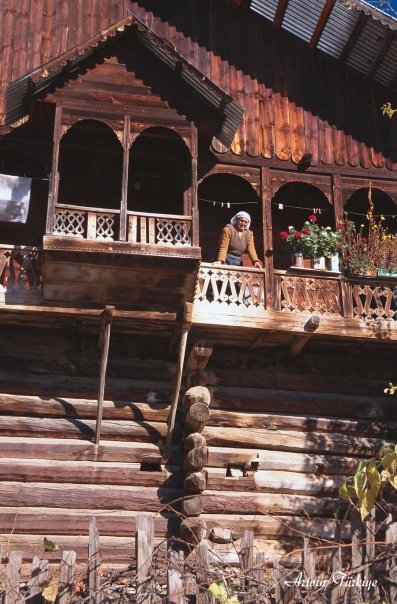
Giresun]" as "the representatives of Xenophon's Mosynœci," who, at the time, "still [lived] in lofty wooden towers as in the days of the Greek historian." These "lofty towers," it seems, have all but disappeared from Giresun Province; modern
masonry buildings (and the odd
half-timbered home) now dominate the region. Still, I managed to locate
this image. (Perhaps, if I spoke Turkish, I could discover more.)
In Georgia, timber construction is rarer, but distinctively
towering dwellings continue to exist in the country's Caucasian foothills, particularly in
Svan-speaking
Svaneti. Defensive towers
dotted the regional capital of Mestia until the late 19th century, and similar structures stand in
Ushguli and elsewhere. The
Laz, who live in Georgia and Turkey,
may, in fact,
be related to the Heptacometae — the two communities' boundaries are almost identical.
Obviously, the tradition described by Strabo, Vitruvius, and Xenophon developed independently of the Scandinavian and Eastern European conventions to which we Americans owe
our log buildings. But who knows? Had a globetrotting Greek wandered into the forests of Finland, perhaps he, too, would have returned with reports of "houses made from trees."
- - - - - - - - - - - - - - - - - - - - - - - - - - - - - - - - - - - - - - - - - - - - - - - - - - - - - - - - - - - -
For thoroughness's sake, I thought
I'd attempt to "translate" the passage from
Geographica. Here's the Greek (transliterated, of course):
Eisi d' hapantes men hoi oreioi toutōn agrioi teleōs, huperbeblēntai de tous allous hoi Heptakōmētai: tines de kai epi dendresin ē purgiois oikousi, dio kai Mosunoikous ekaloun hoi palaioi, tōn purgōn mossunōn legomenōn. (4)
And, a crude and literal translation:
They are but all indeed the Oreioi of these savages perfectly, they throw over but the following another Heptakometai. [?] but and on trees or towers they inhabit, wherefore and Mosunoikous called the old (people), because towers wooden houses were called.
Perseus gives no proper definition for "Oreioi," but the term seems to describe a long-defunct Cretan
city (between modern Anidri and Prodromi). A few resources link the name with "people of the mountains"; perhaps Strabo used the word equivocally or metaphorically, to describe non-Cretan mountain-dwellers. Another phrase — "epi dendresin" — is a more perplexing matter. Assuming Perseus's dictionary is accurate, the preposition "epi" can mean both "on"
and "among," and an accurate translation requires knowledge of the context.
I'll end with a more polished interpretation of the above translation:
Indeed, the mountain people are all perfectly savage, but the Heptakometai surpass ["throw over"] the others. They live on trees or towers, wherefore the people of great age called them 'Mosuoikous,' because the towers were called 'mossunōn' [literally "wooden houses"].
1) From H.L. Jones's translation (1917–1932); transcribed by Bill Thayer.
2) From W. Falconer's translation (1903); transcribed by Robert Bedrosian.
3) From Morris Morgan's translation (1914); hosted by Project Gutenberg.
4) From A. Meineke's Greek edition (1877); transliterated by Tufts University's ever-useful Perseus Digital Library.