Showing posts with label geography. Show all posts

Friday, July 14, 2017

Brick Columns in Warren County

It's not difficult to spot similarities between, say, the boxy braced-frame (and log) farmhouses of Wayne County and dwellings in southeastern Pennsylvania's Amish heartland, but finding direct connections between Ohio buildings and their East-Coast antecedents is a more arduous task. Still, some have managed it. Frary traces floral woodwork in one Western Reserve farmhouse to a home in rural Maine, and Asher Benjamin's designs are duplicated in countless structures — residential, commercial, and public alike. I suspect that most comparisons between individual buildings are, in all likelihood, mistaken, but the temptation remains.

In suburbanizing Hamilton Township, Warren County (one of Ohio's finest counties, if I may say so), are two Federal-era residences with peculiar similarities to at least one Virginia plantation home. One stands on Schlottman Road, just north of the township's southern boundary and a stone's throw from Benjamin Butterworth's hillside farmhouse (1815); the other sits on a sloping, stream-side lot, south of Maineville (a community founded, as its name suggests, by ex-citizens of New England's northeasternmost state).

The Schlottman Road house was owned, during the nineteenth century's second quarter, by members of the Hill family, but its exact history is murky. The building's facade is standard transitional Federal–Grecian fare — five bays in width, with a narrow frieze board, trabeated doorway, and rectangular stone lintels and sills. What lies behind the facade is a bit odder. Unlike most "I" houses (dwellings multiple rooms in width, but only one in depth), the Hill House features an additional row of rooms, which allow for extra fireplaces and a two-story inset porch (now enclosed), and which lend the house a "saltbox" roofline.
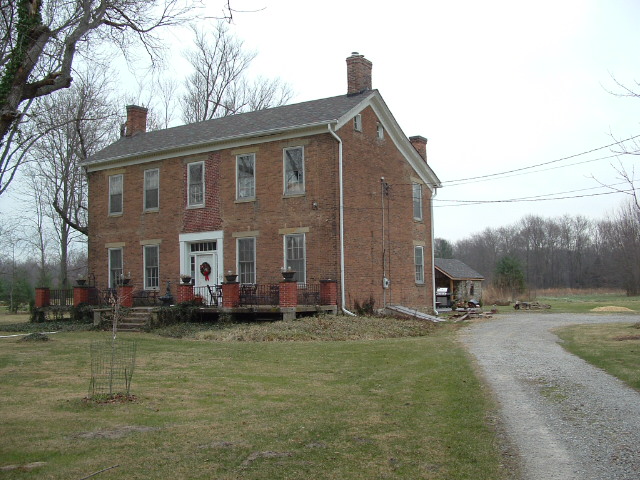
The Hill House (WAR-631-11), supposedly constructed in 1817; expanded circa 1845. Photo from the Warren County Auditor's website.

At the home's rear, though, is its truly intriguing feature. Extending from the two-story section is a one-and-a-half-story wing (not an oddity in itself), constructed of Flemish-bond brick. According to local lore, this wing predates the "I" portion by several decades — a claim I'm more than willing to believe. A two-bay section of this wing is recessed, and the resulting porch is supported by polygonal brick columns with blocky capitals and plinths. Clunky though they may be, these columns are distinctive. Ohio has a plethora of recessed porches, but few — if any — use brick as a supporting material (though I know of two arcaded porches in Lawrence County).

The home's rear (more interesting, I think, than its facade). The 1817 section lies to the right. Note the fieldstone springhouse. Photo from the Warren County Auditor's website.

Campbell County, Virginia's Green Hill Plantation, built about 1800, features a similar porch. As might be expected, Green Hill's columns are more sensitively handled; they're round, rather than polygonal, and they're topped with more typologically accurate capitals and plinths. Unfortunately, some of the many outbuildings and dependencies which once encircled Green Hill have disappeared, but the house remains, thank goodness.

Porch, Green Hill (circa 1800); Long Island vicinity, Campbell County, Virginia. Photo from the Historic American Buildings Survey collection. Photographer and date unknown.

A few miles northeast of the Hill House; in Warren County, Ohio; stands a second dwelling — this one omitted from the Ohio History Inventory — with a brick-columned porch. In this case, the porch is two stories in height, and, instead of being tucked into a rear wing, it boldly graces the facade. The columns are circular (rather than polygonal), but their capitals are no more elegant than the Hill House's. An 1875 property atlas lists a J.E. Murdock as the farm's owner. Murdock's family lent its name to a crossroads community just south of the residence.

Murdock House; circa 1835 (?). Photo from the Warren County Auditor's website.

Saturday, December 17, 2016

Log Buildings and the Fenni

In my last foray into Greco-Roman geography, I ended with speculation — that, "[h]ad a globetrotting Greek wandered into the forests of Finland, perhaps he . . . would have returned with reports of 'houses made from trees.'" Whether or not any Greeks (traders or otherwise) possessed knowledge of the lands which today comprise Scandinavia is an open question. In the fourth century BC, Pytheas explored portions of northern Europe (including the British Isles and Baltic coast); alas, none of his writing survives, and his precise route will forever remain a mystery. The Romans, though, certainly could claim an awareness, dim though it may have been, of today's Scandinavia.

About AD 98, slightly more than a century after Strabo wrote his Geographica, historian Publius Cornelius Tacitus published Germania, one of the classical world's best-known ethnographic works. Germania's final chapter covers tribes living to the Germans' northeast — the Peucini, Veneti, and Fenni. This last group (whose name bears an obvious similarity to the exonym "Finn"), Tacitus considers uniquely barbaric. His (brief) description may be the earliest account of Uralic (1) construction methods:
The Fenni are strangely beast-like and squalidly poor; neither arms nor homes have they; their food is herbs, their clothing skins, their bed the earth. . . . The little children have no shelter from wild beasts and storms but a covering of interlaced boughs. Such are the homes of the young, such the resting place of the old. (2)
At a glance, the text seems to support my contention. But, as usual, the Latin is too vague to reveal much about its subject. The relevant line, "ramorum nexu contegantur," could be translated as "a covering of interlaced boughs," but it might also mean "a roof of connected branches" or "a shelter of fastened twigs." Then again, had Tacitus intended to describe log houses, he surely would've employed truncus or trabes, the two Latin words often applied to trunks and timbers.

It's likely, then, that the Finns adopted log construction well after the first and second centuries AD. But who (if anyone) introduced the practice to them? When did the shift from branch hovels to log houses occur? Alas, I can't say. No doubt, the westernmost Uralic-speaking populations interacted with southern Scandinavia's Germanic peoples, who preferred to build timber long-houses (a practice which survived into the Viking Age). The pastoral Sami constructed tents and pole (or earthen) huts — goahti — into the twentieth century. In some ways, these habitations resemble the "covering of interlaced boughs" described by Tacitus.

A Sami family outside their goahti. Photo, 1870s, from the Galerie Bassenge collection; taken from Wikipedia.

Whatever its origin, log architecture had, by the early modern period, become entrenched in Scandinavia and northwestern Russia. Log dwellings, storehouses, barns, and (especially) saunas dotted the Finnish landscape, and peculiarities of construction acquired distinctive names — hammasnurkka, lukko, and whatnot. At Helsinki's Seurasaari Museum, 87 buildings, the majority log, testify to the popularity of timber construction.

The Niemelä stable, now housed at the Seurasaari Museum. Photo by Jani Patokallio, 2009, from Wikimedia Commons.

In the seventeenth century, Swedes, Norwegians, and Finns brought their architectural traditions to North America, and thus (in conjunction with the Germans) engendered the practice which defined frontier architecture in the United States.

1) I've assumed, of course, that Tacitus's Fenni were, in fact, the ancestors of today's Finns, Estonians, Livonians, Karelians, Ingrians, and Vepsians. But such an identification is a matter of controversy.

2) From the Church, Brodribb, and Cerrato translation (1942); transcribed by Perseus.

Tuesday, May 17, 2016

Warren County: A Pulchritudinous Place (Part I)

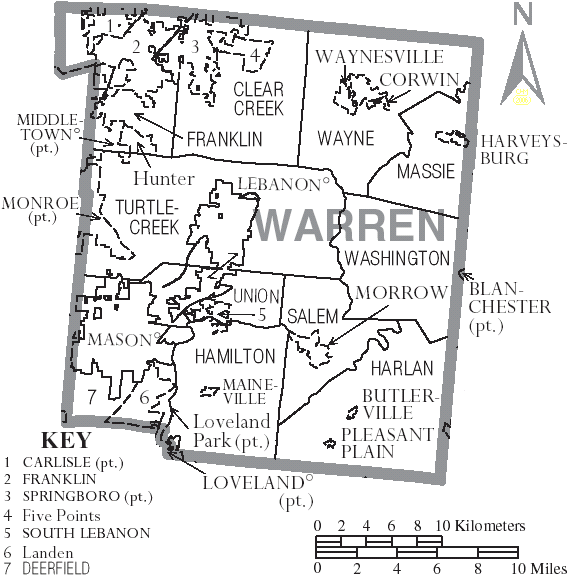
Warren County's political subdivisions. Map plucked from Wikipedia.

If Ross County is a candy store, Warren County may be the ice cream parlor which occupies the adjoining storefront. Like Ross, Warren comprises some of Ohio's earliest-settled lands, straddles a major north-to-south-running river (in its case, the Little Miami), and occupies a surveying boundary zone. The Little Miami River splits the county, roughly, into two regions: the Virginia Military District (east) and Symmes — or Miami — Purchase (west). A few sections of Congress Lands exist in Franklin Township, at the county's northwestern corner, where the Great Miami River skirts the city of Franklin. Warren County's terrain is, as Howe noted, "gently undulating" (1), though broken by the valleys of Clear Creek, Caesar's Creek, Todd's Fork, and — of course — the Little Miami River.

Warren County's first permanent residents arrived in the 1790s. In November 1795, one William Bedle, a New Jerseyan, purchased Section 28 of modern Turtle Creek Township, where he erected a fortified log house, thereafter known as "Bedle's Station." (This home stood due south of Union Village.) Concurrently, a party of Marylanders — led by William Mounts (1762 – ca. 1808) — selected a spot on the Little Miami River's south bank, and built "Mounts' Station," a collection of log dwellings arranged in such a fashion as to dissuade attack. In 1796, less than a year later, surveyors platted Deerfield (now South Lebanon), Franklin, and Waynesville. By 1803, when it was cleaved from Hamilton, Warren accommodated 854 adult males (2); and, by 1810, nearly 10,000 souls called the county home. The Irish writer Thomas Ashe visited (or claimed to have visited) Warren County in August 1806 and described Lebanon (and its environs) thusly:
The remaining fifteen miles to Lebanon [from the Hamilton County border] were nearly the best I ever viewed, and settled considerably for so new a country. The farms were numerous, well improved, and the houses and barns on them built with great care and industry. 
Lebanon contains about two hundred inhabitants, dwelling in about forty neat log and frame houses. A place of worship and school-house are also erected, and the town in every respect bids fair to prosper and encrease with unprecedented success. Seated in the midst of the finest tract of land in the world, and that tract already thickly settled by a hardy and industrious people, it cannot fail to succeed[.] . . . The inhabitants, though few, are composed of several nations, who unite in forming a character of a laborious and religious cast. Their industry is manifest in the extensive improvements and comfortable abodes; all effected within the space of five years[.] (3)
Hyperbole notwithstanding, Ashe's anecdote is accurate enough. In the nineteenth century's opening decades, Warren County far outpaced its northern and eastern neighbors in prosperity. Yes, portions of Harlan and Washington townships — those marked by level, ill-drained, silty Illinoian till — remained little-populated until mid-century, but the county, in toto, enjoyed a prosperous existence.

I'll end my bloviating here, and save a discussion of Warren County's architecture (and regional history) for the next post.

1) Henry Howe, Historical Collections of Ohio, Volume I (1889), 740.

2) This estimate, provided by Beers' 1882 History of Warren County, Ohio, is no doubt inaccurate, and includes residents of Clinton County's western half, which, until 1810, remained within Warren County.

3) Travels in America Performed in 1806, Volume II (1808), 209–211.